Highlight
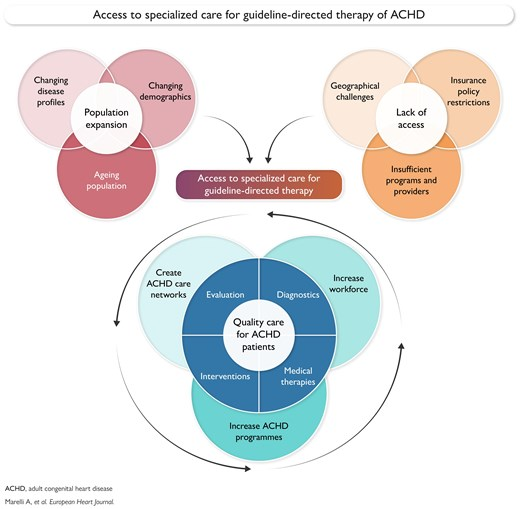
Adult congenital heart disease (ACHD) has transitioned from a pediatric rarity to a chronic condition requiring lifelong management as adult survivors outnumber children. The demographic shift mandates reorientation of healthcare systems to address long-term complications and comorbidities. Specialized ACHD training and the hub-and-scope model have improved care accessibility, but emerging digital health and artificial intelligence (AI) tools provide new opportunities to enhance coordination, equity, and outcomes across the lifespan.
Background: The Changing Landscape of Congenital Heart Disease
Congenital heart disease (CHD) comprises a diverse set of structural cardiac anomalies present at birth. Historically, prognosis for many congenital defects was limited, with high childhood mortality. However, breakthroughs in diagnosis, surgical techniques, and interventional cardiology over recent decades have dramatically improved survival rates. As a consequence, adult survivors with congenital heart disease (ACHD) now form the majority of the CHD population in many countries.
This demographic transformation poses unique challenges. ACHD patients experience a chronic disease course marked by residual cardiac lesions, surgical sequelae, and increased risk for acquired cardiovascular complications such as arrhythmias, heart failure, pulmonary hypertension and vascular disease. Additionally, systemic comorbidities including neurocognitive deficits, psychosocial issues, and non-cardiovascular organ dysfunction emerge as common concerns. The complexity and heterogeneity of ACHD require long-term, multidisciplinary care models that extend beyond traditional pediatric or general adult cardiology frameworks.
Health Systems and Care Models for ACHD
Responding to the needs of the growing ACHD population, the past two decades have seen the establishment of advanced ACHD training pathways worldwide. These programs equip cardiologists with expertise to manage the distinctive anatomy, physiology, and complications of congenital heart disease in adults.
The hub-and-scope model has become the cornerstone of contemporary ACHD care. In this structure, centralized specialized centers (hubs) provide comprehensive clinical expertise and advanced diagnostics, while local affiliated centers (scopes) extend access to patients in underserved regions. This network facilitates coordinated referrals, shared decision-making, and standardized care protocols, minimizing disparities and improving outcomes.
The Evolving Role of Technology and Digital Health
Emerging technologies represent a paradigm shift in ACHD care delivery. Digital health platforms enable remote monitoring of physiological parameters, teleconsultations, and patient engagement tools that transcend geographic barriers. Artificial intelligence and machine learning algorithms can analyze large datasets to predict clinical deterioration, personalize treatment plans, and optimize resource allocation.
Furthermore, digitally enabled learning health systems integrate real-time clinical data with ongoing research findings, fostering continuous quality improvement. These systems support flexible workforce models and facilitate knowledge dissemination among clinicians, patients, and caregivers, which is critical given the rarity and heterogeneity of certain congenital heart defects.
Challenges and Future Directions
Despite advances, significant gaps remain in ACHD care. There is marked variability in access to specialized services worldwide, with large regions lacking ACHD-trained specialists and infrastructure. Transition processes from pediatric to adult care remain suboptimal, contributing to loss to follow-up and adverse outcomes.
Implementing scalable networked care with technology-enabled coordination can help close these gaps, but requires investment and policy support. Research is needed to validate AI tools and digital platforms in diverse ACHD populations, ensuring equitable benefit without exacerbating health disparities.
Looking ahead, integration of genomic, imaging, and biomarker data could refine risk stratification, enabling proactive rather than reactive management. Patient-centered care models emphasizing quality of life, psychosocial support, and comorbidity management will be key to optimizing long-term outcomes.
Conclusion
Adult congenital heart disease has evolved into a chronic condition requiring comprehensive, lifelong care. Advances in specialized training, health system redesign, and digital health innovations offer promising avenues to improve survival, functional status, and quality of life. Embracing integrated, networked care models supported by technology will be essential to meet the complex needs of the ACHD population and deliver equitable outcomes at scale.
References
- Diller GP, Daniels C, Marelli A. Congenital heart disease in adults: evolving health systems and lifelong outcomes. European Heart Journal. 2026 Oct 5; PMID: 42830677.
- Haddad F, et al. Lifelong management of adult congenital heart disease: a roadmap for clinical practice. J Am Coll Cardiol. 2020;75(14):1714-1732.
- Moons P, et al. Current achievement and future challenges in adult congenital heart disease. Circulation. 2019;139(3):289-301.
- Opotowsky AR, Webb GD. Advances in care of adults with congenital heart disease. Circulation. 2014;130(21):1991-2000.
- Kodama M, et al. Digital health applications and machine learning for improving ACHD care: a scoping review. Intl J Cardiol. 2023;355:84-92.