Highlight
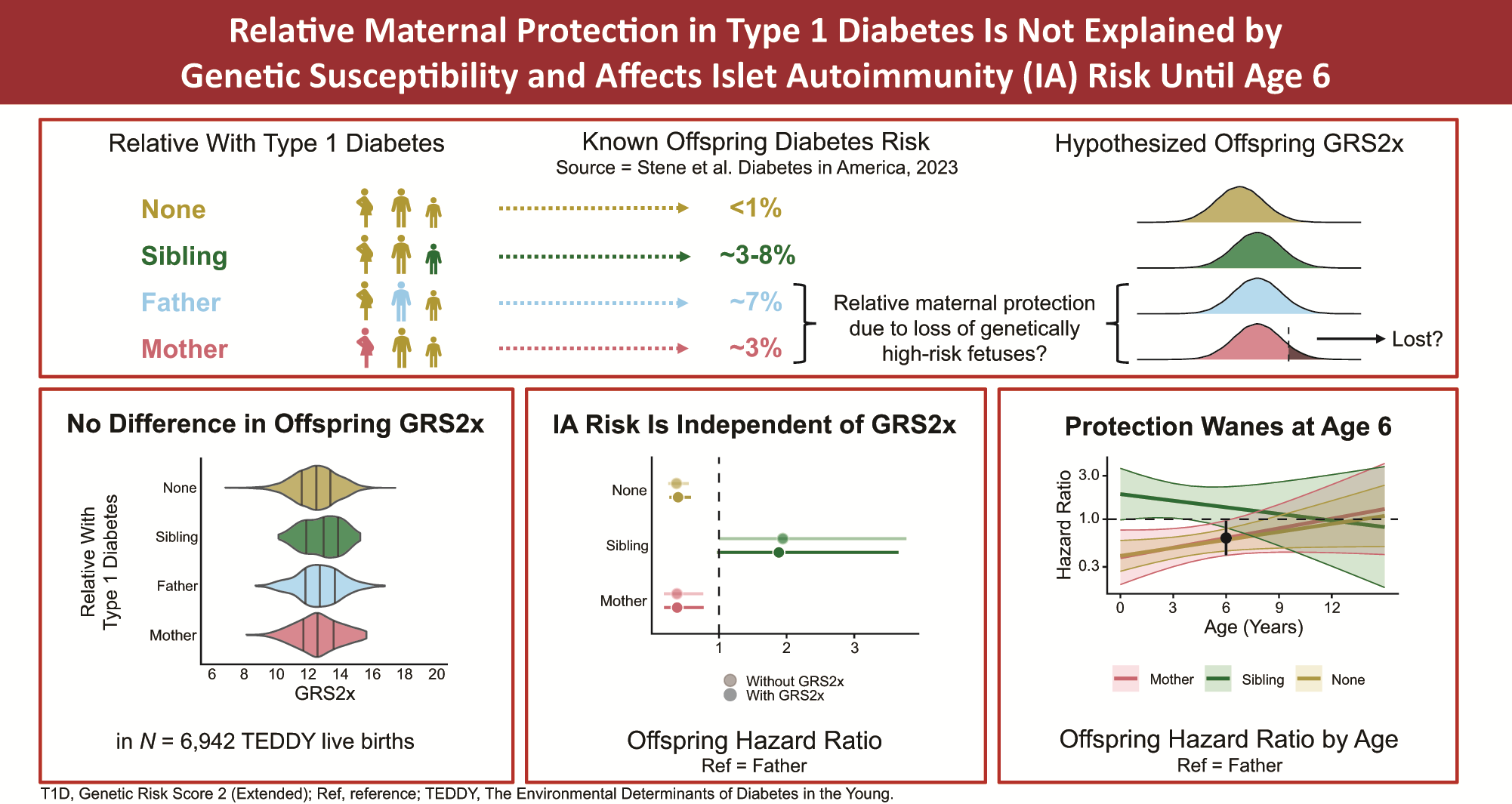
• Offspring of mothers with type 1 diabetes have approximately half the risk of developing the disease compared with offspring of affected fathers.
• Genetic susceptibility measured by an advanced Genetic Risk Score (GRS2x) does not differ significantly between children from mothers, fathers, or siblings with type 1 diabetes.
• Maternal type 1 diabetes appears to confer relative protection against the development of islet autoimmunity (IA) in early childhood, independent of fetal genetic risk.
• This protective effect is strongest before age 6 years and diminishes thereafter, with no significant impact on progression from IA to overt diabetes.
Study Background
Type 1 diabetes (T1D) is an autoimmune condition characterized by destruction of pancreatic beta cells leading to insulin deficiency. The familial risk of T1D is well established, yet epidemiological data highlight a notable asymmetry: children born to mothers with T1D have roughly half the incidence of the disease compared with children of affected fathers. This discrepancy suggests mechanisms beyond simple genetic inheritance, possibly involving in utero factors or selective loss during pregnancy that preferentially affect fetuses at higher genetic risk. Understanding these mechanisms provides insight into disease pathogenesis and prevention strategies.
Study Design
The study analyzed 6,942 live births from the Environmental Determinants of Diabetes in the Young (TEDDY) cohort, a large, prospective international study designed to uncover environmental and genetic risk factors for T1D. Researchers compared genetic susceptibility using an advanced Genetic Risk Score 2 extended (GRS2x)—which incorporates multiple HLA and non-HLA risk loci—among offspring with different family members diagnosed with T1D, specifically mothers, fathers, or siblings. The study further assessed the incidence of islet autoimmunity (IA) and progression to clinical diabetes, examining whether genetic differences explained the observed relative maternal protection.
Key Findings
The principal finding was that the GRS2x values did not significantly differ between children of mothers versus fathers or siblings with T1D (P = 0.36 and P = 0.27, respectively). This indicates that the reduced disease risk in offspring of diabetic mothers is not attributable to lower genetic susceptibility conferred by fetal genotype.
When adjusting for genetic risk, offspring of mothers with T1D demonstrated a marked relative protection against both islet autoimmunity and overt diabetes during early childhood: the hazard ratio (HR) for developing diabetes was 0.50 (P = 0.01), and for IA was 0.38 (P = 0.006), indicating about a 50–62% lowered risk compared to offspring of fathers with T1D. Notably, this protective association was not observed in the later stage transition from IA to clinical diabetes, suggesting that maternal effects exert influence primarily during the initiation of autoimmunity rather than progression once autoimmunity is established.
This relative protection conferred by maternal T1D exposure appeared to wane after age 6 years, which corresponds to critical windows of immune system development and early environmental exposures that might shape autoimmune risk.
Expert Commentary
These results underscore the complexity of T1D inheritance and the importance of non-genetic intrauterine or early-life factors influencing immune tolerance. The lack of differences in genetic risk challenges hypotheses suggesting selective fetal loss of high-risk genotypes during maternal T1D pregnancies. Instead, the data favor a model in which intrauterine exposure to maternal hyperglycemia or maternal immune environment induces immune adaptations in the fetus that delay or reduce the initiation of autoimmunity.
Potential mechanisms include maternal-fetal immune cross-talk, epigenetic modifications, and tolerance induction via regulatory T cells shaped during fetal development. However, the temporary nature of this protection raises questions about environmental triggers post-infancy that eventually overcome these early protections.
Limitations of this study include potential confounding by unmeasured environmental factors and the inherent observational design. Moreover, TEDDY participants represent a genetically high-risk group, which may affect generalizability.
Conclusion
This study provides robust evidence that reduced risk of T1D in children born to affected mothers is not explained by selective fetal genetic susceptibility but rather by protective intrauterine influences. These findings highlight the significance of prenatal and early-life immune environment in modulating T1D risk and call for further research into maternal-fetal interactions and intervention opportunities during pregnancy to prevent or delay autoimmune diabetes onset in children.
Funding and Clinical Trials
The TEDDY study is supported by multiple international funding agencies dedicated to diabetes research. The study referenced (Slack SD et al.) does not report additional specific funding. Clinical trial information for TEDDY cohort studies is available through public registries, emphasizing population-based observational research.
References
Slack SD, Venkatesh N, Ridoux SE, Hohsfield KR, Vanderlinden LA, Norris JM, Johnson RK. Genetic Susceptibility in Relative Maternal Protection From Type 1 Diabetes. Diabetes Care. 2026 Oct 1; PMID: 42821443.
Apollo VN, et al. The TEDDY Study: A Multinational Observational Study of Environmental Determinants of Type 1 Diabetes Risk. J Clin Endocrinol Metab. 2020;105(3):e847-e859.
Knip M, et al. Environmental Triggers and Prevention of Type 1 Diabetes. Diabetes Care. 2016;39(7):1053–1060.
Bonifacio E. Epigenetics and the Pathogenesis of Type 1 Diabetes. Curr Diab Rep. 2015;15:70.