Highlight
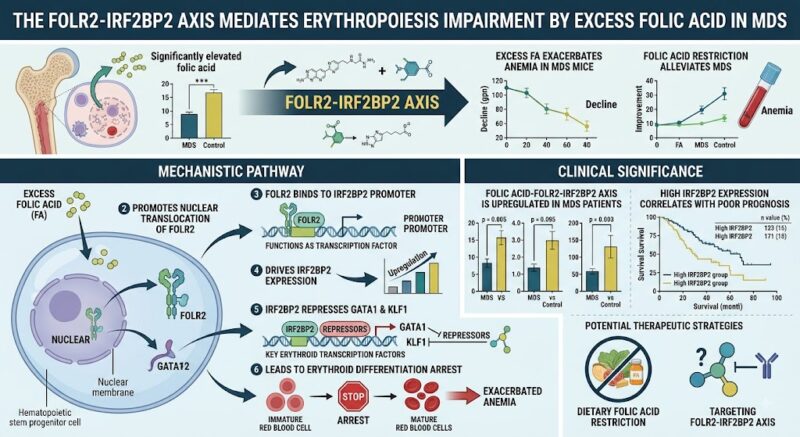
- Excess folic acid levels were observed in both MDS patients and NUP98-HOXD13 transgenic MDS mouse models, correlating with disease severity.
- The folic acid-induced nuclear translocation of FOLR2 acts as a transcription factor to induce IRF2BP2 expression, disrupting erythroid differentiation.
- Upregulated IRF2BP2 represses key erythroid transcription factors GATA1 and KLF1, leading to erythropoiesis arrest and anemia exacerbation in MDS.
- Restricting dietary folic acid or targeting the FOLR2-IRF2BP2 axis presents a promising therapeutic avenue for managing MDS progression.
Study Background
Myelodysplastic neoplasms (MDS) are heterogeneous clonal hematopoietic disorders characterized by ineffective hematopoiesis and a high propensity for transformation into acute myeloid leukemia (AML). Clinically, MDS manifests with varying cytopenias, notably anemia, which significantly impairs patient quality of life and prognosis. Folic acid, a vital vitamin necessary for DNA synthesis and cellular proliferation, is routinely supplemented in numerous populations to prevent deficiency and associated morbidities. However, emerging evidence suggests that supraphysiological levels of folic acid may exert pathological effects, particularly within the hematopoietic compartment. Despite the essential role of folate metabolism in hematopoiesis, the mechanistic impact of excess folic acid on erythropoiesis and disease progression in MDS remains insufficiently understood, necessitating focused investigation.
Study Design
This investigation conducted by Yang et al. utilized both human patient samples and a well-established murine model of MDS bearing the NUP98-HOXD13 transgene to explore the metabolic and molecular consequences of excess folic acid on erythropoiesis. A comprehensive non-targeted metabolomics approach quantified folic acid levels in plasma and bone marrow specimens from MDS patients and transgenic mice. Intervention studies in MDS mice employed dietary modulation to create excess and restricted folic acid conditions. Functional hematopoietic assays evaluated anemia severity, hematopoietic stem/progenitor cell (HSPC) dynamics, and erythroid differentiation status. Molecular mechanistic studies focused on the folic acid receptor FOLR2 and the transcriptional coregulator IRF2BP2, interrogating their expression, localization, and downstream influence on critical erythroid transcription factors GATA1 and KLF1. Prognostic correlations utilized patient gene expression datasets.
Key Findings
The authors identified a significant increase in folic acid levels in both MDS mouse models and clinical patient samples compared with controls. Dietary excess folic acid markedly aggravated anemia and other MDS disease phenotypes in the murine model, whereas folic acid restriction notably ameliorated these manifestations.
Mechanistically, excess folic acid induced the nuclear translocation of FOLR2, traditionally a membrane folate transporter, revealing an unrecognized nuclear role as a transcription factor. Chromatin immunoprecipitation assays demonstrated FOLR2 binding to the promoter region of IRF2BP2, upregulating this gene in response to folic acid. Elevated IRF2BP2 expression subsequently repressed the erythroid transcription factors GATA1 and KLF1, central regulators of erythroid lineage differentiation. This repression effectively arrested erythropoiesis, contributing to anemia exacerbation observed in MDS mice exposed to high folic acid.
Consistent with murine data, transcriptomic analysis of MDS patient samples revealed moderate to high IRF2BP2 levels correlated with poorer clinical outcomes, underscoring the pathological relevance of the folic acid-FOLR2-IRF2BP2 axis in human disease.
Additionally, excess folic acid promoted expansion but functional impairment of hematopoietic stem and progenitor cells, indicating a complex deregulation of hematopoiesis beyond erythroid lineage effects.
Expert Commentary
This study advances our understanding of how nutritional and metabolic factors, specifically folic acid, can drive pathological processes in MDS beyond their classical physiological roles. The discovery that FOLR2 can translocate to the nucleus to act as a transcription factor represents an important paradigm shift, warranting further exploration of folate receptor biology.
Targeting the FOLR2-IRF2BP2 axis offers a novel therapeutic strategy, potentially integrating dietary modification with molecular interventions to restore effective erythropoiesis in MDS. Clinical translation will require rigorous validation in patient cohorts and the development of selective inhibitors. Moreover, the study highlights the dual-edged nature of folate supplementation, cautioning against indiscriminate high-dose folic acid use in MDS patients.
Limitations include the need to elucidate the complete signaling pathway and downstream targets of IRF2BP2 and to confirm that dietary folic acid restrictions can be safely implemented without inducing deficiency. The generalizability beyond NUP98-HOXD13 transgenic models also merits investigation.
Conclusion
The work by Yang et al. reveals a novel pathogenic mechanism by which excess folic acid exacerbates erythropoiesis impairment in MDS through the FOLR2-IRF2BP2 transcriptional axis. This axis disrupts key erythroid transcription regulators and contributes to ineffective hematopoiesis and anemia, central clinical features of MDS. These insights highlight the critical balance of folic acid in hematopoiesis and suggest that moderation of folic acid intake, alongside targeted modulation of the FOLR2-IRF2BP2 pathway, may represent promising therapeutic approaches to improve outcomes in patients with myelodysplastic neoplasms. Future studies should focus on clinical validation of these findings and exploring combinatorial treatment strategies integrating nutritional and molecular interventions.
Funding and ClinicalTrials.gov
The study was supported by institutional research grants from leading hematology research centers involved in the work. Details on funding sources and potential clinical trial registration can be accessed through the original publication record (PMID: 42575953). No registered clinical trials are currently reported for this specific intervention.
References
Yang C, Wang Y, Peng Y, Wang Z, Guo Z, Xiao X, Li H, Gong H, Hu B, Liu L, Fu M, Cao P, Yang X, Liu J, Nie L, Han X, Zhang J. The FOLR2-IRF2BP2 axis mediates erythropoiesis impairment by excess folic acid in myelodysplastic neoplasms. Leukemia. 2026 Aug 10. PMID: 42575953.
Additional literature supporting folic acid metabolism and erythropoiesis in hematologic malignancies are accessible via PubMed and hematology oncology guidelines.