Highlight
– Identification of subtype-specific novel genomic alterations associated with relapse in childhood B-ALL.
– Gain of ETV6::RUNX1 fusion allele and unique fusion transcripts linked to increased relapse risk.
– Chromosomal number variations and CREBBP mutations correlate with relapse in hyperdiploid B-ALL.
– Enrichment of IKZF1 alterations and NSD2 mutations found in Philadelphia-like and TCF3::PBX1 subtypes respectively.
– Approximately 3% of relapses arise from secondary leukemia or underlying germline predisposition.
– Genomic patterns correlate with treatment outcomes in the context of blinatumomab use from a major Children’s Oncology Group trial.
Study Background
Relapsed B-acute lymphoblastic leukemia (B-ALL) in children remains a critical clinical challenge, with resistant leukemic subclones emerging despite intensive chemotherapy. Relapse confers poor prognosis and underscores the need to understand the genomic underpinnings that confer resistance and drive disease progression. Although several genetic alterations influencing risk stratification have been characterized, relapse-associated genomic changes at the subtype level are incompletely elucidated. The Children’s Oncology Group (COG) clinical trial AALL1331 provided an opportunity to investigate the genomic landscape of relapsed B-ALL within the context of modern therapeutic regimens including blinatumomab, a bispecific CD19-directed T-cell engager.
Study Design
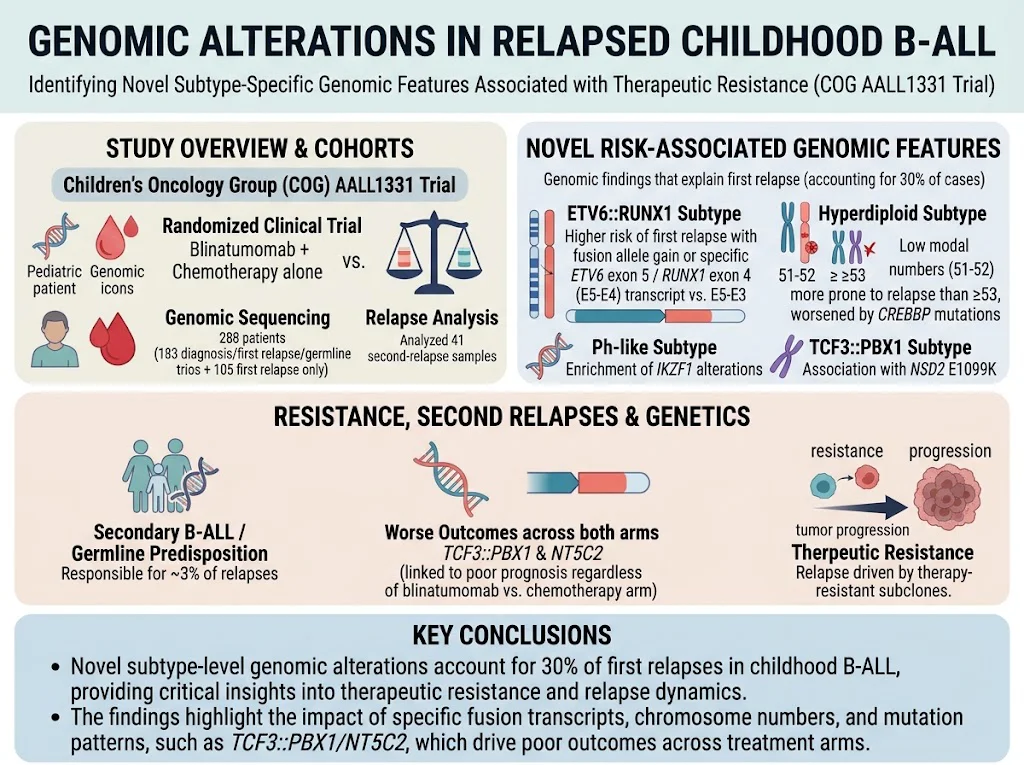
This study involved whole-genome and transcriptome sequencing of 288 patients enrolled in the AALL1331 trial, comprising 183 diagnosis, first relapse, and germline trios, plus 105 additional patients with first-relapse only samples, along with analysis of 41 second-relapse specimens. The clinical trial randomized patients to receive chemotherapy alone versus chemotherapy plus blinatumomab, enabling correlation of genomic alterations with treatment outcomes. Key genomic features were identified by comprehensive sequencing and bioinformatics approaches, focusing on subtype-specific alterations linked to risk of relapse and secondary leukemogenesis.
Key Findings
ETV6::RUNX1 Fusion Alterations: Among ETV6::RUNX1 B-ALL cases, patients harboring a gain of the fusion allele or a fusion transcript involving exon 5 of ETV6 and exon 4 of RUNX1 (referred as E5-E4) demonstrated significantly higher relapse risk compared to the more common E5-E3 fusion transcript. This highlights the complexity of fusion variants influencing leukemogenesis and therapeutic resistance.
Hyperdiploid Subtype Dynamics: The study revealed that hyperdiploid B-ALL cases with low modal chromosome numbers (51-52 chromosomes) showed increased susceptibility to first relapse compared to cases with ≥53 chromosomes. Moreover, the presence of CREBBP mutations acted additively to increase relapse risk, suggesting a cooperative effect of chromosomal and mutational abnormalities in disease progression.
Philadelphia-like and TCF3::PBX1 Subtypes: IKZF1 gene alterations were enriched in Philadelphia-like B-ALL, a subtype known for poor prognosis, implying a contributory role in relapse biology. For the TCF3::PBX1 subtype, the recurrent NSD2 E1099K mutation was frequently associated with relapse and linked to poor outcomes, underscoring its potential as a biomarker for risk stratification.
Secondary Leukemia and Germline Predisposition: Intriguingly, approximately 3% of relapses were attributed to either secondary B-ALL evolving from a distinct leukemic clone or underlying germline predisposition syndromes, emphasizing the importance of genetic counseling and surveillance in certain patients.
Genomic Patterns and Therapeutic Outcomes: Comparative genomic analyses of diagnosis and first relapse samples stratified by second relapse status in the trial cohort revealed that specific genomic alterations, such as TCF3::PBX1 fusion and NT5C2 mutations, are associated with inferior outcomes regardless of blinatumomab administration. This finding underscores the need for adjunctive treatment strategies targeting these resistant clones.
Expert Commentary
This comprehensive genomic characterization advances our understanding of molecular drivers underpinning relapse in childhood B-ALL. The identification of subtype-specific alterations, including fusion transcript variants and cooperative mutations, provides new avenues for biomarker development and therapeutic targeting. The interplay between chromosomal alterations and specific gene mutations such as CREBBP and IKZF1 is particularly noteworthy, suggesting complex clonal evolution in relapsed leukemia. Furthermore, the recognition of secondary leukemias and germline predisposition highlights the necessity for integrated genomic surveillance beyond initial diagnosis.
However, challenges remain in translating these genomic insights into clinical practice. The heterogeneity and clonal complexity necessitate innovative treatment modalities, possibly combining immunotherapy and targeted agents, to overcome resistance. Also, longitudinal studies beyond second relapse are essential to further delineate clonal evolution and optimize personalized approaches.
Conclusion
This study from the Children’s Oncology Group significantly deepens the molecular understanding of relapse in childhood B-ALL by revealing novel genomic alterations that confer therapeutic resistance across distinct subtypes. The findings emphasize the importance of detailed genomic profiling at diagnosis and relapse to guide risk-adapted therapy and identify candidates for investigational treatments. As immunotherapeutic agents like blinatumomab become integrated into frontline and salvage regimens, elucidating the genomics of resistant clones will be crucial in improving survival and minimizing relapse in pediatric B-ALL.
Funding and ClinicalTrials.gov
This research was conducted under the Children’s Oncology Group clinical trial AALL1331, registered as NCT0201853 at www.clinicaltrials.gov. Funding sources included institutional grants and collaborative oncology research funds, details of which are documented within the original publication by Feng et al. in Blood (2026).
References
1. Feng Y, Li H, Mulder HL, et al. Identifying novel genomic alterations in relapsed childhood B-ALL: a report from the Children’s Oncology Group. Blood. 2026 Nov 2;PMID: 42970619.
2. Mullighan CG. Molecular genetics of B-precursor acute lymphoblastic leukemia. J Clin Invest. 2012;122(10):3407-3415.
3. Hunger SP, Mullighan CG. Acute lymphoblastic leukemia in children. N Engl J Med. 2015 Oct 15;373(16):1541-52.
4. Brown PA, et al. A randomized trial of blinatumomab versus chemotherapy for newly diagnosed pediatric B-ALL. Blood. 2022;139(16):2550-2553.
5. Roberts KG, et al. Targetable kinase-activating lesions in Ph-like acute lymphoblastic leukemia. N Engl J Med. 2014 Dec 18;371(11):1005-15.
Specialty calculators
For clinical reference; use professional judgment.