Introduction and Context
Carpal tunnel syndrome (CTS) is the most common entrapment neuropathy, causing hand numbness, pain, and functional limitations that affect daily activities and work. Primary care and internal medicine clinicians are often the first point of contact for patients with CTS symptoms, making early, accurate diagnosis and appropriate management essential to avoid unnecessary testing, delays in effective treatment, and low-value care. In response to accumulating studies and persistent variation in practice, the American Academy of Orthopaedic Surgeons (AAOS) published updated clinical practice guidelines (CPG) for carpal tunnel syndrome in 2024. The guideline development panel used a systematic review process and multidisciplinary input to translate evidence into recommendations intended for orthopaedic surgeons, hand specialists, and nonoperative clinicians alike. This synopsis summarizes the core recommendations most relevant to nonoperative clinicians and highlights practical implications for diagnosis, management, and referral. Why this guideline matters now – Clinical variation: Many clinicians still order routine electrodiagnostic testing, imaging, or low-value therapies despite limited evidence of benefit. – New evidence: Accumulating randomized trials and systematic reviews clarify the short-term benefits and long-term limitations of common nonoperative interventions (for example, corticosteroid injections vs. other therapies). – Health system impact: Reducing unnecessary testing and ineffective therapies can save costs, shorten the path to effective treatment, and improve patient experience.New Guideline Highlights
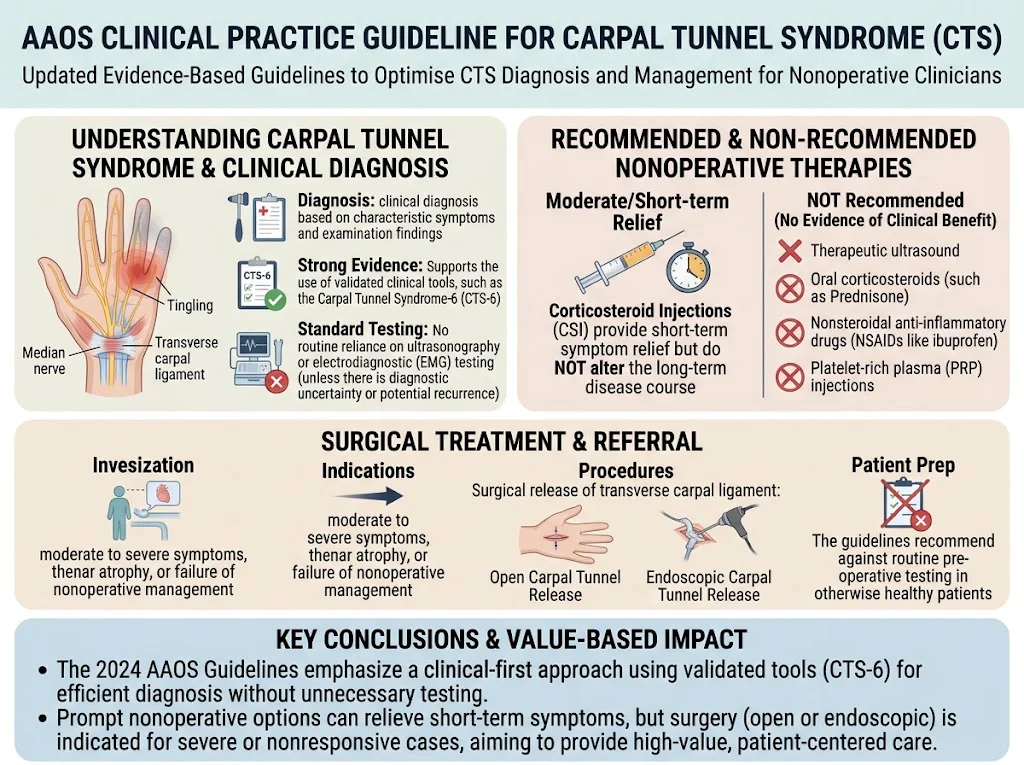
Key themes from the AAOS 2024 guideline – Carpal tunnel syndrome is primarily a clinical diagnosis. Use of validated clinical instruments (e.g., CTS-6) is supported for typical presentations. – Reserve electrodiagnostic studies (nerve conduction studies and EMG) and diagnostic imaging (ultrasound) for diagnostic uncertainty, atypical presentations, or prior surgery/recurrence—not for routine confirmation in straightforward cases. – Nonoperative therapies can provide short-term symptom relief. Corticosteroid injection has high-quality evidence for short-term benefit but does not change long-term outcomes. – Several commonly used treatments lack demonstrable benefit and are not recommended, including therapeutic ultrasound, oral corticosteroids (long-term), NSAIDs as disease-modifying therapy, and biologic injections such as platelet-rich plasma (PRP). – For moderate-to-severe disease, thenar atrophy, or failure of reasonable nonoperative care, timely surgical carpal tunnel release (open or endoscopic) is appropriate. Routine preoperative testing (e.g., labs, imaging, ECG) is not recommended in otherwise healthy patients. Quick clinician takeaways – Trust the history and focused exam. – Use CTS-6 or similar validated tools to standardize assessment. – Offer wrist splints and consider corticosteroid injection for short-term symptom relief. – Avoid routine electrodiagnostic or imaging testing unless the case is atypical or results would change management. – Refer for surgical evaluation if symptoms are moderate-to-severe, progressive motor deficit, thenar atrophy, or refractory to nonoperative care.Updated Recommendations and Key Changes from Prior Guidance
Major updates compared with prior AAOS and specialty guidance (summary): – Stronger emphasis on clinical diagnosis: earlier guidance often promoted routine electrodiagnostic testing; the 2024 guideline elevates validated clinical assessment tools and de-emphasizes routine testing in typical cases. – Clarified role of diagnostic ultrasound: ultrasound is not recommended for routine diagnosis but can be helpful when there is uncertainty or suspicion of structural causes. – Explicit “not recommended” list: the guideline now specifically advises against therapeutic ultrasound, PRP, oral corticosteroids as disease-modifying therapy, and long-term NSAIDs for CTS—decisions previously left more to clinical discretion. – Preoperative testing: updated recommendation against routine pre-op tests in otherwise healthy patients is emphasized to reduce low-value care and streamline surgical pathways. Why these changes were made – Systematic reviews and randomized trials showed limited or no long-term benefit for many commonly used modalities and clarified that short-term benefits (e.g., corticosteroid injection) do not change disease trajectory. Improved methods for guideline development and stronger evidence synthesis supported more definitive recommendations.Topic-by-Topic Recommendations
Diagnosis and initial assessment – Clinical diagnosis: CTS should be diagnosed primarily by characteristic symptoms (numbness/tingling in median nerve distribution, nocturnal symptoms, symptom provocation with activities) and supportive physical findings (thenar weakness, atrophy, positive provocative maneuvers). Use validated tools such as CTS-6 to standardize evaluation (Recommendation strength: Strong). – When to use electrodiagnostic testing (EDX): Reserve for atypical presentations (e.g., isolated sensory findings without classic distribution, suspected proximal neuropathy, polyneuropathy), preoperative baseline in complex cases, or when the diagnosis is uncertain. Routine EDX is not necessary for straightforward clinical cases (Recommendation strength: Moderate). – Role of diagnostic ultrasound: Not required routinely; consider when structural lesions are suspected (tenosynovitis, masses) or when EDX is inconclusive (Recommendation strength: Conditional/Moderate). Grading and staging – Use clinical severity scales and functional assessment rather than relying solely on nerve conduction severity to decide treatment. Neurophysiologic grading (e.g., Bland scale) can inform prognosis and surgical planning when obtained (Guideline commentary: helpful but not mandated for every patient). Initial nonoperative management – Wrist splinting (night): Recommended for mild-to-moderate symptoms for short-term relief and functional improvement (Recommendation strength: Moderate). – Local corticosteroid injection: Demonstrates consistent short-term symptom relief (weeks to months). Useful for patients seeking temporary relief or diagnostic clarification; does not alter long-term need for surgery (Recommendation strength: Strong for short-term benefit, but note lack of long-term disease modification). – Oral corticosteroids: Not recommended as routine disease-modifying therapy; may be considered short-term if injections are not feasible but evidence is limited (Recommendation strength: Not recommended/Weak). – NSAIDs: No evidence of disease modification; may be used for symptomatic pain control but not as a preferred disease-targeted therapy (Recommendation strength: Not recommended for disease modification). – Therapeutic ultrasound and PRP: Not recommended due to lack of evidence of clinical benefit (Recommendation strength: Strong against use). When to refer and surgical management – Indications for referral to hand surgery or specialist: progressive sensory loss, persistent or progressive motor weakness, thenar atrophy, severe electrodiagnostic abnormalities when present, or failure of reasonable nonoperative care (Recommendation strength: Strong). – Surgical options: Open carpal tunnel release and endoscopic release both provide effective decompression. Choice may depend on surgeon expertise, patient preference, and setting; both techniques are acceptable (Recommendation strength: Moderate). – Preoperative testing: Routine lab studies, chest x-rays, ECGs, or pre-op electrodiagnostics are not recommended in otherwise healthy patients prior to surgery (Recommendation strength: Strong against routine testing). Follow-up and prognosis – Inform patients that nonoperative measures may relieve symptoms short-term but often do not change long-term outcomes. – For patients receiving corticosteroid injections who improve, discuss the potential for symptom recurrence and the role of surgery if symptoms recur or persist. – Provide return-to-work guidance based on symptom severity, occupational demands, and treatment approach; early surgical referral may be appropriate for work-limiting symptoms. Special populations – Diabetes and polyneuropathy: Higher prevalence and more severe nerve injury risk; consider earlier specialist involvement and electrodiagnostic assessment when atypical features are present. – Pregnancy: CTS can be transient; consider conservative measures (splinting) and corticosteroid injection when needed; many cases resolve postpartum. – Workers’ compensation and repetitive strain considerations: Address occupational ergonomics; coordinate with occupational health and consider expedited referral when work limitations are severe.Expert Commentary and Insights
Panel perspectives – The guideline panel emphasized practical simplicity: clinicians should rely on careful history and focused exam, using validated tools to standardize decision-making. This reduces reliance on testing that adds cost and delays without improving outcomes. – The value-based care perspective informed recommendations against routine pre-op testing and low-value therapies such as ultrasound and PRP. Areas of consensus – Agreement that corticosteroid injection is useful for short-term relief and diagnostic clarity. – Agreement that surgical release is definitive for moderate-to-severe disease or persistent motor deficits. Areas of ongoing controversy – Timing of surgery after failed nonoperative care: the evidence supports individualized decision-making; the panel did not set a rigid time threshold and encouraged shared decision-making. – Role of electrodiagnostics: some surgeons still prefer routine testing for medicolegal documentation or to guide surgical planning; the guideline clarifies that routine testing is not necessary but remains justified in select circumstances. Research needs highlighted by the panel – High-quality trials comparing long-term outcomes of nonoperative pathways (splinting vs injection vs early surgery) in diverse populations. – Better characterization of subgroups who benefit most from specific therapies (e.g., predictors of durable response to injections). – Cost-effectiveness analyses evaluating pathways that reduce testing and prioritize high-value care.Practical Implications for Clinicians
Practice changes to consider – Use CTS-6 or a similar validated screening tool in primary care to standardize assessment. – Reserve EDX and ultrasound for atypical or complex cases; avoid ordering them reflexively in classic presentations. – Offer night splints and consider corticosteroid injection for short-term relief; counsel patients that injections may delay but not necessarily prevent surgery. – Avoid prescribing therapeutic ultrasound or PRP for CTS outside of clinical trials. – Streamline preoperative evaluation by avoiding routine testing in healthy patients scheduled for carpal tunnel release. A brief illustrative vignette – Patient: Maria, a 42-year-old administrative assistant, presents with three months of nocturnal numbness and intermittent daytime tingling in the thumb, index, and middle fingers, worse with typing and relieved by shaking her hand. On exam she has diminished light touch in the median distribution but no thenar atrophy. The CTS-6 score suggests likely CTS. – Management aligned with the guideline: offer night wrist splint and discuss corticosteroid injection for short-term relief. Because her presentation is typical and uncomplicated, do not order routine electrodiagnostic testing. If symptoms persist or progress over the next 6–12 weeks despite conservative care, arrange referral for surgical consultation.References
– Wright JL, Kamal RN, ASSH Quality and Value Care Committee, Shapiro LM. AAOS Clinical Practice Guidelines for Carpal Tunnel Syndrome: Synopsis and Practice Implications. Journal of General Internal Medicine. 2026 Nov 02. PMID: 42970225. – American Academy of Orthopaedic Surgeons. Clinical Practice Guideline: Management of Carpal Tunnel Syndrome. AAOS; 2024. (AAOS guideline document) – Marshall S, Tardif G, Ashworth N. Local corticosteroid injection for carpal tunnel syndrome. Cochrane Database Syst Rev. 2007;(2):CD001554. – Atroshi I, Gummesson C, Johnsson R, Ornstein E, Ranstam J, Rosen I. Prevalence of carpal tunnel syndrome in a general population. JAMA. 1999;282(2):153–158. – Bland JD. A neurophysiological grading scale for carpal tunnel syndrome. Muscle Nerve. 2000;23(8):1280–1283. – Gerritsen AA, de Vet HCW, Scholten RJPM, Bertelsmann FW. Splints and surgery for carpal tunnel syndrome. Cochrane Database Syst Rev. 2002;(2):CD001922.Closing
The AAOS 2024 guidance for carpal tunnel syndrome reinforces a clinical-first approach, highlights short-term benefits of select nonoperative interventions (notably corticosteroid injections and splints), and advises against routine use of low-value tests and therapies. For primary care and internal medicine clinicians, the guideline supports efficient assessment, targeted use of diagnostic tests, judicious conservative care, and timely referral when surgery is indicated—steps that can improve patient outcomes and reduce unnecessary interventions.Specialty calculators
For clinical reference; use professional judgment.