Introduction and Context
Asthma care is evolving rapidly. For decades, many patients with mild asthma relied on short-acting beta2-agonists (SABA) alone for symptom relief. But accumulating evidence shows that SABA-only strategies increase risk of severe exacerbations and that pairing symptom relief with inhaled corticosteroids (ICS) — either combined with a fast-onset long-acting beta2-agonist (formoterol) or provided together as separate maintenance and reliever components — reduces exacerbations and steroid exposure. To translate this evidence into clinical practice, the American Thoracic Society (ATS) published an official clinical practice guideline in November 2026 on as-needed ICS-containing reliever therapy for adolescents and adults with asthma (Khurana et al., 2026).
This article summarizes the ATS recommendations and their implications for clinicians and health systems, highlights what’s new or changed, and offers practical advice on implementing these strategies.
Why this guideline was issued now
Several factors motivated the ATS panel to develop this guideline:
- Robust randomized trial evidence (including pivotal trials comparing as-needed ICS–formoterol to SABA-only or to maintenance ICS) shows meaningful reductions in severe exacerbations when reliever doses include ICS.
- A growing recognition of harms associated with frequent SABA use, including increased risk of hospitalization and death in observational studies, and the goal of minimizing systemic corticosteroid (SCS) bursts.
- Underuse of ICS-containing relievers in many healthcare settings despite guideline recommendations from other bodies, such as GINA, creating a persistent implementation gap.
- Need to provide clear, graded, evidence-based recommendations across the spectrum of asthma severity (NAEPP steps 1–5) to guide clinicians in everyday practice.
The ATS guideline complements prior international recommendations (for example, GINA) by using rigorous PICO-framed evidence reviews and GRADE methodology tailored to the U.S. clinical context.
New Guideline Highlights
Key headline recommendations from the 2026 ATS guideline (Khurana et al.) are:
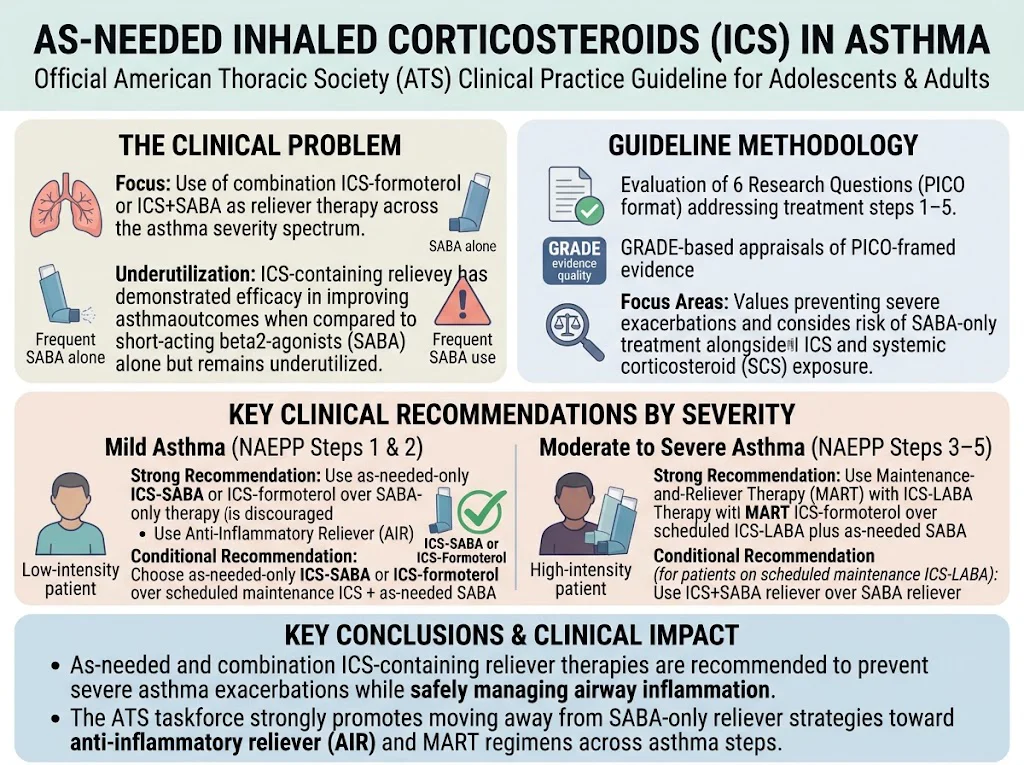
- For patients at NAEPP step 1 (mild, intermittent symptoms) and step 2 (mild persistent), the panel issued a strong recommendation for using as-needed-only ICS+SABA (combined in one inhaler or separate) or as-needed ICS–formoterol compared with SABA-only reliever therapy.
- Against SABA-only care, the panel made a conditional recommendation in favor of as-needed ICS-containing reliever strategies over a regimen of scheduled daily low-dose ICS plus as-needed SABA — emphasizing patient preferences, adherence, and symptom control trade-offs.
- For patients at NAEPP steps 3–5 (moderate to severe disease), the guideline made a strong recommendation for maintenance-and-reliever therapy (MART) using an ICS–formoterol combination (same inhaler for maintenance and reliever) over scheduled ICS–LABA plus as-needed SABA.
- Among those already using scheduled ICS–LABA at steps 3–5, the panel made a conditional recommendation favoring an ICS+SABA reliever (either combined or separate inhalers) over SABA-only reliever therapy.
- Across all recommendations, the panel prioritized reducing severe exacerbations and avoiding harms associated with SABA-only use and excessive systemic corticosteroid exposure.
In short: SABA-only reliever strategies are discouraged; relievers that include ICS are preferred across the severity spectrum, with MART with ICS–formoterol strongly favored for moderate-to-severe asthma.
Updated Recommendations and Key Changes from Prior Practice
How these ATS recommendations differ from older, common practice patterns or earlier advice:
- End of benign view of SABA-only reliever therapy: Historically many patients with mild asthma received SABA alone. The ATS guideline coherently rejects SABA-only as a safe default, aligning with and strengthening the shift that began with GINA’s 2019 recommendation for as-needed ICS–formoterol.
- Clear graded endorsement of MART for steps 3–5: Rather than treating maintenance plus reliever as optional, the panel gave a strong recommendation for ICS–formoterol MART over scheduled ICS–LABA plus SABA reliever, based on consistent evidence of fewer exacerbations and reduced SCS exposure.
- Practical flexibility: The guideline recognizes both combined ICS–formoterol inhalers and strategies using separate ICS + SABA relievers as acceptable alternatives where formoterol-based products are unavailable or not preferred, which is important for real-world implementation.
These recommendations echo international trends but provide a systematic GRADE appraisal within the ATS framework and an explicit summary for NAEPP treatment steps.
Topic-by-Topic Recommendations
Below we distill the main guidance by clinical topic, including strength of recommendation where stated by the ATS panel.
Population covered: Adolescents and adults with asthma, across NAEPP steps 1–5. The guideline does not provide new recommendations for children under age 12 or for pregnancy-specific management; clinicians should consult pediatric and obstetric guidance where relevant.
Reliever strategies for NAEPP steps 1–2
- Recommendation: Strong for as-needed-only ICS+SABA (single or separate inhaler) or as-needed ICS–formoterol versus SABA-only reliever. Rationale: randomized trials show fewer severe exacerbations and less SCS use when reliever doses include ICS.
- Comparison vs scheduled daily low-dose ICS plus as-needed SABA: The panel issued a conditional recommendation favoring as-needed ICS-containing reliever options in certain patients, acknowledging trade-offs related to symptom control and daily anti-inflammatory coverage. Shared decision-making is recommended.
Reliever strategies for NAEPP steps 3–5
- MART (maintenance-and-reliever therapy) with ICS–formoterol: Strongly recommended over fixed-dose scheduled ICS–LABA with as-needed SABA. Evidence supports reduced severe exacerbations and reduced cumulative oral corticosteroid exposure.
- If patients are already on scheduled ICS–LABA: The guideline issues a conditional recommendation to use an ICS-containing reliever (ICS+SABA, combined or separate) rather than a SABA-only reliever.
Practical implementation and follow-up
- Action plans: Update asthma action plans to reflect the chosen reliever strategy, including clear instructions on when to increase doses and when to seek medical care.
- Education: Teach inhaler technique and ensure patients can distinguish maintenance vs reliever inhalers, especially when using separate devices.
- Monitoring: Track reliever use (number of puffs per week) as a marker of control; frequent reliever use still signals poor control and may prompt escalation or reassessment of adherence, inhaler technique, exposures, or comorbidities.
- Safety: Monitor for expected ICS local effects (e.g., oral candidiasis) and counsel on rinsing the mouth when using ICS-containing inhalers. Assess adrenal suppression risk only for very high cumulative steroid exposures; MART regimens often reduce systemic steroid bursts.
Special populations
- Adolescents and older adults: Recommendations apply to adolescents and adults as per the guideline. Consider comorbidities, cognitive issues, and inhaler handling ability when selecting reliever strategies.
- Pregnancy and children <12 years: The ATS guideline did not generate new recommendations. For pregnancy, follow obstetric asthma guidance; for children consult pediatric-specific guidance (e.g., NAEPP pediatric statements and GINA child guidance).
- Access and equity: Where ICS–formoterol MART is unavailable or unaffordable, the panel supports using separate ICS with SABA reliever as a reasonable alternative rather than SABA-only reliever, emphasizing harm reduction.
Evidence base and decision framing
The ATS panel used PICO questions and systematic reviews with GRADE certainty assessments. Key evidence sources included randomized controlled trials comparing as-needed ICS–formoterol with SABA-only relievers or with maintenance ICS. These trials consistently showed fewer severe exacerbations and less oral steroid use with ICS-containing reliever strategies. The panel balanced benefits (reduced exacerbations, reduced SCS exposure) against potential downsides (concerns about variable daily anti-inflammatory dosing, inhaler availability, cost, and patient preference), and therefore sometimes issued conditional recommendations where trade-offs were closer.
Expert Commentary, Controversies, and Practical Insights
Panel perspectives and controversies highlighted in guideline discussions include:
- Regulatory and formulary hurdles: ICS–formoterol products and permitted reliever labeling vary by country and insurer; some U.S. formularies and regulatory labels historically constrained MART usage. The ATS panel urges payers and regulators to align with trial evidence to improve access.
- Adherence vs flexibility: Some clinicians worry that as-needed approaches reduce the consistency of daily anti-inflammatory therapy. The panel notes that for many patients with mild disease, as-needed ICS-containing relievers provide sufficient anti-inflammatory coverage during symptomatic periods and reduce exacerbations, while for others scheduled ICS may still be preferable.
- Monitoring reliever use: Regardless of reliever type, excessive reliever puffs remain a warning sign. Electronic inhaler monitoring and structured follow-up can improve safety and outcomes.
- Education and inhaler technique: Successful implementation depends on educating patients about which inhaler to use when, especially in settings using multiple devices or separate maintenance and reliever inhalers.
Future research areas identified by the panel include long-term adherence and safety data across diverse populations, comparative cost-effectiveness studies, and strategies to expand equitable access.
Practical Implications for Clinical Practice
How clinicians can use the guideline today:
- Review current patients on SABA-only relievers and discuss transitioning to an as-needed ICS-containing reliever (ICS–formoterol or ICS+SABA) to reduce exacerbation risk.
- For patients on maintenance ICS–LABA, consider MART with ICS–formoterol where appropriate and available; if not feasible, ensure reliever includes an ICS rather than SABA alone.
- Update asthma action plans, document discussions, and schedule follow-up to assess control, reliever usage, and inhaler technique.
- Work with formularies, pharmacists, and payers to improve access to recommended inhaler combinations, and advocate for alignment of insurance coverage with current evidence-based recommendations.
Illustrative patient vignette
Maria, a 32-year-old schoolteacher with intermittent wheeze and cough 2–3 times per week, has been using albuterol as-needed for years. She has had two steroid bursts in the past 18 months. After shared decision-making, her clinician recommends switching to an as-needed budesonide–formoterol inhaler instead of albuterol alone. Over the next year Maria has one mild exacerbation managed with a short course of prednisone (less steroid exposure than prior years), reports fewer symptom days, and uses the reliever inhaler predictably for acute symptoms. Her rescue inhaler use is also lower overall, and her asthma action plan is updated with clear instructions for increasing doses if symptoms worsen.
References
(Select sources relevant to the guideline and background evidence)
- Khurana S, Jenkins AR, Reddel HK, et al. As-needed inhaled corticosteroids in asthma: an Official American Thoracic Society clinical practice guideline. Am J Respir Crit Care Med. 2026 Nov 3. PMID: 42974958.
- Global Initiative for Asthma. Global Strategy for Asthma Management and Prevention. 2024 update. Available from: https://ginasthma.org
- O’Byrne PM, et al. As-needed budesonide–formoterol versus maintenance budesonide in mild asthma (SYGMA trials). N Engl J Med. 2018. (SYGMA-1 and SYGMA-2 trial publications provide key randomized evidence on as-needed ICS–formoterol in mild asthma.)
- Reddel HK, Taylor DR, Bateman ED, et al. GINA strategy reporting and implementation documents provide practical guidance on ICS–formoterol reliever strategies and MART implementation (see GINA 2019 onwards for policy change rationale).
Note: clinicians should consult the full ATS guideline for detailed PICO questions, GRADE evidence profiles, and specific implementation considerations.
Bottom line
The 2026 ATS clinical practice guideline provides clear, evidence-based recommendations that move clinical practice away from SABA-only reliever therapy toward reliever strategies that include inhaled corticosteroid. For most adults and adolescents with asthma, using an ICS-containing reliever — whether as-needed ICS–formoterol or ICS+SABA — reduces the risk of severe exacerbations and systemic steroid exposure. For moderate-to-severe asthma, MART with ICS–formoterol is strongly favored. Successful implementation requires patient education, inhaler access, careful monitoring, and shared decision-making.
Specialty calculators
For clinical reference; use professional judgment.