Highlights
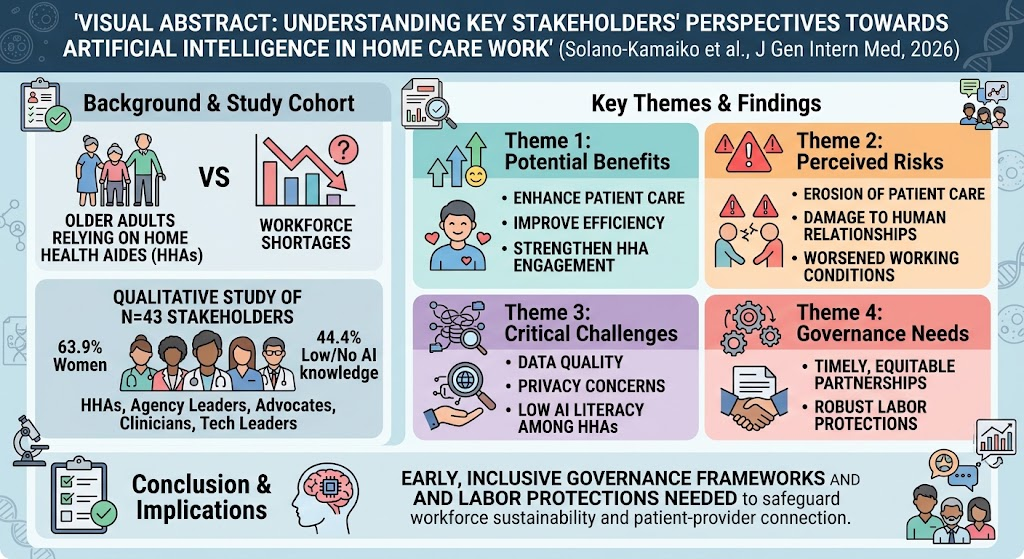
- AI offers potential benefits in enhancing patient care, boosting home health aides’ (HHAs) engagement, and improving organizational workflow efficiency.
- Significant concerns exist about AI possibly eroding care quality, harming patient-provider relationships, and worsening HHAs’ working conditions.
- Challenges identified include data quality issues, privacy concerns, and variable AI literacy among frontline caregivers.
- There is a critical need for early, inclusive governance frameworks and labor protections in AI deployment within home care.
Background
Home care plays a pivotal role in supporting an aging population preferring to age in place. HHAs and attendants deliver personalized care but face workforce shortages and increasing demands. Artificial intelligence (AI) is increasingly promoted to address these gaps by augmenting care delivery and operational efficiency. Despite growing investments in AI technologies for home care, little is known about how stakeholders—those implementing and affected by AI—perceive the benefits and risks associated with these systems. Understanding these perspectives is essential to ensure that AI deployment supports rather than undermines care quality and workforce sustainability.
Key Content
Study Design and Stakeholder Diversity
The foundational study by Solano-Kamaiko et al. (2026), a qualitative investigation involving 43 participants from five key stakeholder groups—including HHAs, home care agency leaders, worker advocates, clinicians, and technology leaders—provides critical insight. Participants’ mean age was 44.6 years; most had some college education, but nearly half reported low AI knowledge. Purposive and snowball sampling captured a variety of perspectives, analyzed through structural coding and thematic analysis.
Theme 1: Potential Benefits of AI in Home Care
Stakeholders recognized AI’s promise to enhance patient care by supporting monitoring, medication management, and personalized interventions. HHAs anticipated AI tools could strengthen their engagement through decision support, training aids, and reducing administrative burdens. Organizational leaders highlighted AI’s potential to improve scheduling, resource allocation, and efficiency, which could alleviate some workforce challenges. These anticipated benefits align with broader AI applications in healthcare that improve clinical decision-making and operational management.
Theme 2: Risks of AI Impacting Care Quality and Workforce Conditions
Concerns were prevalent regarding AI’s possible erosion of patient-centered care. Participants feared that reliance on AI might depersonalize interactions, damage provider-patient trust, and reduce the caregiving role to task execution. The risk of AI introducing errors or bias also raised alarms. Moreover, HHAs worried about worsening working conditions, such as increased surveillance, job insecurity, and augmented workloads due to AI-generated demands. These apprehensions echo broader ethical debates about automation and employment in caregiving professions.
Theme 3: Challenges of Data Quality, Privacy, and AI Literacy
Key barriers identified included concerns over data accuracy and completeness, critical for reliable AI outputs. Privacy protections emerged as a priority given the sensitivity of health and personal data collected in home environments. Additionally, uneven AI literacy among HHAs posed challenges for effective adoption and trust. These challenges mirror established hurdles in healthcare AI implementation, where data governance and end-user training are vital for success.
Theme 4: Need for Inclusive Governance and Equitable Partnerships
Participants emphasized early, transparent governance involving all stakeholders to guide AI development and deployment. Labor protections and equitable technology partnerships were deemed necessary to safeguard workers’ rights and ensure that AI supports rather than supplants human caregiving. This aligns with emerging frameworks advocating participatory design and ethical AI governance to promote fairness and accountability.
Expert Commentary
The findings from the key qualitative study complement existing literature highlighting both technological potential and ethical complexities of AI in health and social care sectors. The balanced recognition of AI benefits and risks underscores the critical role of human-centered design principles. Mechanistically, AI’s augmentation of decision-making processes must integrate seamlessly with human judgment and contextual knowledge unique to home care environments.
Current clinical guidelines and policy recommendations for AI in healthcare advocate for robust validation, bias minimization, and user empowerment. However, home care settings present unique challenges, including heterogeneity of care environments, diverse caregiver backgrounds, and close interpersonal dynamics. Workforce sustainability concerns necessitate that AI deployment be accompanied by labor protections, ongoing training, and adaptive workflow integration.
Controversies persist regarding automation’s impact on employment stability and the potential devaluation of caregiving roles. Limitations include variability in digital infrastructure, potential for exacerbating inequities if access is uneven, and the evolving nature of AI algorithms requiring continuous oversight.
Conclusion
Artificial intelligence in home care holds significant promise to enhance care delivery and operational efficiency but also poses risks to care quality, workforce well-being, and patient relationships. An inclusive, multidisciplinary approach to AI governance that incorporates stakeholder perspectives—particularly frontline workers—is crucial to foster equitable, sustainable, and person-centered AI integration. Future research should expand on evaluating impact longitudinally, developing tailored AI literacy programs, and refining ethical frameworks suited for home care contexts.
References
- Solano-Kamaiko IR, Dicpinigaitis M, Tan M, Avgar A, Vashistha A, Dell N, Sterling MR. Understanding Key Stakeholders’ Perspectives Towards Artificial Intelligence in Home Care Work. J Gen Intern Med. 2026 Sep 22. doi: 10.1007/s11606-026-xxxx-x. PMID: 42773397.
- Russell S, Norvig P. Artificial Intelligence: A Modern Approach. 4th ed. Pearson; 2020.
- Topol EJ. High-performance medicine: the convergence of human and artificial intelligence. Nat Med. 2019;25(1):44–56. doi:10.1038/s41591-018-0300-7.
- Shah NH, Milstein A, Bagley SC. Making Machine Learning Models Clinically Useful. JAMA. 2019;322(14):1351-1352. doi:10.1001/jama.2019.13465.
- Cabitza F, Rasoini R, Gensini GF. Unintended Consequences of Machine Learning in Medicine. JAMA. 2017;318(6):517–518. doi:10.1001/jama.2017.7797.