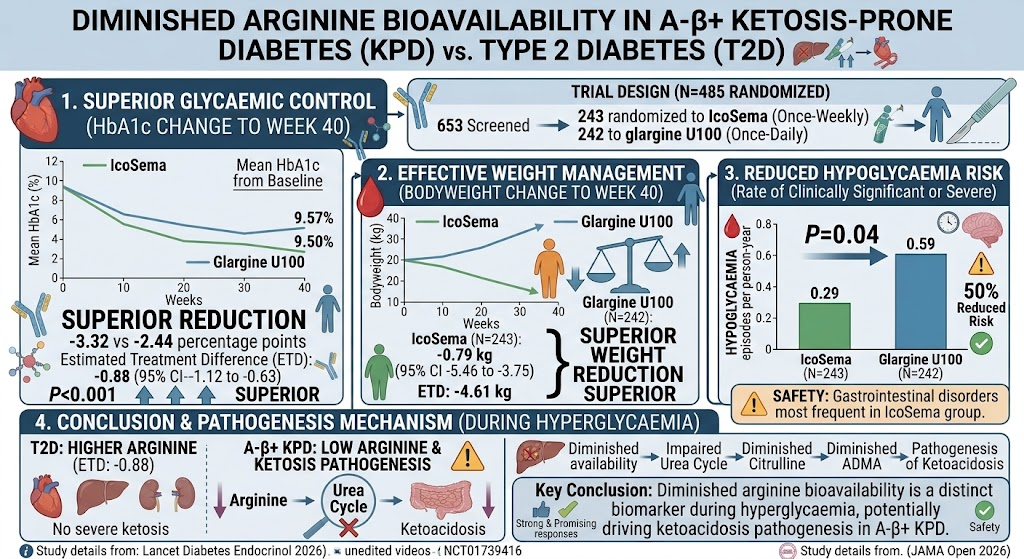
Highlight
– Individuals with A-β+ ketosis-prone diabetes (KPD) have decreased arginine bioavailability during hyperglycaemia compared to those with type 2 diabetes (T2D).
– Reduced arginine availability in KPD correlates with diminished arginine flux primarily due to decreased protein-derived arginine.
– Citrulline supplementation restores arginine bioavailability and nitric oxide synthesis in KPD individuals without adverse effects.
– Arginine potentiates insulin secretion during hyperglycaemia, suggesting a mechanistic link to susceptibility to diabetic ketoacidosis (DKA) in KPD.
Study Background
Ketosis-prone diabetes mellitus, particularly the A-β+ subtype characterized by absence of islet autoantibodies and preservation of beta cell function, presents a clinical conundrum. Although clinically resembling type 2 diabetes, patients with KPD are predisposed to recurrent episodes of unprovoked diabetic ketoacidosis (DKA), a serious and potentially life-threatening metabolic complication. The pathophysiology underlying this proclivity remains incompletely understood, complicating efforts to optimize prevention and management strategies.
Prior observations indicated that plasma arginine levels are reduced in clinically stable KPD subjects, raising the possibility that alterations in arginine metabolism could contribute to their unique metabolic vulnerability. Given arginine’s central role as a substrate for nitric oxide (NO) synthesis and insulin secretion potentiation, perturbations in its bioavailability may have pathophysiologic relevance during hyperglycaemic crises.
Study Design
This investigation employed a two-protocol study design involving individuals with A-β+ KPD, those with type 2 diabetes, and non-diabetic controls to elucidate arginine metabolism dynamics under controlled metabolic conditions.
Protocol 1: Participants underwent euglycaemic and hyperglycaemic clamp studies to assess arginine, citrulline, ornithine, and phenylalanine kinetics. Stable isotope tracer infusions combined with mass spectrometric analyses quantified arginine production (de novo synthesis and from protein breakdown) and catabolism, alongside measuring insulin secretion responses to glucose and arginine stimulation.
Protocol 2: To test the therapeutic potential of augmenting arginine availability, ten KPD participants engaged in a randomized, double-blind crossover trial of oral citrulline supplementation—a known arginine precursor—compared with alanine placebo. The primary outcome was arginine flux, with secondary outcomes including de novo arginine synthesis, plasma arginine concentrations, nitric oxide production, and insulin secretory responses.
Key Findings
Under hyperglycaemic conditions in Protocol 1, participants with KPD exhibited a pronounced decrease in arginine flux—a 42.5% greater reduction compared to T2D participants (p=0.035). This decline stemmed predominantly from diminished arginine derived from protein breakdown rather than changes in de novo synthesis or arginine catabolism. Notably, NO synthesis and ornithine flux were similar between KPD and T2D groups.
In response to hyperglycaemia, both diabetic groups showed blunted insulin secretion to glucose bolus; however, KPD subjects demonstrated an enhanced insulin secretory response to arginine, indicating preserved beta cell responsiveness to arginine stimulation despite hyperglycaemic stress.
Protocol 2 revealed that citrulline supplementation in KPD participants significantly increased arginine flux (effect size 0.746; 95% CI 0.258 to 0.931), as well as plasma arginine levels and NO synthesis, without reported adverse effects. Alanine placebo did not produce these changes. This suggests that citrulline can effectively restore arginine availability and related metabolic pathways in KPD during hyperglycaemic states.
Expert Commentary
These findings offer novel mechanistic insights into the metabolic dysfunction characteristic of A-β+ ketosis-prone diabetes. The observed decrement in arginine bioavailability during hyperglycaemia may impair arginine-dependent potentiation of insulin secretion, contributing to the abrupt loss of metabolic control leading to ketoacidosis. The preferential reduction in arginine from protein catabolism rather than biosynthesis suggests a metabolic bottleneck or dysregulation at the level of protein turnover or amino acid recycling during hyperglycaemic stress.
The maintained responsiveness of beta cells to arginine stimulation in KPD implies that therapeutic strategies aimed at augmenting arginine availability could enhance endogenous insulin secretion and ameliorate ketoacidosis risk. Citrulline supplementation emerges as a promising approach, given its ability to bypass first-pass hepatic metabolism and elevate plasma arginine effectively.
Limitations of the study include the relatively small sample size, especially in the interventional crossover trial, and the need to assess long-term clinical outcomes of citrulline therapy. Furthermore, whether these metabolic signatures translate to other KPD phenotypes or to distinct ethnic populations requires further exploration.
Conclusion
In summary, this study identifies diminished arginine availability during hyperglycaemia as a metabolic hallmark distinguishing A-β+ ketosis-prone diabetes from typical type 2 diabetes. This deficit may underpin their increased susceptibility to unprovoked diabetic ketoacidosis via reduced arginine-mediated insulin secretion potentiation. Importantly, citrulline supplementation restores arginine bioavailability and nitric oxide synthesis, representing a potential therapeutic intervention to forestall DKA episodes in this unique diabetes subtype.
Future research should focus on larger clinical trials to validate citrulline supplementation’s efficacy and safety, clarify the underlying molecular mechanisms impairing arginine flux, and integrate these insights into personalized management algorithms for ketosis-prone diabetes.
Funding and Clinical Trial Registration
This work was supported by grant R01-DK101411 from the National Institutes of Health. The randomized crossover trial was registered at ClinicalTrials.gov under identifier NCT03566524.
Reference
Hsu JW, Elizondo A, Gutierrez A, Caducoy E, Tosur M, Gaba R, Mulukutla SN, Jahoor F, Balasubramanyam A. Diminished arginine bioavailability during hyperglycaemia distinguishes individuals with A–β+ ketosis-prone diabetes from those with type 2 diabetes: implications for the pathogenesis of ketoacidosis in A–β+ ketosis-prone diabetes. Diabetologia. 2026 Aug 14. doi: 10.1007/s00125-026-06834-y. Epub ahead of print. PMID: 42595807.