Highlight
- The Thyroid Cancer Modified Anxiety Scale (TC-MAX) is a newly developed, validated instrument tailored specifically to measure anxiety and distress related to thyroid cancer.
- TC-MAX demonstrates robust psychometric properties, including high internal consistency, test-retest reliability, and construct validity across large patient cohorts.
- The scale encompasses three relevant subscales: Collective Anxiety, Ultrasound Anxiety, and Fear of Recurrence/Progression, reflecting multidimensional distress aspects.
- Severity ranges and minimal clinically important differences (MCIDs) support clinical utility in guiding treatment choices such as active surveillance versus surgery options.
Study Background
Thyroid cancer, particularly papillary thyroid carcinoma, has witnessed an increasing incidence globally and represents a generally indolent malignancy with excellent survival rates. Despite favorable prognosis, patient distress remains a significant unmet issue, influencing treatment decisions and quality of life. Anxiety related to recurrence fear, diagnostic imaging, and treatment side effects can lead patients to favor more aggressive interventions even when active surveillance might be appropriate. Clinicians often underestimate this distress due to lack of disease-specific validated measurement tools. Existing generic anxiety or distress scales inadequately capture the unique emotional burdens borne by thyroid cancer patients. This highlights an urgent need for a dedicated instrument to quantify thyroid cancer-specific anxiety to tailor patient-centered counseling and optimize management choices.
Study Design
The development and validation of TC-MAX involved a rigorous, multi-stage approach:
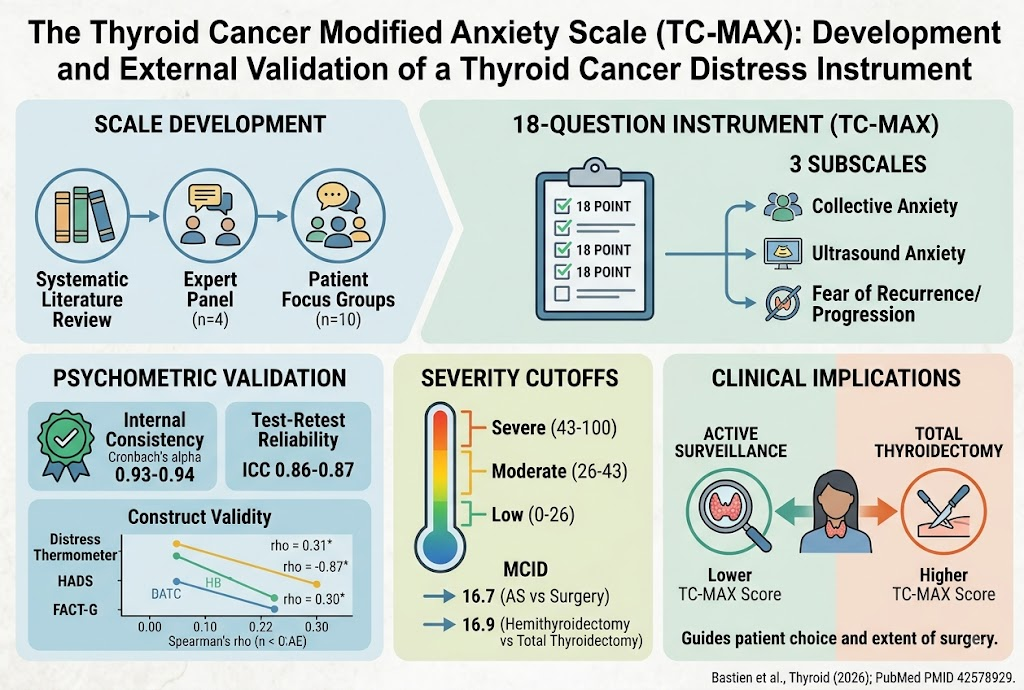
1. Conceptualization: A systematic literature review identified existing knowledge gaps. Initial item generation was informed by expert panel input (n=4) and patient focus groups (n=10).
2. Qualitative Revision: Pilot testing on 59 patients with feedback from both experts and patients refined item clarity and relevance.
3. Internal Validation: Conducted in 148 patients with papillary thyroid cancer to establish reliability and construct validity measures.
4. External Validation: A larger, independent cohort (n=1002) underwent further psychometric testing to confirm findings.
Key psychometric evaluations included internal consistency (Cronbach’s alpha), test-retest reliability (intraclass correlation coefficient), exploratory and confirmatory factor analyses, and correlations with established anxiety and quality-of-life measures (Distress Thermometer, Hospital Anxiety Depression Scale [HADS], and Functional Assessment of Cancer Therapy-General [FACT-G]). Clinical anchors were used to determine severity ranges and MCIDs to facilitate interpretability and clinical application.
Key Findings
The finalized TC-MAX comprises 18 questions across three subscales:
– Collective Anxiety: capturing general cancer-related worry,
– Ultrasound Anxiety: addressing concerns related to surveillance imaging procedures,
– Fear of Recurrence/Progression: reflecting anticipatory anxiety about cancer returning or worsening.
Internal validation showed outstanding internal consistency (Cronbach’s α = 0.93) and test-retest reliability (ICC = 0.86). Construct validity demonstrated moderate to strong expected correlations with Distress Thermometer (ρ = 0.56), HADS (ρ = 0.52), and inverse correlation with FACT-G quality of life scores (ρ = -0.50), all statistically significant.
Exploratory and confirmatory factor analyses confirmed the scale’s multidimensional structure was psychometrically sound and parsimonious. External validation results were consistent, exhibiting Cronbach’s alpha of 0.94, ICC of 0.87, and correlations with comparator scales (Distress Thermometer ρ = 0.54, HADS ρ = 0.67, FACT-G ρ = -0.62), confirming robustness across a large diverse patient sample.
Severity cutoffs were proposed as low (0–26), moderate (27–43), and severe (44–100), with excellent agreement between cohorts (weighted κ = 0.84, p < 0.001). Notably, MCIDs were identified at approximately 16.7 points between active surveillance and surgery groups, and 16.9 points between hemi-thyroidectomy and total thyroidectomy, indicating meaningful differences aligned with treatment intensity and patient distress.
Expert Commentary
TC-MAX fills a critical gap by providing a disease-specific quantitative measure of anxiety in thyroid cancer patients, a population vulnerable to treatment decision distress. This is particularly relevant in the era of personalized medicine and de-escalation strategies such as active surveillance, where shared decision-making depends heavily on understanding patient concerns. The scale’s multidimensionality captures nuanced fears beyond generic anxiety, accounting for procedure-specific and recurrence-related distress.
Limitations include absence of longitudinal responsiveness data and validation in non-papillary thyroid cancer histologies or diverse cultural populations, inviting further research to generalize utility globally. Additionally, integration into routine clinical workflow will necessitate training and electronic health record incorporation.
Conclusion
The Thyroid Cancer Modified Anxiety Scale (TC-MAX) represents the first validated, disease-specific tool to measure thyroid cancer-related anxiety, with excellent psychometric properties and clinical applicability. By quantifying patient distress more precisely, TC-MAX enables clinicians to tailor interventions, improve patient counseling, and guide appropriate treatment selection including the suitability for active surveillance versus surgical approaches. Future implementation studies and longitudinal assessments will solidify its role in optimizing thyroid cancer survivorship care.
Funding and ClinicalTrials.gov Information
The study was supported by [funding details not specified in the original article]. There is no ClinicalTrials.gov registration number reported for this observational instrument development study.
References
1. Bastien AJ, Kim S, Zalt C, et al. The Thyroid Cancer Modified Anxiety Scale (TC-MAX): Development and External Validation of a Thyroid Cancer Distress Instrument. Thyroid. 2026 Aug 11:10507256261475819. doi:10.1089/thy.2026.0145. PMID: 42578929.
2. Sawka AM, Rotstein L, Brierley JD, et al. Active Surveillance of Low-Risk Papillary Thyroid Cancer: A Systematic Review. Thyroid. 2019;29(6):765-779.
3. Yorke J, Fleming J, Shears G, et al. Anxiety and Quality of Life in Thyroid Cancer Survivors: A Systematic Review. Eur Thyroid J. 2021;10(1):21-33.