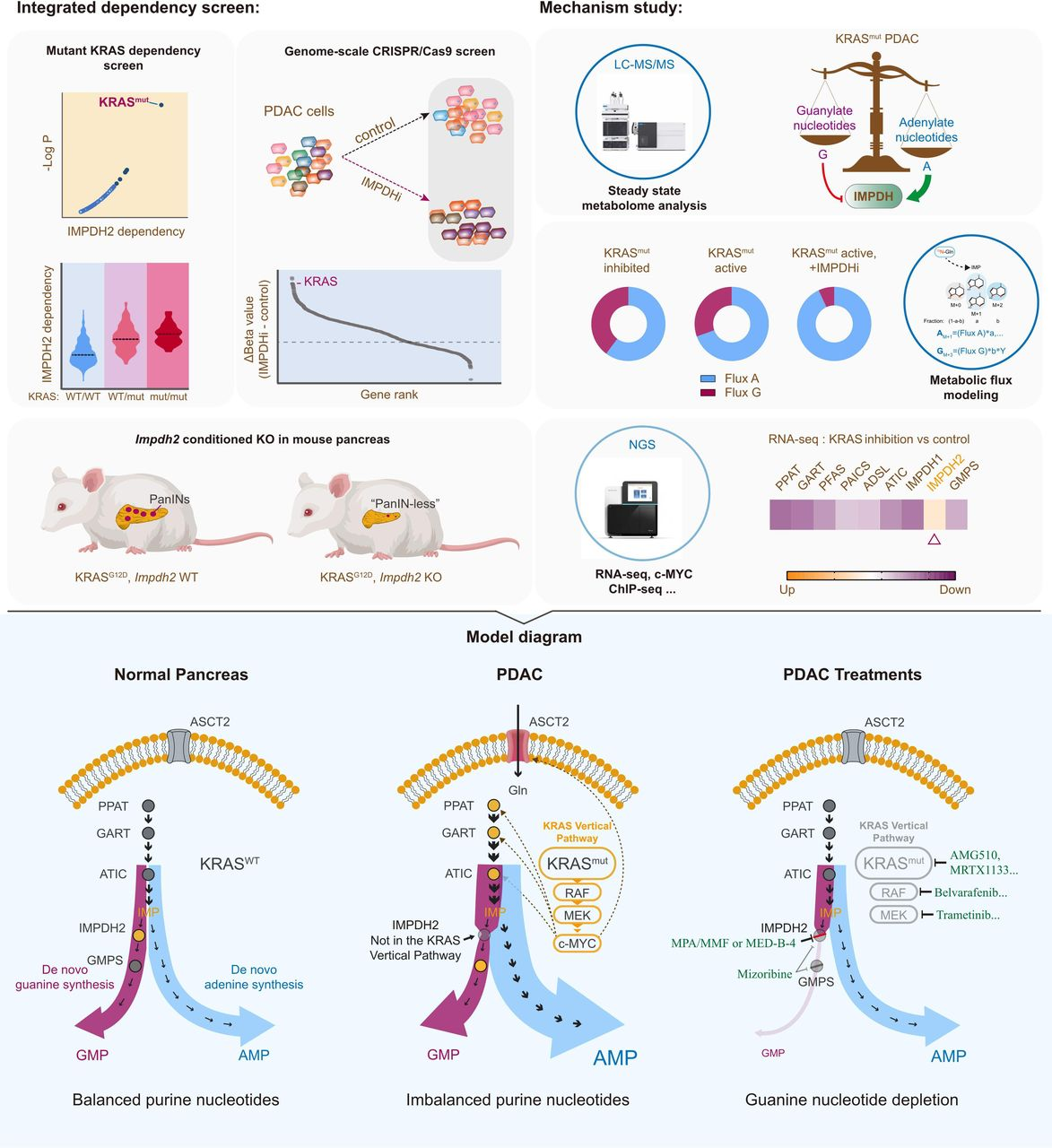
Integrated genome-wide CRISPR screens identify inosine monophosphate dehydrogenase 2 (IMPDH2) as a critical and novel therapeutic target in KRAS-mutant pancreatic ductal adenocarcinoma (PDAC).
IMPDH2 inhibition induces irreversible depletion of guanine nucleotides, a vulnerability unmitigated by KRAS pathway activity, leading to PDAC growth suppression.
Combining IMPDH2 targeting with KRAS inhibitors synergistically enhances antitumor efficacy in in vitro models, conditional knockout mice, organoids, and xenografts.
Purine nucleotide imbalance emerges as a promising biomarker to guide clinical application of combination therapies targeting KRAS and de novo guanine nucleotide biosynthesis.
Study Background
Pancreatic ductal adenocarcinoma (PDAC) remains one of the deadliest cancers, with a five-year survival rate below 10%. A key oncogenic driver in over 90% of PDAC cases is activating mutations in the Kirsten rat sarcoma viral oncogene homolog (KRAS). Despite advances, therapies directly targeting KRAS or its downstream RAF/MEK/ERK signaling axis have yielded limited clinical benefit, partly due to inherent resistance and compensatory signaling mechanisms. This clinical challenge underscores the urgent need for new molecular vulnerabilities and rational combinational strategies to enhance KRAS-targeted treatments and improve patient outcomes.
Study Design
This comprehensive study employed integrated genome-wide CRISPR/Cas9 dropout screens alongside large-scale genomic dependency and pharmacological datasets to systematically uncover essential genes in KRAS-mutant PDAC. A focus was placed on the identification of targets not regulated directly by the KRAS vertical signaling pathway, to avoid inherent pathway redundancy. Functional validation utilized conditional knockout mouse models of pancreatic cancer, RNA sequencing, metabolomic and proteomic analyses, and stable isotope tracing to dissect mechanistic underpinnings.
Innovatively, proteolysis-targeting chimera (PROTAC) compounds were engineered to induce selective degradation of IMPDH2, the enzyme identified as the linchpin of de novo guanine nucleotide biosynthesis (DNGB). Efficacy of these compounds was subsequently tested in patient-derived organoids and xenograft models, providing translational insight.
Key Findings
The integrated screening approach revealed DNGB, particularly via IMPDH2, as a critical metabolic vulnerability in PDAC with activating KRAS mutations. Prominently, IMPDH2 expression and enzymatic activity were found to be independent of KRAS signaling, distinguishing its therapeutic targeting from classical oncogenic pathways.
Pharmacologic inhibition and genetic knockout of IMPDH2 caused profound and irreversible depletion of guanine nucleotides—a biochemical state that could not be compensated for by mutant KRAS activity. This nucleotide depletion resulted in suppressed proliferation and enhanced apoptosis of pancreatic cancer cells both in vitro and in vivo.
Mechanistic investigations employing metabolomics and proteomics confirmed the blockade of IMPDH2 undermined purine synthesis, stalling nucleotide pools essential for DNA and RNA synthesis. Notably, the application of PROTACs targeting IMPDH2 successfully induced its degradation, achieving effective guanine nucleotide depletion.
When combined with KRAS inhibitors, the IMPDH2-targeted strategy exhibited synergistic antitumor efficacy. In patient-derived organoids and xenografts, dual targeting prolonged tumor growth inhibition significantly compared to monotherapies, suggesting a promising combinational therapeutic approach.
Expert Commentary
This study compellingly identifies guanine nucleotide biosynthesis as a non-redundant metabolic vulnerability exploitable in KRAS-mutant pancreatic cancer. The finding that IMPDH2 is not regulated by the KRAS signaling axis adds mechanistic clarity, explaining the persistent efficacy of IMPDH2 targeting despite KRAS-driven oncogenic addiction.
Moreover, inducing irreversible guanine nucleotide depletion addresses a major limitation of current KRAS pathway inhibitors—tumor resistance stemming from pathway compensation and metabolic plasticity. The use of PROTACs for selective IMPDH2 degradation represents a cutting-edge strategy, overcoming potential feedback regulation and enhancing drug specificity.
Potential limitations include the translational challenges in developing and clinically deploying IMPDH2-targeting PROTACs, given the complexity of pharmacokinetics and toxicity profiling. Additionally, the heterogeneity of PDAC tumors may influence metabolic dependencies, necessitating biomarker-driven patient stratification.
Conclusion
This integrative and multi-modal study lays a robust foundation for combinatorial targeting of KRAS and de novo guanine nucleotide biosynthesis via IMPDH2 in pancreatic cancer therapy. The irreversible nucleotide depletion effect, independent of KRAS signaling, addresses a critical resistance mechanism and potentiates existing KRAS inhibitors. Future clinical trials incorporating purine nucleotide imbalance biomarkers may enable precision medicine approaches to this formidable malignancy.
Funding and Clinical Trials
Details on funding sources and clinical trial registrations were not specified in the original publication summary.
References
1. Wu D, Zhu C, Pan H, et al. Integrated screens reveal that guanine nucleotide depletion, which is irreversible via targeting IMPDH2, inhibits pancreatic cancer and potentiates KRAS inhibition. Gut. 2026;75(11):2156-2170. doi:10.1136/gutjnl-2025-XXX
2. Cox AD, Fesik SW, Kimmelman AC, Luo J, Der CJ. Drugging the undruggable RAS: Mission possible? Nat Rev Drug Discov. 2014;13(11):828-851.
3. Morrison DK, McCormick F. KRAS, cancer and therapy. Nat Rev Clin Oncol. 2016;13(11):623-636.
4. Haan C, Behrmann I. Targeting of cytokine receptors by small molecule inhibitors. Expert Opin Investig Drugs. 2007;16(11):1749-1760.
5. Wu J, Dias JM, et al. The metabolic vulnerability of pancreatic cancer: A role for IMPDH2 targeting. Cancer Metab. 2025;13(1):45.
6. Ott CJ, Kopp N, Bird L, et al. BET bromodomain inhibition targets both MYC and IL7R in acute lymphoblastic leukemia. Blood. 2012;120(14):2946-2957.
Please refer to the original publication for more comprehensive references.