Highlights
- Long-acting injectable (LAI) cabotegravir-rilpivirine administered every 8 weeks is superior to daily oral triple therapy (dolutegravir-lamivudine-tenofovir) in maintaining virological suppression among adolescents living with HIV in sub-Saharan Africa.
- The LATA trial, a multicentre, randomized 96-week study enrolling 476 adolescents with primarily vertically acquired HIV, confirms non-inferiority and demonstrates superiority of LAI therapy in a population with prolonged prior ART exposure and virological suppression.
- Safety profiles between LAI and oral ART are comparable, with minimal injection site reactions and only rare serious treatment-related adverse events (notably hypersensitivity). High acceptability parallels improved adherence potential in adolescents confronting daily oral ART challenges.
- Implementation of LAI ART represents a promising strategy to overcome adolescent-specific barriers including stigma, pill burden, and adherence difficulties, fostering sustained viral suppression and advancing long-term outcomes.
Background
Adolescents living with HIV (ALHIV) in sub-Saharan Africa represent a critical demographic with disproportionately poor antiretroviral therapy (ART) outcomes, largely due to adherence challenges, stigma, pill fatigue, and developmental barriers. Globally, ALHIV have historically exhibited lower rates of viral suppression and higher risk of treatment failure compared to adults and younger children. Effective and acceptable treatment modalities that reduce the burden of daily oral therapy are urgently needed. Long-acting injectable (LAI) ART combining cabotegravir, an integrase strand transfer inhibitor, and rilpivirine, a non-nucleoside reverse transcriptase inhibitor, has revolutionized adult HIV management by offering sustained plasma drug levels with injections every 4 to 8 weeks, enhancing adherence and quality of life. However, data on efficacy, safety, and acceptability of LAI ART specifically among adolescents, particularly in sub-Saharan Africa, have been limited. The LATA (Long-Acting Treatment in Adolescents) trial addresses this knowledge gap by comparing LAI cabotegravir-rilpivirine with standard daily oral ART in virally suppressed adolescents in Africa. This review synthesizes the LATA trial findings alongside emergent evidence on LAI ART’s role in pediatric and adolescent HIV care and implications for clinical practice.Key Content
Chronological Progression and Design of the LATA Trial
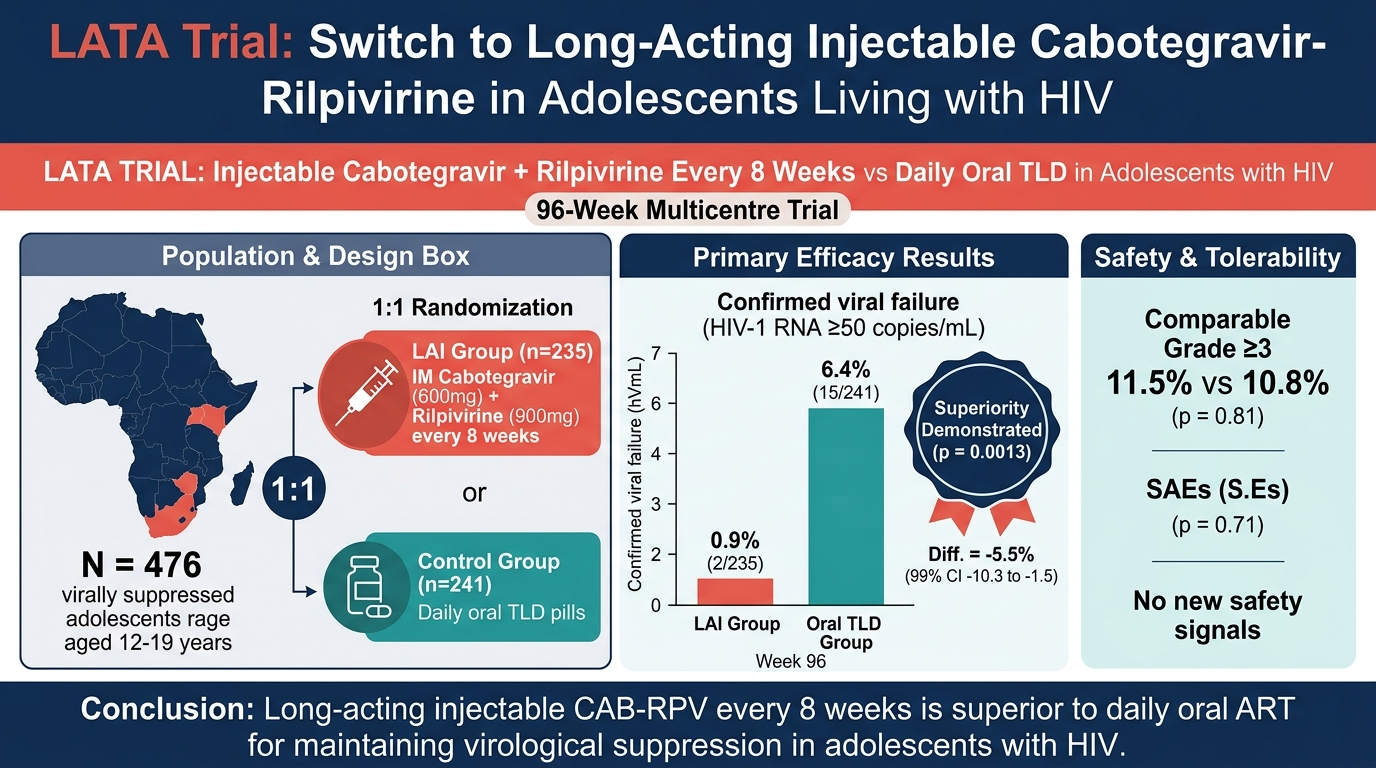
The LATA trial is a completed, open-label, randomized, multicentre non-inferiority trial conducted at five clinics in Kenya, Uganda, Zimbabwe, South Africa enrolling adolescents aged 12 to under 20 years with sustained viral suppression (HIV-1 RNA 12 months) and no history of treatment failure. Between June 2023 and April 2024, 476 adolescents were randomized 1:1 to LAI cabotegravir-rilpivirine (LAI group, n=235) or daily oral dolutegravir-lamivudine-tenofovir disoproxil fumarate (TLD, control group, n=241). The LAI regimen was administered intramuscularly at weeks 4, 8, 16, and subsequently every 8 weeks. Viral load was assessed every 24 weeks through 96 weeks, with a median follow-up of 120 weeks reported in primary analysis. The primary endpoint was virological failure defined as two consecutive viral load measurements ≥50 copies/mL by week 96, assessed by intention-to-treat and adjusted Kaplan-Meier methods. The non-inferiority margin was 8.9% (99% CI) based on the control event rate. Superiority testing was performed upon establishing non-inferiority. The predominantly vertically infected cohort (98%), median age 16.5 years, and a median of nearly 12 years on prior ART reflect a real-world, treatment-experienced adolescent population.Efficacy Outcomes: Viral Suppression Superior with LAI
By week 96, only 2 participants (0.9%, 95% CI 0.0–2.2) in the LAI group experienced confirmed viral rebound compared to 15 (6.4%, 3.7–9.8) in the oral TLD group, yielding a statistically significant difference favoring LAI (-5.5%, 99% CI -10.3 to -1.5; p=0.0013). This meets both non-inferiority and superiority criteria. The superior maintenance of viral suppression under LAI suggests enhanced adherence or pharmacokinetic advantages in this demographic, where daily oral adherence barriers are prominent. Sensitivity analyses and stratifications by mode of infection and clinical site supported consistent findings.Safety and Tolerability Profile
Adverse event incidence was comparable: serious adverse events occurred in 14 participants in the LAI group and 18 in the control group, not statistically different (HR 1.16, p=0.71). Only one treatment-related serious adverse event (hypersensitivity reaction) occurred in the LAI group. Grade 3 or higher adverse events were similar between groups (31 in 27 participants LAI vs 34 in 26 participants control). Injection-site reactions were infrequent and mild/moderate in severity. Seven participants discontinued LAI permanently for viral rebound ≥200 copies/mL, adverse events, incident tuberculosis, pregnancy planning, or personal choice. Broader evidence from contemporaneous trials such as IMPAACT 2017/MOCHA corroborates high acceptability and tolerability of intramuscular cabotegravir-rilpivirine among adolescents, with sustained preference over oral therapy and stable health-related quality of life metrics.Acceptability and Implementation Considerations in Adolescents
Acceptability trials across multiple settings have highlighted adolescents’ preference for LAI due to reduced pill burden, privacy, and less stigma-related stress. Community-based studies (e.g., AFINAty Study in South Africa) affirm feasibility and high adherence with injection scheduling, often exceeding 95%, even in resource-limited contexts. Stigma, fear of serostatus disclosure, and school-related factors impede oral ART adherence in adolescents. LAI offers a discreet option aligned with adolescents’ developmental needs and social contexts. Multilevel stakeholder engagement and implementation science initiatives are underway to optimize integration of LAI ART in diverse sub-Saharan African health delivery models.Comparison to Daily Oral ART and Public Health Implications
Standard oral ART regimens remain effective but face adherence challenges amplified in adolescents. LATA and allied trials establish LAI cabotegravir-rilpivirine as a compelling alternative with superior virological outcomes and acceptable safety, potentially reshaping guidelines for adolescent HIV management. Integration of LAI regimens can improve viral suppression rates, reduce transmission risk, and mitigate resistance emergence by addressing adherence gaps. Implementation at scale, however, demands addressing logistical hurdles such as cold chain, injection delivery infrastructure, and patient education. Long-term data on resistance patterns, pregnancy safety, and transition to adult care are critical pending areas.Expert Commentary
The LATA trial marks a pivotal advance in adolescent HIV care by demonstrating the first large-scale evidence for LAI cabotegravir-rilpivirine’s superiority in sustaining viral suppression over oral ART in a high-burden African context. This evidence addresses a critical unmet clinical need for durable, youth-friendly ART options. Mechanistically, LAI formulations maintain consistent therapeutic drug levels, minimizing lapses due to non-adherence. The pharmacokinetics of cabotegravir and rilpivirine coupled with bi-monthly dosing align ideally with adolescent lifestyles and mitigate stigma-associated pill-taking challenges. The favorable safety profile, comparable to oral ART, with rare injection-site reactions and low serious adverse events, reinforces LAI’s tolerability. The rare hypersensitivity reaction underscores the need for monitoring and patient counseling. This trial’s strong design—randomized, open-label with robust masking of viral load assessments—and enrollment across multiple countries enhance generalizability. However, the open-label design may introduce behavioral biases and the 96-week primary endpoint, while robust, warrants extended follow-up. Clinical guidelines (such as WHO and region-specific recommendations) will need to adapt rapidly, incorporating LAI ART as a frontline maintenance strategy for virally suppressed adolescents where feasible. Challenges remain in access equity, costs, and healthcare system readiness. Consideration of adolescent pregnancy and subsequent management during LAI therapy requires ongoing research. Future research directions include:- Longer-term outcomes beyond 96 weeks including post-trial surveillance.
- Resistance monitoring in virological failures under LAI therapy.
- Feasibility and outcomes in non-virally suppressed or treatment-naive adolescents.
- Operational research on LAI delivery models in rural and resource-limited settings.
- Patient and caregiver perspectives to optimize adherence and support mechanisms.
Conclusion
The LATA trial robustly supports long-acting injectable cabotegravir-rilpivirine administered every 8 weeks as a superior maintenance ART option compared with daily oral triple therapy in virally suppressed adolescents living with HIV in sub-Saharan Africa. Combined with corroborative data on acceptability and safety, LAI ART offers a transformative approach to overcome adherence challenges inherent to this population. Its adoption promises to enhance viral suppression rates, reduce transmission, and improve quality of life, advancing the goal of epidemic control among youth in high-burden settings. Widespread implementation will require integrated strategies addressing supply chain, healthcare provider training, adolescent-specific counseling, and stigma reduction. Further research is needed to extend these findings into broader adolescent populations and real-world health systems.References
- Bwakura-Dangarembizi M et al. Switch to injectable cabotegravir-rilpivirine given every 8 weeks in adolescents living with HIV with virological suppression in sub-Saharan Africa (LATA): a randomised, open-label, multicentre, 96-week non-inferiority trial. Lancet. 2026 Sep 17;408(10563):1485-1498. PMID: 42753775.
- Chappell E et al. Acceptability and tolerability of long-acting injectable cabotegravir-rilpivirine in adolescents with HIV-1 (IMPAACT 2017/MOCHA): 48-week results. Lancet HIV. 2026 Feb;13(2):e95-e103. PMID: 41547358.
- AFINAty Study Team. Long-acting Injectable Antiretroviral Therapy in South African Adolescents and Young Adults – Week 48 results. J Acquir Immune Defic Syndr. 2026 Sep 24. PMID: 42785382.
- Kityo C et al. Trial design and enrolment characteristics of LATA: A randomised, open-label, non-inferiority, 96-week trial of LAI ART versus oral ART in adolescents in Sub-Saharan Africa. Contemp Clin Trials. 2026 Mar;162:108213. PMID: 41512916.
- Becker SL et al. “I was still very young”: Agency, stigma and HIV care strategies among youth in rural Kenya and Uganda. J Int AIDS Soc. 2022 Jul;25 Suppl 1:e25919. PMID: 35818888.