Pure laparoscopic donor right hepatectomy (PLDRH) is increasingly adopted due to its minimally invasive benefits and donor safety profile.
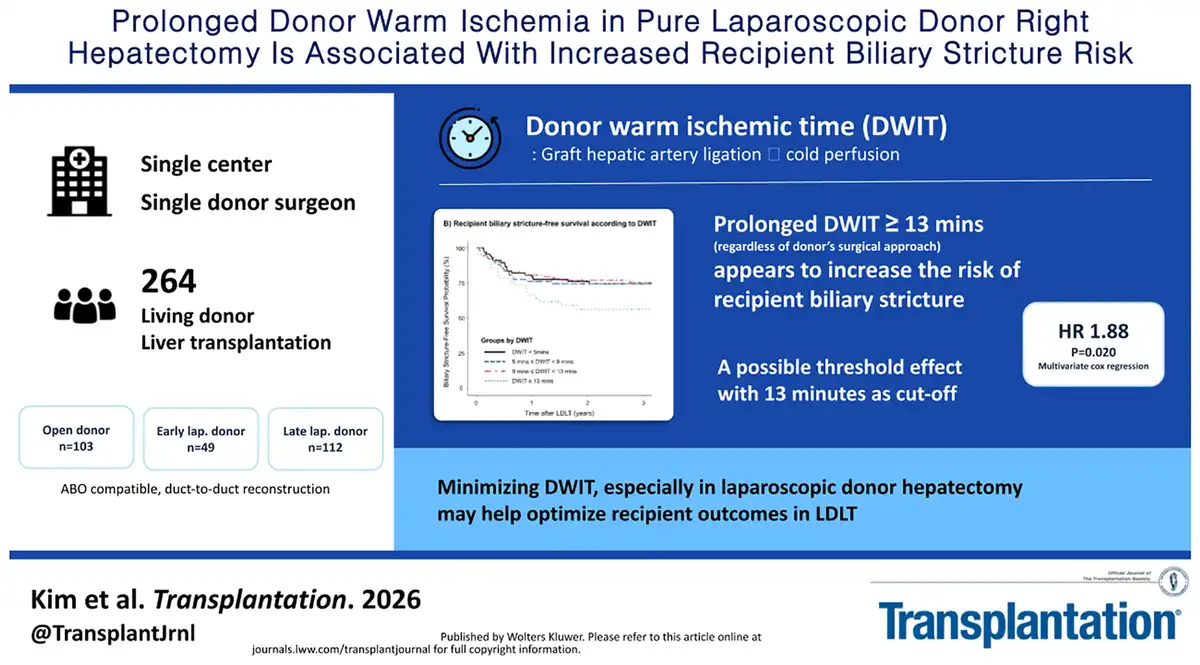
Prolonged donor warm ischemic time (DWIT) during PLDRH correlates with increased recipient biliary stricture risk.
A DWIT of 13 minutes or more independently predicts higher incidence of biliary strictures post-transplant.
Minimizing DWIT during laparoscopic donor hepatectomy may improve recipient biliary outcomes and graft longevity.
Study Background
Living donor liver transplantation (LDLT) has become a critical intervention for patients with end-stage liver disease, offering survival advantages over deceased donor transplantation in regions with organ shortages. Right hepatectomy from living donors provides adequate liver volume for adult recipients. Recently, pure laparoscopic donor right hepatectomy (PLDRH) gained traction due to its minimally invasive nature, reduced donor morbidity, and faster recovery. Despite established donor safety, concerns remain about how this surgical approach impacts recipient outcomes, particularly biliary complications, which remain a leading cause of morbidity post-transplant.
Biliary strictures after LDLT can lead to recurrent cholangitis, graft dysfunction, and need for repeated interventions. Donor warm ischemic time (DWIT)—the period from arterial ligation to cold perfusion during procurement—is hypothesized to affect bile duct viability due to ischemic injury, potentially predisposing recipients to biliary strictures.
Understanding whether prolonged DWIT during PLDRH influences recipient biliary complications is pivotal for optimizing surgical strategies and enhancing graft outcomes.
Study Design
This retrospective cohort study analyzed 264 consecutive LDLT procedures performed by a single experienced surgeon between 2011 and 2023. Donor hepatectomies were categorized into three groups based on the surgical approach and temporal experience: open donor hepatectomy (group O; n=103), early period laparoscopic donor hepatectomy (group EL; n=49), and late period laparoscopic donor hepatectomy (group LL; n=112).
All recipients were ABO-compatible and underwent duct-to-duct biliary reconstruction. Donor warm ischemic time (DWIT) was precisely defined as the interval between hepatic artery ligation and initiation of cold perfusion to the graft.
Recipients were followed for at least one year, and the primary outcome was the development of biliary strictures requiring intervention. Statistical analyses included Kaplan-Meier survival curve comparisons for biliary stricture-free survival, receiver operating characteristic (ROC) curve analysis to identify an optimal DWIT cutoff, and multivariate Cox regression to identify independent predictors of biliary stricture.
Key Findings
The study found no statistically significant difference in biliary stricture-free survival across the open, early laparoscopic, and late laparoscopic groups (P=0.278), indicating that the surgical approach alone was not the determinant factor.
ROC analysis demonstrated that a DWIT cutoff of 12.5 minutes could discriminate increased biliary stricture risk (area under the curve 0.543; P=0.043), albeit with modest predictive ability.
Importantly, in multivariate analysis adjusting for confounders, a DWIT of 13 minutes or longer was independently associated with a higher risk of recipient biliary stricture (hazard ratio 1.88; P=0.020). This nearly doubled the risk compared to DWIT below 13 minutes.
These findings emphasize that while PLDRH is generally safe and progressively refined, prolonged warm ischemia during donor hepatectomy constitutes a modifiable risk factor for downstream biliary complications.
Expert Commentary
Biliary complications post-LDLT remain a formidable challenge despite advances in surgical technique. This study provides valuable evidence that prolonged DWIT during laparoscopic right hepatectomy significantly contributes to recipient biliary strictures. The importance of DWIT likely stems from ischemia-reperfusion injury to delicate biliary epithelium and peribiliary vascular plexus, which are vulnerable to hypoxia.
The single-surgeon design ensures consistency in surgical technique but may limit generalizability. The retrospective nature precludes establishing causality, and the ROC curve area implies other factors also contribute to biliary risk. Nonetheless, the data align with biological plausibility and prior literature associating ischemic insult to the biliary tree with postoperative stricture.
These findings underscore the need for surgical teams to implement optimized protocols to minimize DWIT, including improved vascular control and expedited cold perfusion during laparoscopic hepatectomy, without compromising donor safety.
Conclusion
Pure laparoscopic donor right hepatectomy represents a landmark advancement in living donor liver transplantation, offering donor benefits without compromising overall recipient outcomes. However, this study identifies prolonged donor warm ischemic time as an important, independent predictor of recipient biliary stricture.
Minimizing DWIT—keeping it under 13 minutes—during laparoscopic donor right hepatectomy should be a surgical priority to reduce biliary complications. This optimization can improve graft function, recipient quality of life, and long-term transplant success.
Future prospective, multicenter studies are warranted to validate these findings and integrate them into standardized donor hepatectomy protocols. Enhanced intraoperative strategies such as real-time ischemic monitoring may further refine surgical safety in minimally invasive donor liver procurement.
Funding and Clinical Trial Registration
The original study details do not specify funding sources or clinical trial registration.
References
1. Kim G, Lee KW, Kim MK, et al. Prolonged Donor Warm Ischemia in Pure Laparoscopic Donor Right Hepatectomy Is Associated With Increased Recipient Biliary Stricture Risk: A Retrospective Cohort Study. Transplantation. 2026 Oct 12; PMID: 42862884.
2. Troisi RI, Fondevila C. Minimally invasive living donor hepatectomy: current status and future directions. Liver Transpl. 2020;26(2):291-299.
3. Ghobrial RM, Ejaz A, Pruett TL. Donor complications in living donor liver transplantation. Liver Transpl. 2016;22(1):12-18.
4. Radtke A, Eisele R, Hoang SA, et al. Biliary complications after liver transplantation: a current overview. Clin Transplant. 2019;33(12):e13646.
5. Feng S, Goodrich NP, Bragg-Gresham JL, et al. Characteristics associated with liver graft failure: the concept of a donor risk index. Am J Transplant. 2006;6(4):783-790.