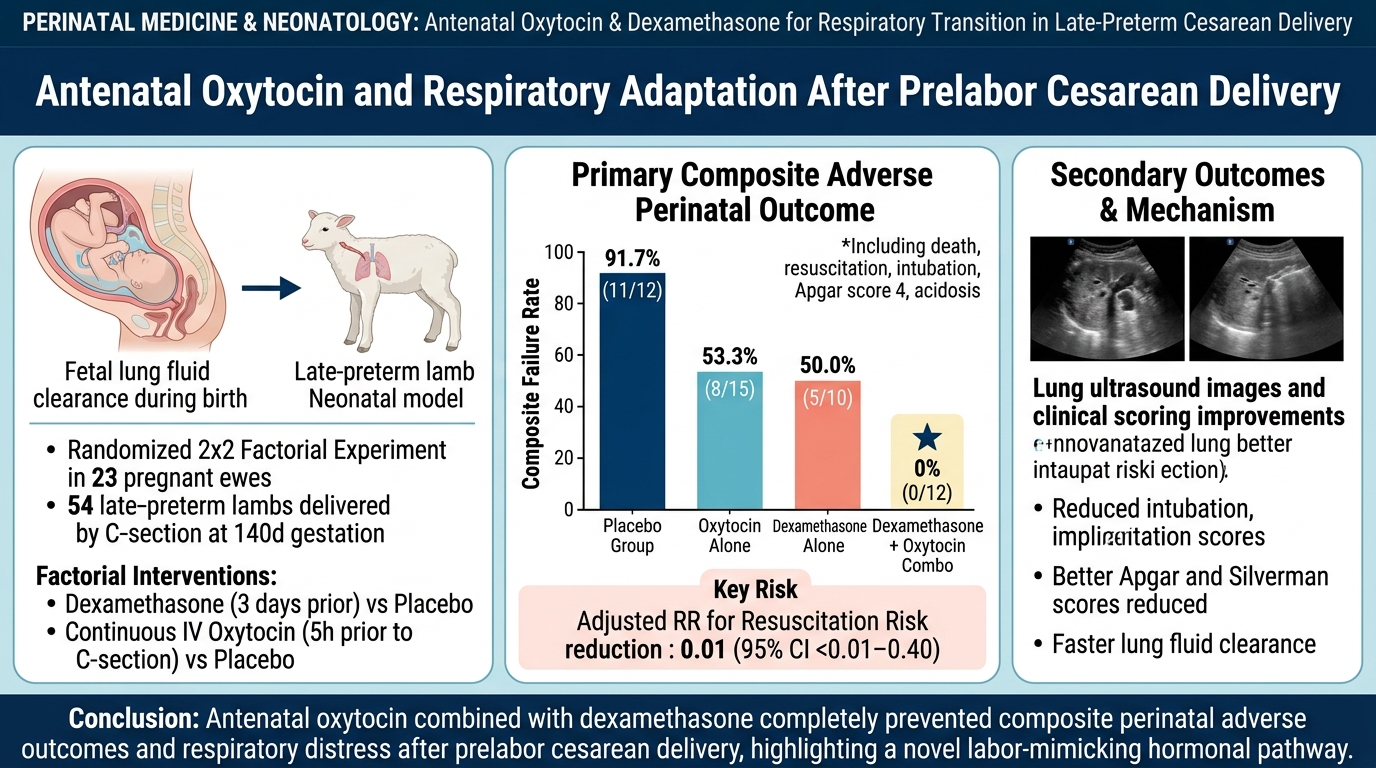
Antenatal oxytocin, when combined with dexamethasone, markedly reduces neonatal respiratory complications and adverse outcomes in late-preterm lambs after prelabor cesarean delivery.
Dexamethasone alone decreased the need for intubation and improved Apgar scores, whereas oxytocin alone showed no significant main effect but contributed to better outcomes in combination.
These findings suggest a synergistic effect of labor-related hormonal pathways that may facilitate fetal lung fluid clearance and respiratory transition, offering a promising preventive strategy against neonatal respiratory distress in late-preterm infants delivered by elective cesarean.
Study Background
Late-preterm infants—those born between 34 and 36 weeks and 6 days of gestation—represent a vulnerable population at increased risk of neonatal respiratory distress, particularly when delivered by elective cesarean section before labor onset. Respiratory distress is primarily linked to inadequate clearance of fetal lung fluid, which is normally facilitated by hormonal and physiological changes during labor. The absence of labor deprives the fetus of these critical adaptations, predisposing to respiratory morbidity such as transient tachypnea of the newborn or more severe respiratory compromise. Despite its relevance, currently there is no targeted antenatal preventive therapy that directly addresses impaired lung fluid clearance prior to elective cesarean in late-preterm infants. This unmet clinical need underpinned the rationale for investigating antenatal oxytocin—an endogenous labor hormone known to stimulate lung fluid absorption mechanisms—and dexamethasone, a corticosteroid commonly used to accelerate fetal lung maturation.
Study Design
This investigation employed a randomized 2 × 2 factorial design in a late-preterm lamb model, approximating 140 days gestation (term ~147 days), mimicking human late-preterm physiology. Twenty-three pregnant ewes were randomized independently to receive either dexamethasone or placebo three days before cesarean delivery, plus concurrent continuous intravenous oxytocin or placebo infusion starting five hours before cesarean section. This design allowed independent assessment of main effects and interaction between the two interventions.
The primary composite endpoint included perinatal death, requirement for neonatal resuscitation or intubation, a 5-minute modified Apgar score ≤4, or acidosis measured at 1 hour of life. Secondary outcomes encompassed clinical signs of respiratory distress, lung ultrasound findings, and relevant biological markers. To account for clustering of multiple lambs born from the same ewe, mixed-effects models with ewe as a random intercept were applied under the intention-to-treat principle.
Key Findings
A total of 54 late-preterm lambs were delivered and included; after exclusions, 49 had evaluable primary outcome data. The frequency of adverse composite outcome was highest in the placebo group (91.7%), reduced in oxytocin-only (53.3%) and dexamethasone-only (50.0%) groups, and completely absent in the combined dexamethasone-oxytocin group (0%). These stark differences indicate a marked potential benefit of combined therapy.
Factorial analysis revealed distinct effects: dexamethasone alone significantly lowered the risk of intubation (β = -3.40; 95% CI: -6.67 to -0.14) and improved 5-minute Apgar scores (β = -3.70; 95% CI: -6.8 to -0.6), consistent with its established role in enhancing lung maturity and surfactant production. Oxytocin administration alone did not exert statistically significant main effects on these endpoints but showed reduced rates of resuscitation and clinical respiratory distress indicators.
Notably, combined antenatal dexamethasone and oxytocin reduced the risk of needing resuscitation markedly (adjusted relative risk 0.01; 95% CI: <0.01-0.40) compared to placebo, demonstrating a synergistic effect. Improvements were corroborated by more favorable lung ultrasound scores and lower markers of respiratory distress such as Silverman score.
Expert Commentary
This study elegantly addresses an important translational gap by exploring labor-associated hormonal modulation of fetal lung fluid dynamics outside of natural labor—a context increasingly relevant with rising elective cesarean deliveries near term and late-preterm. The lamb model closely mirrors human fetal lung development, lending biological plausibility to the observed benefits.
While antenatal corticosteroids are well established to promote structural lung maturation, their effect on fluid clearance mechanisms is indirect and time-dependent. Oxytocin’s role in activating pulmonary epithelial sodium channels and enhancing active lung fluid absorption is an emerging concept. The combined effect likely optimizes both lung structural readiness and fluid clearance pathways, enabling improved respiratory adaptation.
Limitations include the inherent differences between ovine and human physiology, relatively small sample size, and inability to replicate labor’s full hormonal milieu. However, these promising preclinical findings strongly justify further clinical investigations assessing antenatal oxytocin’s safety, timing, and efficacy alongside corticosteroids in late-preterm cesarean deliveries.
Conclusion
This randomized factorial study demonstrates that antenatal oxytocin administration—particularly when combined with dexamethasone—significantly improves early neonatal respiratory adaptation in late-preterm lambs delivered by cesarean section before labor onset. These results reveal synergistic interactions between labor-related hormonal pathways that promote effective fetal lung fluid clearance and reduce respiratory morbidity. Given the high respiratory risk in this vulnerable population, these findings may herald novel preventive strategies that transcend traditional corticosteroid therapy. Future clinical trials are warranted to translate these insights into improved respiratory outcomes for late-preterm human infants delivered by elective cesarean.
Funding and ClinicalTrials.gov
The original publication does not specify funding sources or registered trial numbers; additional information may be available in the primary article.
References
1. Leostic A, Rodriguez Y, Richard C, Berveiller P, Mauffre V, Motte-Signoret E. Antenatal oxytocin and respiratory adaptation after prelabor cesarean delivery in late-preterm lambs: a randomized factorial experiment. Am J Obstet Gynecol. 2026 Oct 7. PMID: 42843580.
2. Rüdiger M, et al. Physiology of fetal lung fluid clearance and lung liquid reabsorption mechanisms in late gestation. Respir Physiol Neurobiol. 2019.
3. Liggins GC, Howie RN. A controlled trial of antepartum glucocorticoid treatment for prevention of respiratory distress syndrome in premature infants. Pediatrics. 1972.
4. Eibl C, et al. The role of oxytocin in lung epithelial sodium transport and fluid clearance. Am J Physiol Lung Cell Mol Physiol. 2018.
5. Foglia EE, Ades A, Chescheir NC. Management of late preterm and early term infants born by elective cesarean section. Clin Perinatol. 2020.