Highlight
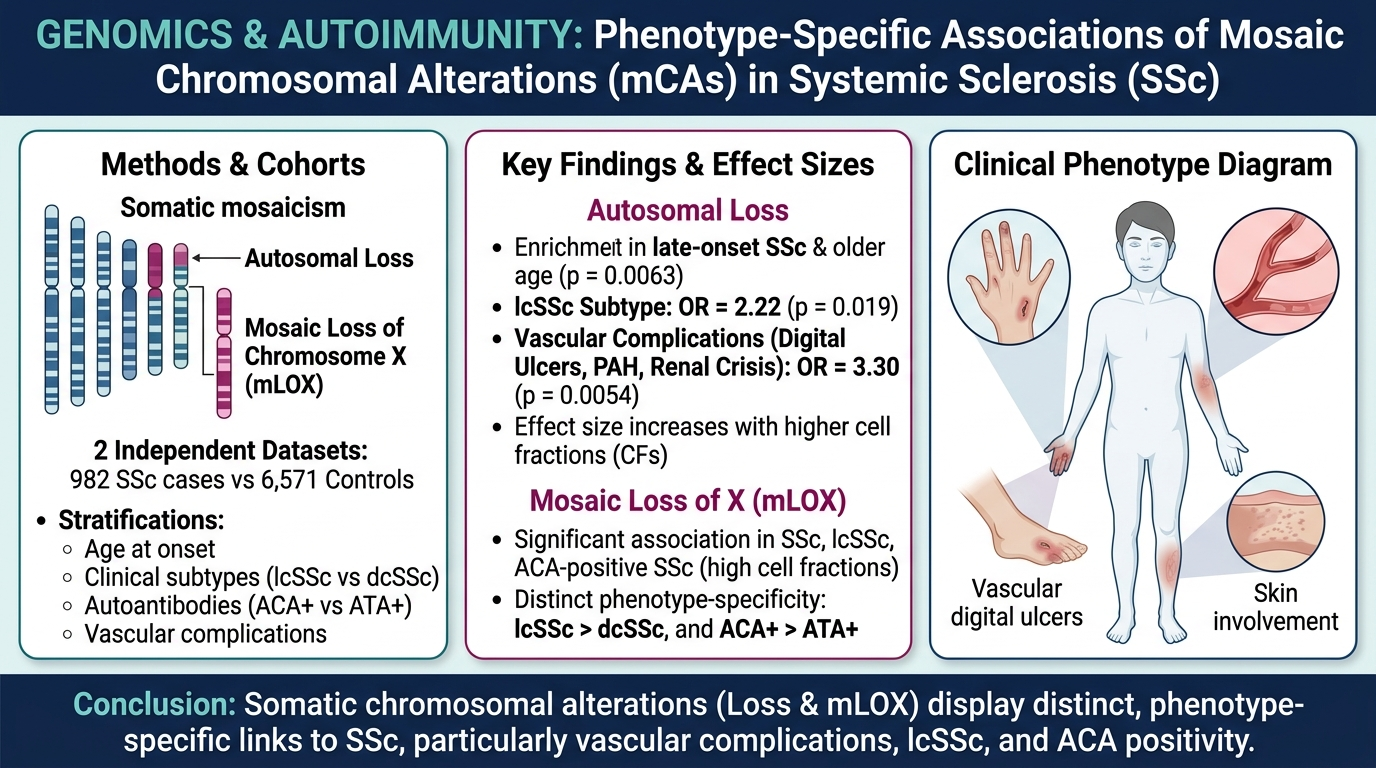
- Mosaic chromosomal alterations (mCAs), including chromosomal loss and mosaic loss of the X chromosome (mLOX), are associated with systemic sclerosis (SSc) and its clinical subtypes.
- Chromosomal loss is particularly linked to limited cutaneous systemic sclerosis (lcSSc) and SSc cases with vascular complications such as digital ulcers, pulmonary hypertension, or renal crisis.
- mLOX shows significant association with lcSSc and anticentromere antibody-positive SSc, especially in patients with higher cell fractions of affected blood cells.
- Most of these associations are driven by late-onset SSc, underlining the possible age-related genetic contributions to disease heterogeneity.
Study Background
Systemic sclerosis (SSc) is a complex autoimmune connective tissue disease characterized by skin fibrosis, vascular abnormalities, and internal organ involvement. The clinical presentation is heterogeneous and is broadly categorized into limited cutaneous systemic sclerosis (lcSSc) and diffuse cutaneous systemic sclerosis (dcSSc), often associated with distinct autoantibody profiles and complications. Despite advances in understanding its immunopathogenesis, the genetic and molecular mechanisms contributing to disease heterogeneity remain incompletely understood. Mosaic chromosomal alterations (mCAs) refer to structural chromosomal changes affecting a subset of cells, typically detected in peripheral blood. These alterations, including chromosomal losses, gains, copy-neutral loss of heterozygosity (LOH), and mosaic loss of the X chromosome (mLOX), increase with age and have been linked to hematological malignancies and autoimmune conditions. Their role in systemic sclerosis and varied clinical phenotypes has not been extensively characterized, presenting an unmet need to clarify the genetic drivers and potential pathophysiologic mechanisms that underpin SSc heterogeneity.Study Design
This investigation involved two independent cohorts comprising 635 SSc patients with 4,401 controls (set 1) and 347 SSc patients with 2,170 controls (set 2). Peripheral blood samples from all subjects were analyzed to detect various types of mCAs, including chromosomal loss, gain, copy-neutral LOH, and mLOX. The study leveraged logistic regression models with adjustment for relevant covariates to characterize associations between mCAs and SSc, followed by meta-analysis of the two datasets to consolidate findings. Further stratified analyses examined these relationships across age strata, age at disease onset, skin lesion-based clinical subtypes (lcSSc versus dcSSc), autoantibody profiles (anticentromere antibody [ACA] positive and anti-topoisomerase I antibody [ATA] positive), and specific vascular complications such as digital ulcers, pulmonary hypertension, and scleroderma renal crisis.Key Findings
General Association of Chromosomal Loss with SSc and Aging: The study observed a significant trend toward increased chromosomal loss in SSc patients, particularly prominent in older individuals (P = .0063). This suggests that chromosomal loss as a mosaic alteration may accumulate or contribute more substantially in the aging SSc population. Phenotype-Specific Associations of Chromosomal Loss: The association between chromosomal loss and SSc was augmented in the limited cutaneous subtype (lcSSc), with an odds ratio (OR) of 2.22 (P = .019). Furthermore, SSc patients experiencing vascular complications such as digital ulcers, pulmonary hypertension, or renal crisis showed a stronger association with chromosomal loss (OR = 3.30, P = .0054). These effects were even more pronounced in patients with higher cell fractions harboring loss, implying a dose-dependent relationship. Mosaic Loss of the X Chromosome (mLOX) Associations: mLOX exhibited significant associations with SSc overall and was particularly linked to lcSSc and anticentromere antibody–positive SSc (ACA-SSc). Notably, this association was restricted to individuals with high mosaic cell fractions. Comparative analyses also demonstrated that mLOX was more strongly associated with lcSSc versus dcSSc and ACA-SSc versus ATA-SSc, respectively. These findings were consistent across both independent cohorts. Influence of Age at Disease Onset: Most significant associations between chromosomal loss and SSc subtypes appeared driven by patients with a later age at disease onset, highlighting the importance of aging-related genetic mosaicism in disease phenotype and progression.Expert Commentary
This study provides compelling evidence that mosaic chromosomal alterations, long recognized in hematologic malignancies and aging, also contribute distinctly to systemic sclerosis and its clinical subtypes. The identification of phenotype-specific associations, especially increased chromosomal loss and mLOX with lcSSc and vascular complications, introduces new perspectives on the biological heterogeneity of SSc. The observed stronger associations in older patients and those with late-onset disease align with the concept that age-related clonal hematopoiesis or genomic instability may influence autoimmune pathophysiology. Chromosomal loss and mLOX represent different underlying mechanisms; for example, mLOX is a recognized driver of hematopoietic clonal expansion in females and has been linked to immune dysregulation, potentially explaining its selective association with ACA-positive lcSSc. Limitations of the study include reliance on peripheral blood samples, which may not fully capture tissue-specific mosaicism or direct pathogenic mechanisms in skin and other organs affected in SSc. Further mechanistic work is warranted to elucidate how these mCAs modulate immune responses or vascular remodeling in SSc. Additionally, longitudinal studies would help clarify the temporal relationship between mCAs emergence and clinical disease course.Conclusion
The detailed investigation of mosaic chromosomal alterations reveals their significant and phenotype-specific associations with systemic sclerosis subtypes. Chromosomal loss and mosaic loss of the X chromosome emerge as important genetic contributors, particularly in lcSSc, ACA-positive cases, and those with vascular complications, predominantly in older patients and late-onset disease. These findings enhance understanding of SSc pathobiology, emphasizing the contributions of acquired genetic mosaicism to disease heterogeneity and vascular pathology. They also underscore the potential for mCAs to serve as biomarkers for stratifying SSc phenotypes and guiding precision approaches to management. Future research exploring the mechanistic implications of mosaic chromosomal alterations may unlock novel therapeutic targets to improve outcomes in systemic sclerosis.Funding and Clinical Trials
The study was funded by institutional and governmental research grants supporting autoimmune genomic research. No clinical trial registration was reported.References
- Nishio Y et al. Phenotype-specific associations of mosaic chromosomal alterations in systemic sclerosis. Ann Rheum Dis. 2026 Jul 9;85(10):2022-2032. PMID: 42425799.
- Bick AG, Weinstock JS, Nandakumar SK, et al. Inherited causes of clonal haematopoiesis in 97,691 whole genomes. Nature. 2020;586(7831):763-768.
- Nguyen TH, Perbal B. Biological pathways in systemic sclerosis. FEBS Lett. 2015;589(22):3194-3204.