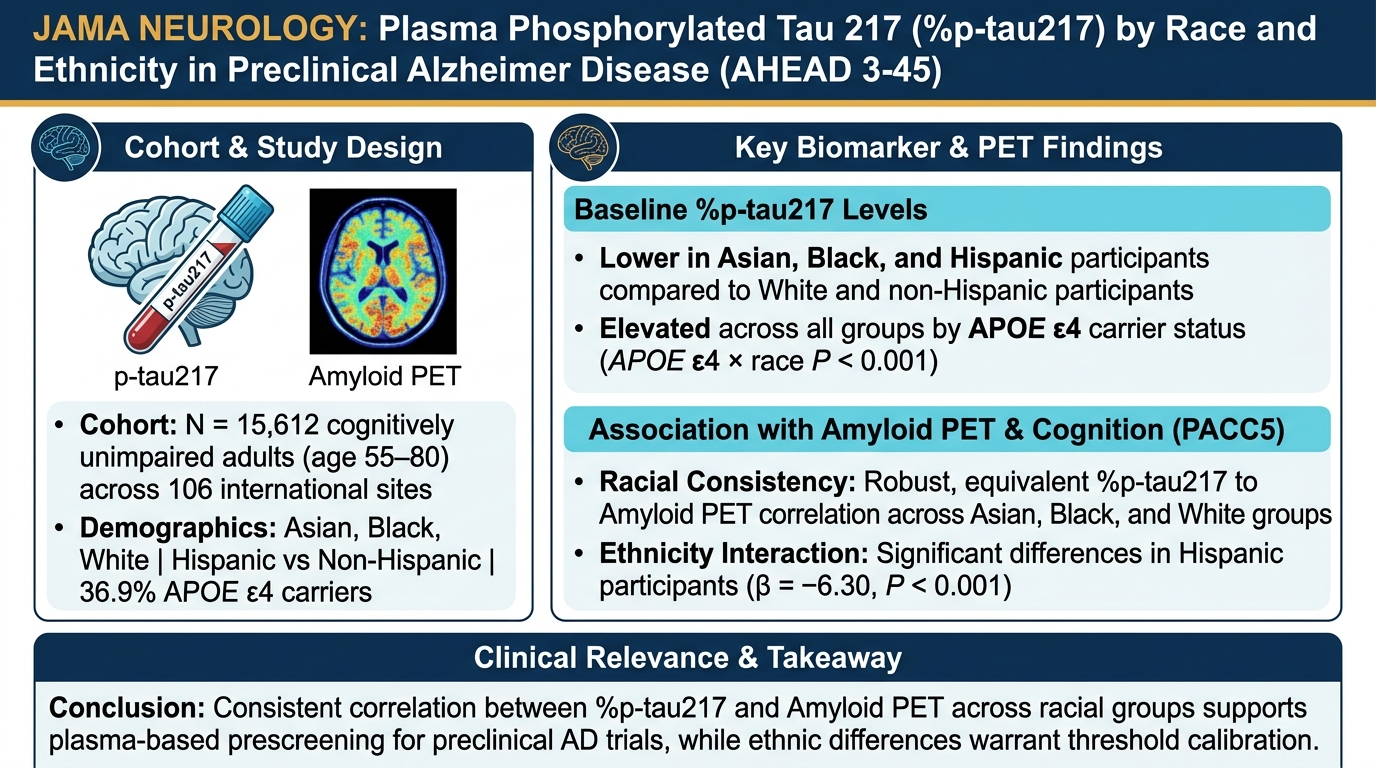
Plasma %p-tau217 levels differ significantly across racial and ethnic groups in preclinical Alzheimer disease (AD), with lower levels observed in Asian, Black, and Hispanic populations compared to White and non-Hispanic groups.
APOE ε4 carrier status consistently associates with higher %p-tau217 levels, but the strength of this association varies by race and ethnicity, indicating genetic and demographic influences on biomarker expression.
Despite biomarker level variances, associations between %p-tau217 and cognitive performance (PACC5 score) and amyloid PET imaging are largely consistent across racial groups, supporting plasma %p-tau217 as a useful screening tool before confirmatory PET imaging.
Ethnicity-based differences in biomarker and outcome associations underscore the need for further research to ensure equitable diagnostic accuracy and trial inclusivity.
Background
Alzheimer disease (AD) is a neurodegenerative disorder characterized by progressive cognitive decline and pathological hallmarks including amyloid-β plaques and neurofibrillary tangles formed by phosphorylated tau proteins. Early detection, particularly at the preclinical stage (presence of amyloid pathology without overt cognitive symptoms), is critical for timely intervention and enrollment in clinical trials. Plasma biomarkers, such as phosphorylated tau 217 (p-tau217), have emerged as minimally invasive, scalable tools for identifying preclinical AD pathology. However, racial and ethnic variations in biomarker levels may influence screening eligibility and diagnostic accuracy, potentially exacerbating health disparities. Understanding these differences is essential for optimizing AD biomarker utility across diverse populations.
Key Content
Plasma p-tau217 as a Biomarker in Alzheimer Disease
Phosphorylated tau 217 in blood plasma reflects AD-related tau pathology and correlates strongly with amyloid PET positivity and cognitive decline. Recent analytical advances enable sensitive quantification of p-tau217, facilitating its integration as a screening biomarker. For example, validated chemiluminescence immunoassays and digital single-molecule sensing platforms provide reliable measurements with high accuracy and specificity (Clin Chim Acta. 2027 Feb;42668129; 42556454).
Race and Ethnicity-Based Variations in %p-tau217 Levels
The study by Molina-Henry et al. (JAMA Neurol. 2026 Oct;42862590) analyzed plasma %p-tau217 across 15,612 adults aged 55-80 years in the AHEAD 3-45 screening cohort. They found:
Lower %p-tau217 levels in Asian, Black, and Hispanic participants compared to White and non-Hispanic individuals.
APOE ε4 allele carriers exhibited higher %p-tau217 levels universally, with a significant interaction between APOE ε4 status and race/ethnicity influencing biomarker levels.
This indicates that both genetic and demographic factors modulate plasma biomarker expression, which can have implications for screening thresholds and trial inclusivity.
Associations of %p-tau217 with Cognitive Outcomes and Amyloid PET
The study also assessed the relationship between %p-tau217, cognitive performance measured by the Preclinical Alzheimer Cognitive Composite 5 (PACC5), and amyloid PET across racial and ethnic groups:
Consistent associations between %p-tau217 and PACC5 scores were observed across racial groups, suggesting that plasma %p-tau217 reliably reflects cognitive status irrespective of race.
Association between %p-tau217 and amyloid PET was similarly consistent across races.
However, ethnicity-related differences were noted in these associations, with Hispanic ethnicity modifying the relationship between %p-tau217 and both PACC5 performance and amyloid PET positivity.
These findings advocate for plasma %p-tau217-based screening strategies prior to PET confirmation but highlight the need for ethnicity-specific considerations.
Methodological Context and Related Evidence
The use of large, geographically and racially diverse cohorts strengthens the evidence for biological variability in plasma tau biomarkers. Analytical validation studies (Clin Chim Acta, 2027) emphasize assay precision across populations, critical for generalizability. Other plasma biomarkers (p-tau181, GFAP, NfL) also demonstrate racial variations, underscoring systemic considerations in biomarker development.
Expert Commentary
The observed racial and ethnic differences in plasma %p-tau217 levels reflect a complex interplay of genetic factors, environmental exposures, and social determinants that influence AD biomarker expression and pathophysiology. That APOE ε4 impacts %p-tau217 variably across groups suggests allele penetrance and its downstream pathological effects differ, potentially affecting risk stratification.
The consistency of %p-tau217 correlations with cognitive and PET markers across racial groups supports its robustness as a screening tool in multiethnic populations, facilitating equitable access to early diagnosis. Yet, the ethnicity-specific interaction effects warrant further mechanistic studies and replication to refine biomarker thresholds and predictive models.
Practically, these data call for caution in applying universal biomarker cutoffs, advocating for racially and ethnically calibrated norms to optimize diagnostic sensitivity and specificity. Clinical guidelines may need to reflect these nuances to avoid under- or over-diagnosis in underrepresented populations.
Conclusion
Plasma phosphorylated tau 217 percentage (%) exhibits significant variation by race and ethnicity in preclinical Alzheimer disease, influenced by APOE ε4 status. Despite biomarker variance, the stable association with cognitive decline and amyloid deposition across racial groups supports the use of plasma %p-tau217 as a valuable screening modality before costly amyloid PET imaging. However, ethnic-specific differences in biomarker associations highlight a critical area for future research to ensure equitable diagnostic accuracy and trial representation. Advancing sensitive, validated plasma assays combined with epidemiologic and mechanistic insights will enhance precision medicine approaches in Alzheimer disease across diverse populations.
References
Molina-Henry DP, Liu A, Langford O, et al. Plasma Phosphorylated Tau 217 Percentage by Race and Ethnicity in Preclinical Alzheimer Disease. JAMA Neurol. 2026 Oct 12; PMID: 42862590. https://pubmed.ncbi.nlm.nih.gov/42862590/
Chen Y, Zhu L, Huang F, et al. Analytical validation and clinical performance of a chemiluminescence immunoassay panel for plasma biomarkers in Alzheimer’s disease: a preliminary study. Clin Chim Acta. 2027 Feb 15;593:121300. PMID: 42668129.
Wang J, Zhang Q, Liu C, et al. An accessible digital single-molecule sensing platform for plasma P-tau217 quantification in Alzheimer’s disease screening. Clin Chim Acta. 2027 Feb 15;593:121255. PMID: 42556454.