Highlight
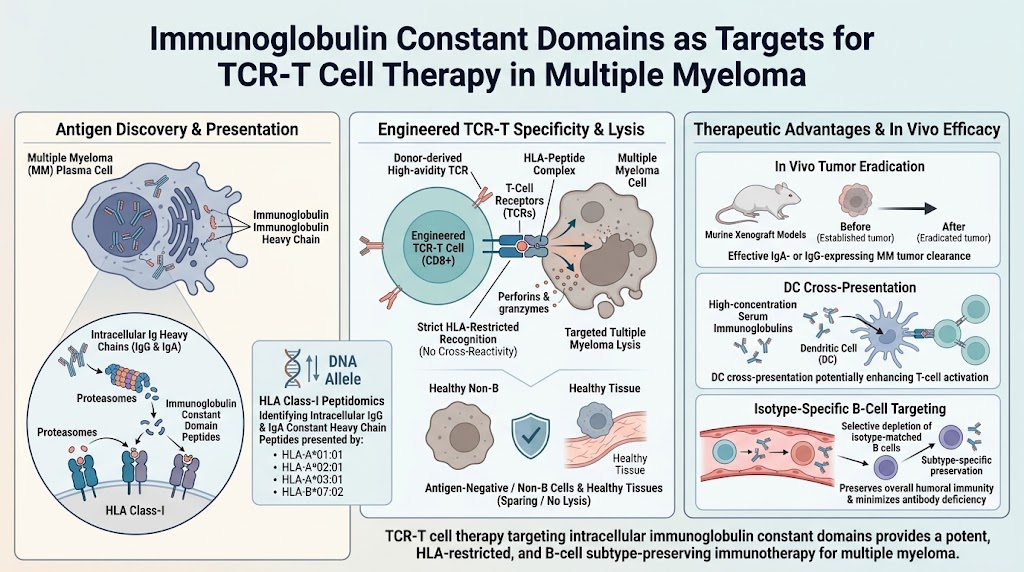
1. Identification of immunoglobulin G- and A-derived peptides presented by common HLA class I alleles allows new TCR-based targeting of intracellular antigens in multiple myeloma (MM). 2. Engineered T cells expressing high-avidity TCRs selectively recognize and eradicate IgG- or IgA-expressing MM cells while sparing antigen-negative and non-B-lineage cells. 3. Safety profiling reveals strict HLA-restricted specificity, with limited off-target effects except expected depletion of isotype-matched B cells, suggesting potential preservation of humoral immunity. 4. Ex vivo and xenograft models confirm potent anti-myeloma efficacy, highlighting a promising new avenue for cellular immunotherapy in MM and other immunoglobulin-producing diseases.
Study Background
Multiple myeloma is a malignant plasma cell disorder characterized by clonal proliferation within the bone marrow, leading to significant morbidity and mortality. Despite advances in treatment, including proteasome inhibitors, immunomodulatory agents, monoclonal antibodies, and more recently chimeric antigen receptor (CAR) T-cell therapies, MM remains largely incurable and relapse is common. CAR T-cell therapies targeting surface antigens such as BCMA have shown impressive responses but are limited by antigen escape and durability. There is therefore an unmet need for novel immunotherapeutic strategies that expand the repertoire of targetable tumor antigens and mitigate relapse.
Study Design
This study used HLA class I peptidomics to identify peptides derived from the constant domains of immunoglobulin heavy chains presented on MM cells in the context of prevalent HLA alleles (HLA-A*01:01, HLA-A*02:01, HLA-A*03:01, HLA-B*07:02). High-avidity T-cell clones specific for 4 of these immunoglobulin-derived peptides were isolated from healthy HLA-mismatched donors. The T-cell receptor (TCR) genes from these clones were introduced into donor T cells, creating immunoglobulin-specific TCR-engineered T cells. Functional assays evaluated recognition, cytotoxicity, and specificity against MM cell lines, healthy tissues, and other tumor types. Safety profiling and cross-reactivity assessments were performed. Ex vivo patient-derived MM cells and murine xenograft models were employed to examine therapeutic efficacy. Mechanistic studies assessed antigen cross-presentation by dendritic cells.
Key Findings
First, nine immunoglobulin G (IgG)- or immunoglobulin A (IgA)-derived peptides naturally presented by MM cells were identified across common HLA alleles. Notably, four peptides elicited high-avidity T-cell responses. Transduction of donor T cells with immunoglobulin-specific TCRs conferred potent recognition and selective killing of IgG- or IgA-expressing MM cell lines, sparing antigen-negative hematopoietic and non-B-lineage cells.
Importantly, this cytotoxicity was strictly restricted to the cognate HLA allele without cross-reactivity, minimizing the risk of off-target effects. Safety assays demonstrated no recognition of other HLA alleles or non-B lineage cells, with the exception of depletion of isotype-matched normal B cells, consistent with target antigen expression.
Ex vivo experiments with patient-derived MM cells verified efficient lysis by immunoglobulin-TCR T cells, and in vivo murine xenograft models showed eradication of established IgG- or IgA-positive MM tumors, supporting translational potential.
Mechanistic exploration revealed that dendritic cells can cross-present immunoglobulin peptides in the presence of high serum immunoglobulin concentrations, which may amplify T-cell activation and therapeutic efficacy in vivo.
Expert Commentary
The authors present a compelling novel approach to TCR-based immunotherapy in MM, targeting intrinsic intracellular immunoglobulin heavy chain constant domains rather than variable or lineage-specific markers. This strategy addresses key issues in MM treatment by broadening antigenic targets and potentially limiting immune escape. The finding that immunoglobulin-TCR T cells selectively target MM cells and isotype-matched B cells implies an improved therapeutic index compared to pan-B-cell depletion approaches, which are associated with humoral immunodeficiency requiring antibody replacement.
While the preclinical data are promising, several considerations remain. The limited depletion of normal B cells may still impact humoral immunity, necessitating clinical monitoring and supportive care. The HLA restriction requires patient selection based on HLA typing, which could limit applicability. Furthermore, long-term safety and persistence of engineered T cells, potential for immunogenicity, and risk of tumor antigen heterogeneity will need careful evaluation in clinical trials.
Overall, the use of immunoglobulin constant domain-derived peptides as TCR targets demonstrates biological plausibility and translational promise. It represents a complementary mechanism to surface antigen targeting CAR-T approaches and may extend benefit to patients who develop resistance or relapse.
Conclusion
This study establishes immunoglobulin heavy chain constant domains as novel and promising targets for TCR-based cellular immunotherapy in multiple myeloma, with potential applications in other immunoglobulin-producing malignancies and autoimmune diseases mediated by autoantibodies. The approach offers selective cytotoxicity with an enhanced safety profile and potential preservation of humoral immunity compared to existing therapies. These findings pave the way for clinical development of immunoglobulin-TCR T-cell therapies, which may become an important addition to the MM treatment landscape and improve long-term disease control.
Funding and ClinicalTrials.gov
The study was supported by institutional and grant funding; detailed sources are listed in the original publication. As of the date of publication, no registered clinical trials of immunoglobulin-TCR T-cell therapy in MM were reported, highlighting the investigational status of this approach.
References
1. Meeuwsen MH, Wouters AK, Wellershoff JC, et al. Immunoglobulin constant domains as targets for T-cell receptor-based treatment of multiple myeloma. Blood. 2026 Oct 15;148(16):1998-2012. PMID: 42636156.
2. Munshi NC, Anderson LD Jr, Shah N, et al. CAR T cell therapy in multiple myeloma: State of the field and future directions. Nat Rev Clin Oncol. 2021;18(10):531-547.
3. Raje N, Berdeja J, Lin Y, et al. Anti-BCMA CAR T-cell therapy (idecabtagene vicleucel) in relapsed and refractory multiple myeloma. N Engl J Med. 2019;380(18):1726-1737.
4. Schietinger A, Greenberg PD. Tolerance and exhaustion: defining mechanisms of T cell dysfunction. Trends Immunol. 2014;35(2):51-60.