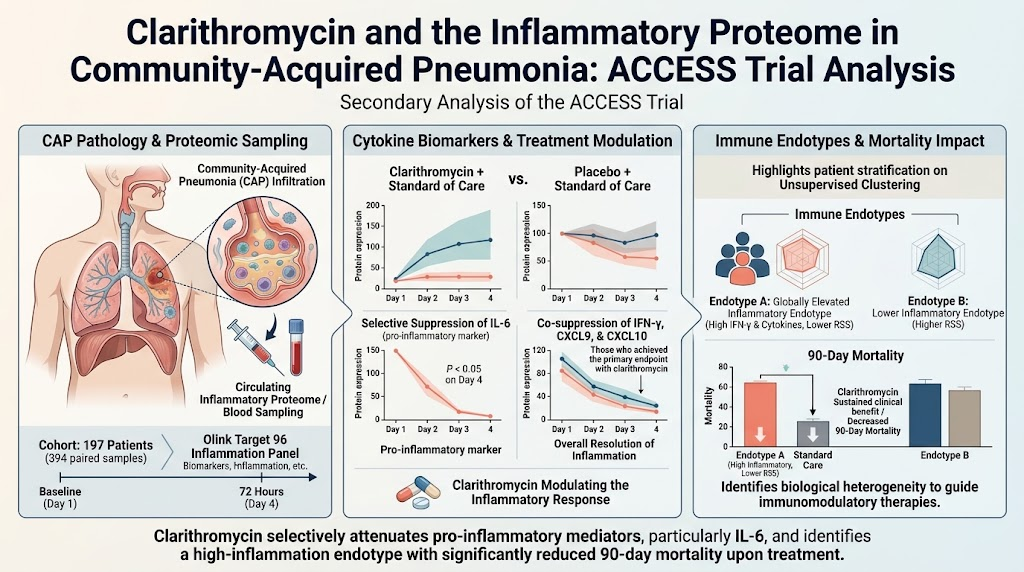
Clarithromycin adjunct treatment in community-acquired pneumonia (CAP) selectively reduces pro-inflammatory cytokines, notably IL6, accelerating clinical recovery and reducing organ dysfunction progression. Distinct inflammatory endotypes were identified, correlating with treatment response and mortality, supporting endotype-based precision immunomodulation strategies in CAP.
Study Background
Community-acquired pneumonia remains a prominent cause of morbidity and mortality worldwide, particularly in hospitalized adults. Despite effective antimicrobial therapies, some patients deteriorate due to excessive or dysregulated host inflammatory responses leading to organ dysfunction. Macrolide antibiotics like clarithromycin are hypothesized to provide benefits beyond antimicrobial activity by modulating inflammatory pathways. However, the precise nature of these immunomodulatory effects in CAP and their impact on patient subgroups remain incompletely understood. The ACCESS trial previously demonstrated clinical benefits of clarithromycin adjunct therapy, including accelerated recovery and reduced organ dysfunction. This secondary analysis seeks to elucidate the underlying inflammatory proteome changes associated with clarithromycin treatment and identify immune endotypes with differential clinical outcomes.
Study Design and Methods
This secondary analysis utilized serum samples obtained from the ACCESS randomized double-blind controlled trial. The cohort consisted of hospitalized adults with moderate to severe CAP randomized to standard-of-care therapy with or without adjunct clarithromycin. Serum inflammatory protein profiles were measured at baseline and 72 hours post-treatment initiation using the Olink Target 96 Inflammation panel, covering 70 inflammation-associated proteins after quality control.
Analytical methods included:
– Comparison of intra- and inter-group protein expression changes over time stratified by treatment arm and clinical endpoint achievement.
– Association analyses between inflammatory markers and clinical outcomes.
– Unsupervised clustering to define inflammatory endotypes based on proteomic profiles.
Primary clinical endpoints encompassed a composite measure including progression to organ dysfunction, while secondary endpoints considered mortality and clinical recovery parameters.
Key Findings
The analysis highlighted several key immunomodulatory effects of clarithromycin:
1. Selective Downregulation of IL6: On day 4 (72 hours), IL6 levels significantly decreased only in the clarithromycin arm, indicating targeted attenuation of this pivotal pro-inflammatory cytokine.
2. General Resolution Markers: IFN-γ, CXCL9, CXCL10, and stem cell factor (SCF) declined over time in both treatment arms, reflecting overall resolution of inflammation in CAP.
3. Differential Suppression in Primary Endpoint Achievers: Patients who achieved the composite primary endpoint (improved clinical outcome) had suppression of IL6, CXCL9, CXCL10, and IFN-γ predominantly in the clarithromycin-treated subgroup, underscoring a treatment-dependent immunomodulatory benefit.
4. Inflammatory Endotypes: Unsupervised clustering consistently identified two distinct inflammatory endotypes:
– One endotype was characterized by higher IFN-γ and globally elevated inflammatory protein expression but had lower Respiratory Severity Scores (RSS).
– The other endotype exhibited comparatively lower inflammatory activation.
Notably, clarithromycin treatment reduced 90-day mortality only in patients belonging to the endotype with higher inflammatory activity and lower RSS, suggesting biological heterogeneity that influences treatment responsiveness.
Interpretation and Mechanistic Insights
Clarithromycin’s immunomodulatory impact in CAP appears to center on downregulating key pro-inflammatory mediators, particularly IL6, a cytokine integrally involved in systemic inflammatory responses and cytokine storm phenomena. By tempering IL6 and IFN-γ-related pathways, clarithromycin may mitigate excessive host inflammation that leads to organ dysfunction.
The identification of distinct inflammatory endotypes supports the concept that CAP is not a homogenous disease but comprises biologically diverse phenotypes. Patients with a heightened yet controlled inflammatory profile may derive greater survival benefit from adjunct macrolide therapy. These findings advocate for a precision medicine approach where inflammatory proteomic profiling could guide individualized immunomodulatory strategies.
Expert Commentary
This study adds to the evolving narrative on the immunomodulatory roles of macrolides in respiratory infections. The rigorous biomarker-focused approach provides mechanistic validation of clinical observations from the ACCESS trial. While clarithromycin’s antimicrobial effects are well established, its capacity to selectively modulate cytokine networks suggests an added therapeutic dimension worth further prospective evaluation.
Limitations include the observational nature of the secondary analysis and the relatively short temporal window of biomarker assessment. Additionally, these findings require validation in diverse CAP populations and across different severities to ascertain generalizability. Future studies should examine whether real-time inflammatory endotyping can be operationalized in clinical practice to optimize treatment selection.
Conclusion
Adjunct clarithromycin therapy in hospitalized CAP patients modulates circulating inflammatory proteins, notably lowering IL6 and IFN-γ-related chemokines, thereby facilitating faster recovery and reduced organ dysfunction. The delineation of inflammatory endotypes with variable clinical outcomes highlights biological heterogeneity in CAP and underscores the potential of endotype-guided immunomodulatory therapy. These insights support integrating immunoprofiling into CAP management, paving the way for precision medicine approaches to enhance outcomes.
Funding and Clinical Trial Registration
The ACCESS trial and this secondary analysis were supported by institutional and grant funding as detailed in the primary publication (ClinicalTrials.gov NCT04724044, EudraCT 2020-004452-15).
References
Stylianakis E, Tsiakos K, Niotis G, et al. Effect of clarithromycin on the circulating inflammatory proteome in community-acquired pneumonia: a secondary analysis of the ACCESS trial. Chest. 2026 Oct 17. PMID: 42892349. DOI available through PubMed.
Additional relevant literature on macrolide immunomodulation in pneumonia and cytokine profiling can be accessed via PubMed.

 By
No Comments