Highlight
Garetosmab, an antibody blocking activin A, significantly reduces new heterotopic bone lesions in adults with fibrodysplasia ossificans progressiva (FOP). The phase 3 OPTIMA trial demonstrates a favorable safety profile, supporting its potential as the first effective disease-modifying therapy for FOP, a rare and profoundly disabling genetic disorder.
Study Background
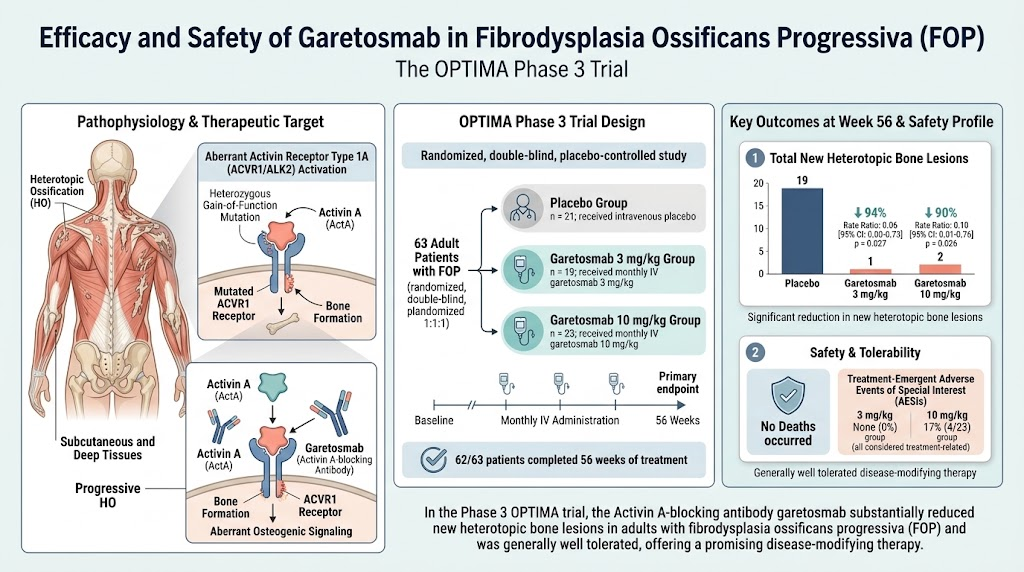
Fibrodysplasia ossificans progressiva (FOP) is an ultrarare, devastating genetic disorder characterized by progressive heterotopic ossification—the abnormal formation of bone outside the normal skeleton—affecting ligaments, tendons, and skeletal muscles. This pathological ossification leads to progressive immobility, physical disability, and ultimately early mortality, severely impacting quality of life. The condition is caused by heterozygous gain-of-function mutations in the activin receptor type 1A (ACVR1) gene. Normally, activin A (ActA) acts as an inhibitor of this receptor; however, in FOP, ACVR1 becomes aberrantly activated by ActA, which paradoxically drives the ossification process instead of inhibiting it.
Until recently, treatment options have been limited to symptomatic management, with no approved therapies that alter disease progression. Preclinical studies, along with an initial phase 2 trial (LUMINA-1), highlighted that blocking activin A with garetosmab, a monoclonal antibody, can prevent heterotopic ossification, grounding the rationale for further investigation in a larger, controlled setting.
Study Design
OPTIMA was a randomized, double-blind, placebo-controlled, phase 3 trial conducted across 18 sites in 16 countries and regions. It enrolled 63 adults (≥18 years) diagnosed with FOP. Participants were randomly assigned in a 1:1:1 ratio to one of three treatment arms: monthly intravenous placebo, garetosmab 3 mg/kg, or garetosmab 10 mg/kg. Randomization was stratified by baseline disease severity using the Cumulative Analogue Joint Involvement Scale and by prior participation in the LUMINA-1 trial.
The primary efficacy endpoint was the total number of new heterotopic bone lesions detected at week 56 of treatment. Safety evaluation focused on treatment-emergent adverse events of special interest (AESIs) during the same period. The trial enrolled 63 participants, with 62 completing the full 56 weeks of treatment.
Key Findings
The trial demonstrated that garetosmab substantially reduced new heterotopic ossification compared to placebo. Specifically, the placebo group developed 19 new heterotopic bone lesions over 56 weeks, whereas the garetosmab 3 mg/kg group had only one new lesion, and the 10 mg/kg group had two. These reductions translated into rate ratios of 0.06 (95% CI 0.00-0.73; p=0.027) and 0.10 (95% CI 0.01-0.76; p=0.026) for the two garetosmab doses versus placebo, respectively, indicating a statistically significant and clinically meaningful effect.
Regarding safety, treatment-emergent AESIs were infrequent and mostly mild. One participant (5%) in the placebo arm experienced an AESI, none were reported in the 3 mg/kg group, and four participants (17%) in the 10 mg/kg group had AESIs, all considered related to the treatment. Importantly, there were no deaths during the study, and overall garetosmab was generally well tolerated at both dosage levels.
Expert Commentary
OPTIMA is the first large-scale, controlled trial to demonstrate that targeting activin A with garetosmab can effectively inhibit pathologic heterotopic ossification in FOP patients. The trial’s design is robust, with international multi-center scope and stratification based on baseline disease severity and prior trial exposure, enhancing the generalizability of the findings.
The magnitude of reduction in new lesions is remarkable, suggesting that blocking activin A signaling interrupts the aberrant osteogenic signaling cascade, consistent with the underlying pathogenic mechanism. Nevertheless, longer-term data are needed to assess sustained efficacy and safety, as well as the impact on clinical outcomes such as mobility, pain, and quality of life.
Limitations include the relatively small sample size inherent to rare diseases and the short follow-up period. Furthermore, AESIs at the higher dose of garetosmab underscore the need for vigilance in monitoring, although no severe safety signals emerged.
This study represents a major advance toward the first disease-modifying treatment for FOP, a condition where therapeutic options have been virtually nonexistent.
Conclusion
The OPTIMA phase 3 trial provides compelling evidence that garetosmab, an activin A-blocking antibody, significantly decreases the formation of new heterotopic bone lesions in adults living with FOP and has an acceptable safety profile. These findings support garetosmab as a landmark therapeutic option in this ultra-rare, disabling disorder, offering hope for altering the natural history of FOP. Future studies are warranted to evaluate long-term outcomes and to expand understanding of optimal treatment regimens.
Funding and Registration
This study was funded by Regeneron Pharmaceuticals. It is registered on ClinicalTrials.gov under the identifier NCT05394116.
References
Papa R, Rhee S, Delai P, et al. Efficacy and safety of garetosmab, an activin A-blocking antibody, in fibrodysplasia ossificans progressiva (OPTIMA): a randomised, double-blind, placebo-controlled, phase 3 trial. Lancet. 2026;408(10564):1583-1592. PMID: 42805227.
Kawano H, et al. Pathogenesis and targeted treatment of fibrodysplasia ossificans progressiva. Nat Rev Rheumatol. 2021;17(4):195-207.
Merrill AE, et al. Activin A and FOP: Targeting a ligand-induced derangement of the BMP pathway. Annu Rev Genomics Hum Genet. 2019;20:179-203.