Withdrawal of low-dose digoxin in heart failure patients significantly increased cardiovascular events compared to placebo withdrawal.
Digoxin discontinuation led to acute clinical deterioration, including higher hospitalization rates and worsening symptoms within six weeks.
Physiological changes post-withdrawal included increased heart rate, decreased systolic blood pressure, and raised NT-proBNP levels, indicating heart failure exacerbation.
Findings suggest cautious clinical consideration before stopping digoxin in patients with reduced or mildly reduced ejection fraction on contemporary guideline-directed medical therapy.
Study Background
Heart failure (HF) remains a major public health challenge globally, with high morbidity and mortality despite advances in pharmacologic therapy aimed at neurohormonal modulation. Digoxin, a cardiac glycoside, historically played a pivotal role in HF management by improving symptoms and reducing hospitalizations primarily through inotropic and neurohormonal effects. However, its role in current treatment algorithms has become controversial due to the availability of other effective agents and concerns about toxicity. It has thus become common in clinical practice to reconsider or withdraw digoxin once patients are stabilized on contemporary guideline-directed medical therapy, such as beta-blockers, angiotensin-converting enzyme inhibitors, angiotensin receptor-neprilysin inhibitors, mineralocorticoid receptor antagonists, and sodium-glucose cotransporter 2 inhibitors.
Despite widespread use, limited prospective data exist regarding the safety of withdrawing digoxin in this setting. The DECISION trial was designed to address this evidence gap by evaluating the clinical consequences of blinded withdrawal of low-dose digoxin or placebo in patients with chronic HF and reduced or mildly reduced left ventricular ejection fraction (LVEF) on optimized background therapy.
Study Design
The DECISION trial was a randomized, double-blind, placebo-controlled study enrolling 1001 patients with HF, randomized to receive either low-dose digoxin or placebo. The median treatment duration was 36.5 months under blinded conditions, ensuring stable background guideline-recommended medical therapy.
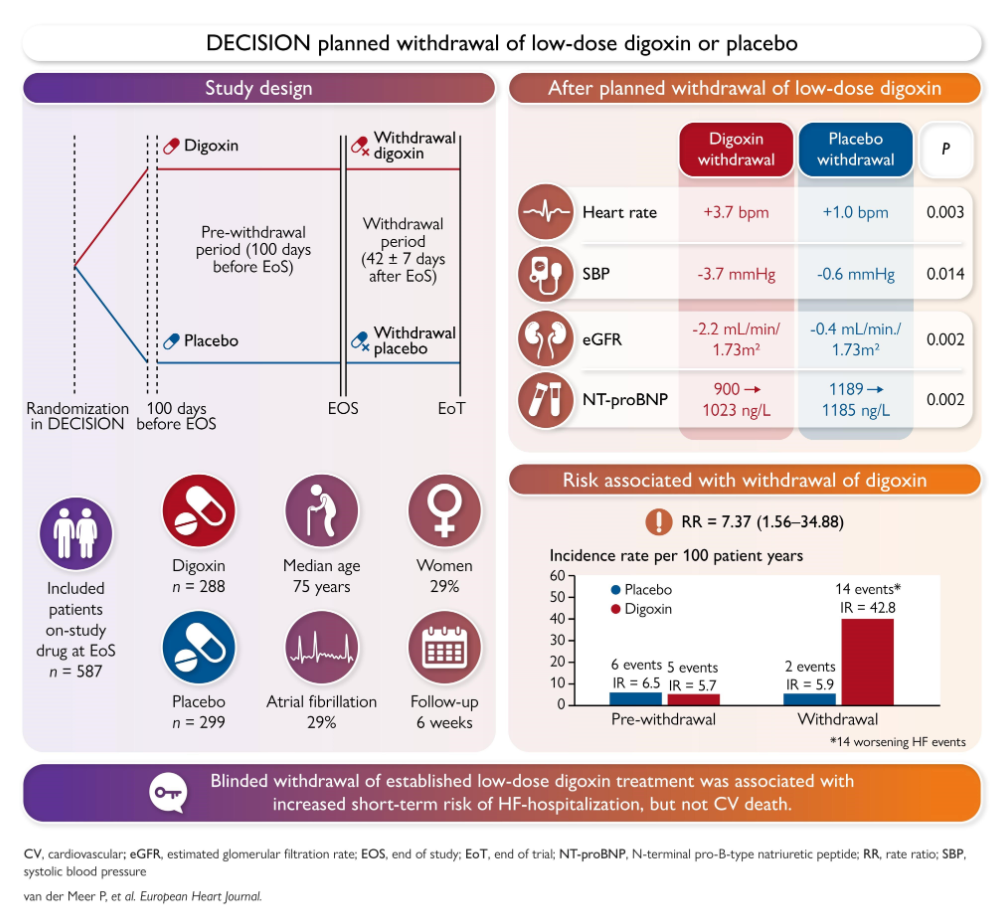
At the conclusion of the treatment phase, 587 patients receiving active treatment (288 on digoxin, 299 on placebo) underwent a blinded withdrawal of treatment between digoxin and placebo groups to assess the effects of discontinuation. A thorough clinical assessment with an in-person follow-up was conducted at 6 weeks post-withdrawal. All cardiovascular events were adjudicated by a dedicated committee to ensure objective outcome assessment.
The primary endpoints focused on cardiovascular death or worsening HF events, including hospitalizations and urgent HF visits during both the pre-withdrawal and post-withdrawal windows.
Key Findings
During the pre-withdrawal period of 100 days, both digoxin and placebo groups exhibited relatively low and similar rates of cardiovascular death or HF worsening (5.7 vs 6.5 events per 100 patient-years respectively; rate ratio 0.88, 95% CI 0.24-3.10), demonstrating clinical stability on ongoing therapies.
Following blinded withdrawal, a stark divergence emerged. Patients withdrawn from digoxin experienced a dramatic increase in incidence rates of cardiovascular death or HF worsening events to 42.8 events per 100 patient-years, compared to a stable rate of 5.9 events per 100 patient-years in patients where placebo was withdrawn. The interaction between treatment and time period was statistically significant (P = 0.036). This represented a more than sevenfold higher relative risk (rate ratio 7.37, 95% CI 1.56-34.88, P=0.012) in the digoxin discontinuation arm.
Specifically, 14 clinically significant events occurred post-withdrawal in the digoxin arm (12 hospitalizations and 2 urgent HF visits), contrasted with only 2 events (1 HF hospitalization, 1 cardiovascular death) in the placebo arm. These findings underscore the clinical impact of losing digoxin’s therapeutic effect.
Physiologically, withdrawal of digoxin was associated with an increase in heart rate (P=0.003), a reduction in systolic blood pressure (P=0.014), and significant elevation of NT-proBNP levels (P=0.002), biomarkers reflecting increased cardiac stress and worsening congestion. These objective measures corroborate the clinical deterioration observed and biologically support digoxin’s role in modulating cardiac function and neurohormonal balance.
Expert Commentary
The DECISION trial provides robust randomized evidence supporting the continued use of digoxin in selected HF patients despite modern treatment advances. The rapid and pronounced clinical deterioration following digoxin withdrawal challenges assumptions that digoxin can be routinely stopped once patients are optimized on other therapies.
These findings align with prior observational studies suggesting digoxin reduces HF hospitalizations, but they provide a higher level of causal inference through the randomized blinded withdrawal design. The trial also highlights the biomarker changes driving clinical events, reinforcing digoxin’s multifaceted benefits beyond simple inotropy.
Limitations include the selected patient population with reduced or mildly reduced EF, which may not extrapolate fully to all HF phenotypes, such as preserved EF. Additionally, the relatively short follow-up post-withdrawal (6 weeks) highlights acute effects but does not address long-term outcomes after discontinuation. Future studies could explore differential responses based on digoxin serum levels, concomitant therapies, or HF etiology.
Clinically, this trial advocates caution for clinicians contemplating digoxin withdrawal and suggests careful individualized assessment weighing benefits against potential risks. Given digoxin’s narrow therapeutic window and potential toxicity, continued monitoring remains essential.
Conclusion
The DECISION trial conclusively shows that blinded withdrawal of low-dose digoxin in chronic heart failure patients optimized on contemporary medical therapies leads to clinically meaningful worsening, including increased cardiovascular hospitalizations and biomarker evidence of decompensation. This evidence supports maintaining digoxin therapy in appropriate patients with reduced or mildly reduced ejection fraction unless contraindicated.
Clinicians should exercise caution when considering digoxin discontinuation and monitor closely for signs of HF exacerbation if withdrawal is pursued. These results reinforce the role of digoxin as a valuable adjunct in heart failure management, emphasizing the need for personalized therapy decisions grounded in randomized evidence.
Funding and Trial Registration
The original publication did not specify funding sources or clinical trial registration details in the abstract. Access to the full paper is recommended for comprehensive disclosures.
References
1. van der Meer P, van Veldhuisen DJ, et al. Blinded withdrawal of randomized treatment with low-dose digoxin or placebo in heart failure: the DECISION trial. Eur Heart J. 2026 Oct 9;47(38):5545-5553. PMID: 42106981.
2. Ziff OJ, Samra M, et al. Digoxin for heart failure. Cochrane Database Syst Rev. 2015; (8):CD002901.
3. McMurray JJV, et al. 2021 ESC Guidelines for the diagnosis and treatment of acute and chronic heart failure. Eur Heart J. 2021; 42(36):3599-3726.
4. Ahmed A, Rich MW, et al. Digoxin and Reduction Over All Study Endpoints in Heart Failure (DIG Trial). N Engl J Med 1997; 336:525–533.