Aquatic plyometric exercises provide superior pain relief in adolescents suffering from patellofemoral pain syndrome compared to conventional exercises.
Significant improvements in quadriceps and hamstring isokinetic muscle strength were observed with aquatic plyometrics.
Functional disability decreased and health-related quality of life improved more markedly in the aquatic plyometrics group.
Study Background
Patellofemoral pain syndrome (PFPS) is a prevalent musculoskeletal condition in adolescents, characterized by anterior knee pain exacerbated by activities like running, squatting, or stair climbing. It imposes a significant functional burden, often limiting participation in sports and daily activities, and sometimes leading to chronic disability. Optimal rehabilitation aims to alleviate pain without exacerbating joint stress. The advent of aquatic therapy, offering reduced joint load through buoyancy, presents a promising therapeutic avenue. Plyometric exercises, which involve rapid eccentric-concentric muscle actions, have shown efficacy in improving muscle power and functional outcomes on land but entail higher mechanical stress on joints. Integrating plyometrics in an aquatic environment might combine benefits of muscle strengthening and pain reduction by mitigating joint loading, yet evidence in adolescent PFPS remains limited. This dual-arm randomized controlled trial investigates whether aquatic plyometric exercises outperform conventional land-based exercise programs for this patient group.
Study Design
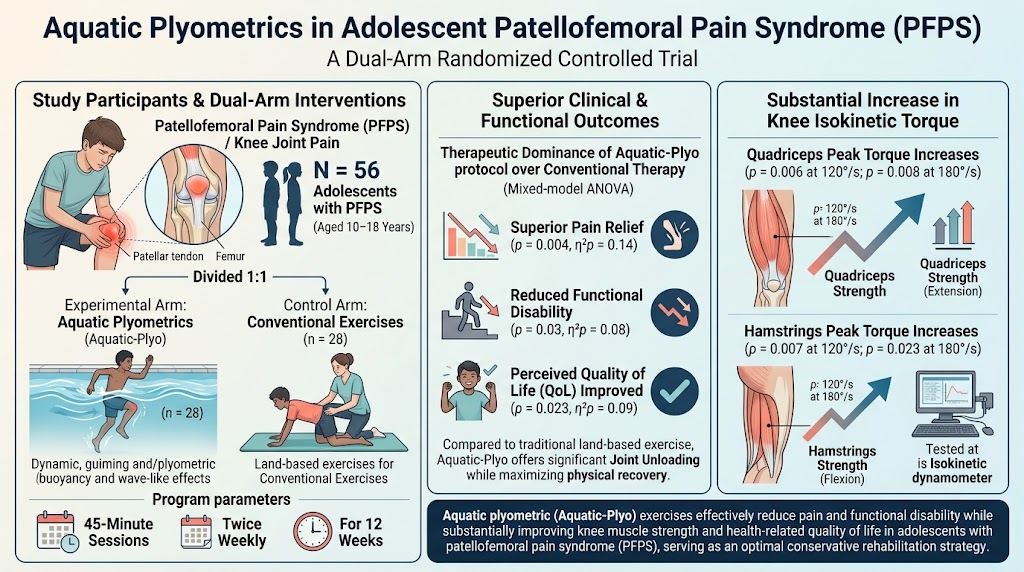
This randomized controlled trial enrolled 56 adolescents aged 10 to 18 years diagnosed with patellofemoral pain syndrome. Participants were randomly allocated to two groups: an experimental group undergoing aquatic plyometric (Aquatic-Plyo) exercise sessions and a control group performing conventional rehabilitation exercises. Both groups engaged in 45-minute training sessions twice weekly over a 12-week period.
Outcome measures were assessed pre- and post-intervention, including:
– Pain intensity using validated scales.
– Isokinetic peak torque measurements of the quadriceps and hamstrings at angular velocities of 120°/s and 180°/s.
– Functional disability through standardized indices.
– Health-related quality of life evaluations.
The study employed mixed-model ANOVA to assess the intervention effects while controlling for repeated measures.
Key Findings
The study demonstrated significant therapeutic advantages of the Aquatic-Plyo exercise regimen over conventional exercises:
1. Pain Relief: The Aquatic-Plyo group experienced markedly greater reductions in knee pain intensity (p=0.004, η2p=0.14), indicating a moderate effect size and clinical relevance in symptom control.
2. Muscle Strength Enhancement: Isokinetic testing revealed significant increases in peak torque for both quadriceps and hamstrings at 120°/s and 180°/s angular velocities in the aquatic plyometric group compared to controls (quadriceps at 120°/s, p=0.006, η2p=0.13; at 180°/s, p=0.008, η2p=0.12; hamstrings at 120°/s, p=0.007, η2p=0.13; at 180°/s, p=0.023, η2p=0.09). These findings underscore the protocol’s effectiveness in enhancing dynamic muscle function essential for joint stability and movement.
3. Functional Disability: Participants engaging in aquatic plyometrics reported greater decreases in functional limitations (p=0.03, η2p=0.08), facilitating improved activity performance.
4. Health-Related Quality of Life: Notable improvements were recorded in perceived quality of life metrics post-intervention in the Aquatic-Plyo group (p=0.023, η2p=0.09), suggesting broader psychosocial benefits beyond physical recovery.
The effect sizes across all major outcomes ranged from small to moderate, supporting the clinical relevance of the observed benefits.
Expert Commentary
The integration of plyometric exercises within an aquatic setting addresses a key challenge in managing adolescent PFPS: optimizing muscle strengthening while minimizing patellofemoral joint stress. Water’s buoyant properties reduce joint compressive forces and impact loads during dynamic movements, thus potentially preventing symptom exacerbation common with traditional plyometric training on land.
This trial’s robust randomized design and objective strength measurements lend credibility to the efficacy of aquatic plyometrics as a rehabilitation strategy. However, future research could examine longer-term outcomes and assess adherence and safety profiles across diverse clinical settings. While improvements in muscle torque and pain were statistically significant, individualized progression and supervision remain critical to maximize benefits and mitigate injury risk.
Current guidelines for PFPS rehabilitation emphasize quadriceps strengthening and pain management; these findings position aquatic plyometrics as a viable adjunct or alternative for adolescents disqualified from high-impact land-based regimens. Clinicians should consider this modality especially for patients presenting with pain limiting traditional exercise tolerance.
Conclusion
Aquatic plyometric exercise is an effective, evidence-based intervention for adolescents with patellofemoral pain syndrome, providing superior reductions in pain and disability alongside enhanced muscle strength and improved quality of life. This dual-arm randomized trial supports its incorporation into conservative rehabilitation programs to optimize functional recovery without overloading the patellofemoral joint. Incorporating aquatic plyometrics can potentially improve long-term adherence and outcomes in this vulnerable population, addressing a critical gap in current therapeutic strategies. Further studies validating these results and exploring mechanistic pathways will strengthen translational application in clinical practice.
Funding and Clinical Trial Registration
The study details regarding funding sources and clinical trial registration were not provided in the original publication summary.
References
1. Alotaibi MA, et al. Clinical and functional outcomes of aquatic plyometrics in adolescent patellofemoral pain syndrome: a dual-arm randomized controlled trial. J Rehabil Med. 2026 Oct 19;58:jrm46495. PMID:42895359.
2. Crossley KM, et al. Patellofemoral pain consensus statement from the 4th International Patellofemoral Pain Research Retreat, Manchester. Part 1: Terminology, definitions, clinical examination, natural history, patellofemoral osteoarthritis and patient-reported outcome measures. Br J Sports Med. 2016 Apr;50(14):839-43.
3. Powers CM. The influence of altered lower-extremity kinematics on patellofemoral joint dysfunction: a theoretical perspective. J Orthop Sports Phys Ther. 2003 Nov;33(11):639-46.
4. Hinman RS, et al. Aquatic physical therapy for knee osteoarthritis: a systematic review. Phys Ther Sport. 2020 Jan;42:85-93.