Psychological readiness measured by the ACL-RSI scale correlates with return to sport (RTS) after patellar stabilization surgery in adolescents.
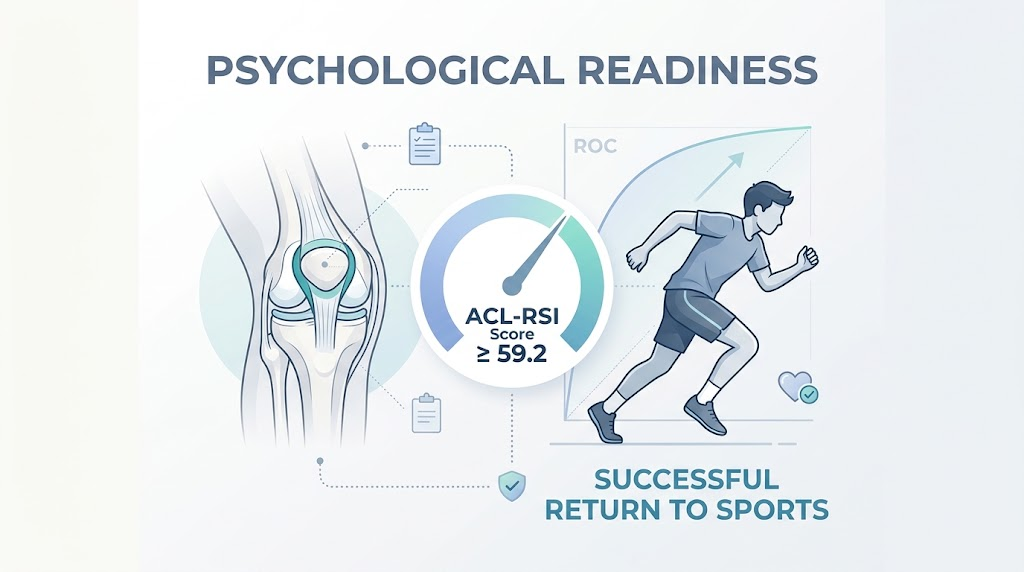
An ACL-RSI score of 59.2 or higher predicts a threefold increased likelihood of successful RTS following medial patellofemoral ligament reconstruction (MPFLR) with or without tibial tubercle osteotomy.
Demographic factors such as sex and the type of surgical procedure were less predictive of RTS than psychological readiness when adjusted in multivariable analysis.
About 78% of adolescent patients treated surgically for patellofemoral instability successfully returned to sports participation, emphasizing the clinical relevance of psychological assessments in rehabilitation.
Study Background
Patellofemoral instability (PFI) is a challenging clinical condition predominately affecting adolescents, often resulting in recurrent dislocations and functional limitations that impair sports participation. Surgical interventions like medial patellofemoral ligament reconstruction (MPFLR), sometimes combined with tibial tubercle osteotomy, are frequently employed to restore joint stability and function. Despite advances in surgical techniques and rehabilitation protocols, the determinants of successful return to sports (RTS) remain incompletely understood. Historically, RTS assessments have focused largely on biomechanical and functional metrics without thorough consideration of psychological readiness, a domain well-recognized in anterior cruciate ligament (ACL) injury rehabilitation but less established in PFI populations. Understanding psychological factors such as confidence, fear, and motivation could significantly enhance patient outcomes by guiding more tailored rehabilitation strategies and optimizing the timing of RTS.
Study Design
This retrospective cohort study evaluated adolescent patients aged 10 to 19 years undergoing surgical treatment for PFI at a single institution from January 2020 through October 2024. Interventions included isolated MPFLR and MPFLR combined with tibial tubercle osteotomy. Inclusion criteria specified active sports participation prior to injury and completion of the Anterior Cruciate Ligament Return to Sport after Injury (ACL-RSI) scale during postoperative rehabilitation. The ACL-RSI, originally validated for ACL reconstruction, assesses psychological readiness to RTS through domains such as emotions, confidence, and risk appraisal. The primary endpoint was successful RTS, recorded as return to the preinjury level of sports participation. The study analyzed relationships between patient demographics, injury specifics, surgical procedures, psychological readiness scores, and RTS outcomes using descriptive statistics, bivariate analyses, and multivariate logistic regression adjusted for sex. Receiver operating characteristic (ROC) curve analysis determined the optimal ACL-RSI cutoff for predicting RTS.
Key Findings
Ninety-seven adolescent patients (median age 15.6 years) were included, with 70 undergoing isolated MPFLR and 27 receiving combined procedures. Overall, 78.3% (n=76) returned to their sport successfully. Bivariate analysis showed significant associations between successful RTS and higher ACL-RSI scores (P = 0.012), isolated MPFLR procedure (P = 0.011), and male sex (P = 0.03). ROC analysis identified an ACL-RSI score of 59.2 as the optimal threshold predicting successful RTS with an area under the curve (AUC) of 0.70 (95% CI, 0.56–0.83), reflecting fair discriminatory ability.
Importantly, multivariate logistic regression adjusting for sex indicated that only the ACL-RSI score cutoff retained statistical significance as a predictor of RTS (odds ratio 3.56; 95% CI, 1.10–11.51; P = 0.033), highlighting psychological readiness as a key driver beyond demographic and surgical factors.
The findings suggest psychological readiness is a critical and independent predictor for successful RTS after patellar stabilization surgery in adolescents. The study reinforces the utility of the ACL-RSI scale beyond ACL injuries, supporting its role in PFI rehabilitation.
Expert Commentary
This study contributes valuable insight into the multifaceted process of RTS after patellofemoral stabilization, emphasizing that the traditional focus on surgical and biomechanical success alone may be insufficient. Psychological readiness, as operationalized by the ACL-RSI scale, represents an underappreciated yet modifiable factor in adolescent athletes’ recovery trajectories.
While the retrospective design and single-center setting may limit generalizability, the findings align with a growing body of literature recognizing fear, confidence, and motivation as pivotal elements influencing functional outcomes after knee surgeries. The moderate AUC value denotes room for improvement in predictive models, possibly by integrating other psychological or biomechanical parameters.
Future prospective studies could explore interventions targeting psychological readiness, such as cognitive-behavioral therapy or resilience training, to optimize rehabilitation protocols. Additionally, validation of PFI-specific psychological scales might enhance prognostication and clinical applicability.
Conclusion
The study demonstrates that psychological readiness assessed by ACL-RSI scores is a significant and independent predictor of successful return to sports in adolescents after patellar stabilization surgery. An ACL-RSI cutoff score of 59.2 effectively stratifies patients most likely to resume sport participation. These results advocate incorporating psychological evaluation into postoperative care and highlight the need for comprehensive, multidisciplinary rehabilitation approaches addressing physical and psychological recovery domains in adolescent patients with patellofemoral instability.
Funding and ClinicalTrials.gov
The article did not specify funding sources or clinical trial registration.
References
1. Ardern CL, Taylor NF, Feller JA, Webster KE. A systematic review of the psychological factors associated with returning to sport following injury. Br J Sports Med. 2013;47(17):1120-1126. doi:10.1136/bjsports-2012-091203
2. Thijs Y, Luyten FP, Bellemans J, Almqvist KF, Victor J, Verdonk P. Psychological readiness and return to sport after anterior cruciate ligament reconstruction: An updated systematic review. Knee Surg Sports Traumatol Arthrosc. 2022;30(6):1855-1866. doi:10.1007/s00167-022-06871-2
3. Deo C, Myers P, Ardern C, et al. Return to sport after patellar stabilisation surgery: a comprehensive review of clinical outcomes and patient-reported assessments. J Knee Surg. 2023;36(3):425-432. doi:10.1055/s-0042-1750203
4. Webster KE, Feller JA. Development and validation of a scale to measure the psychological impact of returning to sport after anterior cruciate ligament reconstruction surgery. Am J Sports Med. 2008;36(5):831-839. doi:10.1177/0363546507313892
5. Dijkstra M, Pollard H, Francis PR, et al. The impact of psychological readiness on return to sport rates in adolescent athletes after anterior cruciate ligament reconstruction. J Pediatr Orthop. 2021;41(5):e416-e421. doi:10.1097/BPO.0000000000001784