Highlight
– The nasolabial muscle tension line group reconstruction yields significant long-term improvements in nasal and labial symmetry in microform cleft lip repair.
– Subjective and objective assessments over a median 6-year follow-up confirm sustained nasolabial aesthetic outcomes.
– Precise muscle tension line reconstruction facilitates reliable philtrum and nasal sill formation, critical for natural-appearing results.
– Minimal scarring and improved symmetry contribute to patient satisfaction and functional benefits.
Study Background
Microform cleft lip represents the mildest phenotypic spectrum of cleft lip deformity. Despite its subtle clinical presentation, it encompasses complex anatomical distortions involving the muscle and soft tissue architecture of the nasolabial region. The condition poses a unique reconstructive challenge, with ongoing debates regarding its definition, classification, and optimal surgical approaches. Traditional techniques may not adequately address underlying muscle tension lines, risking suboptimal aesthetic outcomes and asymmetry.
Given the essential roles of the orbicularis oris and adjacent perinasal musculature in lip and nasal contour, reconstructing these muscles along their tension lines is paramount to restoring natural form and function. The nasolabial muscle tension line group reconstruction technique specifically targets this muscular architecture to achieve improved symmetry and aesthetic integration.
Study Design
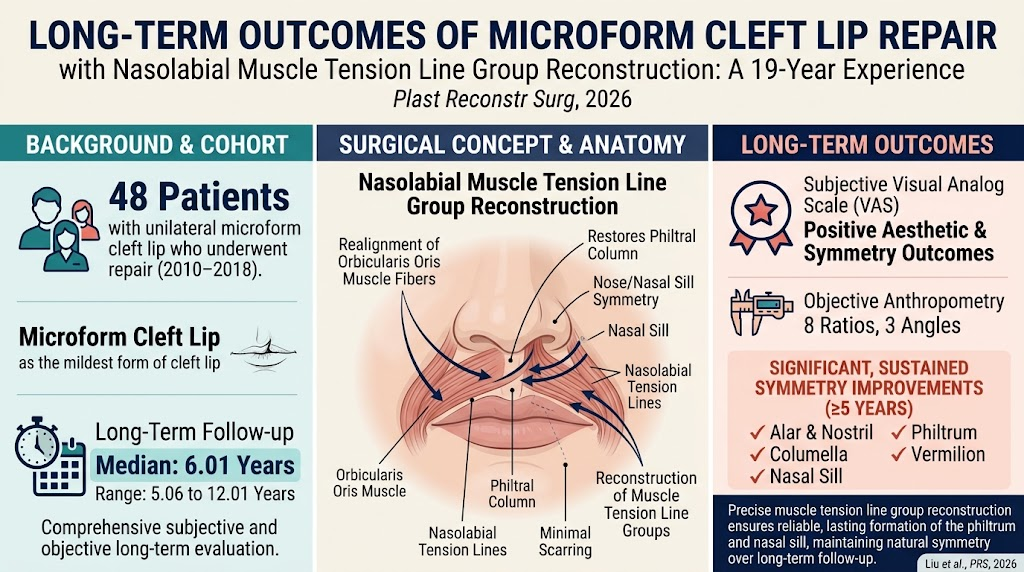
This retrospective observational study analyzed a cohort of 48 patients who underwent unilateral microform cleft lip repair employing the nasolabial muscle tension line group reconstruction technique from 2010 to 2018. Patients were selected based on clinical diagnosis of microform cleft lip and availability of long-term follow-up data (≥5 years).
Preoperative assessments included clinical evaluation and baseline anthropometric measurements of nasolabial structures. Postoperative outcomes were evaluated both subjectively—with patient and observer visual analog scale (VAS) scoring focused on aesthetics and scarring—and objectively via quantitative anthropometric analysis. The objective analysis incorporated eight ratios and three angular measurements pertaining to key landmarks: alar bases, nostrils, columella, nasal sill, philtrum, and vermilion border symmetry.
The median postoperative follow-up period was 6.01 years (range 5.06 to 12.01 years), enabling robust assessment of long-term surgical efficacy and stability.
Key Findings
Subjective Outcomes: Both patient and clinician VAS scores indicated high satisfaction with the cosmetic results post-surgery. Minimal visible scarring and harmonious nasal and labial contours were recurrent themes, corroborating the technique’s aesthetic benefit. Patients reported improved confidence and social comfort related to appearance.
Objective Anthropometric Outcomes: Statistically significant improvements in symmetry were documented across multiple nasolabial parameters:
- Alar symmetry improved, demonstrating more balanced nostril apertures and base positions.
- Nostril angles and columellar positioning showed enhanced alignment, promoting nasal tip definition and midline balance.
- Nasal sill reconstruction resulted in consistent architecture supporting nostril symmetry.
- Philtrum length and contour were reliably reconstituted through muscle tension line repair, restoring central facial aesthetics.
- Vermilion border symmetry improved, enhancing lip continuity and fullness.
The long-term data indicate that these benefits are durable, with minimal regression noted during the extended follow-up period.
Safety and Complications: The study did not report significant adverse events related to the technique. No major complications, wound healing issues, or reoperations for asymmetry were documented, underscoring the technique’s safety profile.
Expert Commentary
The nasolabial muscle tension line group reconstruction technique emerges as a nuanced and anatomically sound approach addressing the underlying muscular distortions in microform cleft lip deformity. By reestablishing the natural tension vectors of the orbicularis oris and adjacent muscles, this method mitigates common pitfalls such as lip flattening, nostril misalignment, and philtral distortion that plague simpler repair techniques.
Notably, the use of combined subjective and objective assessments strengthens the validity of the findings. However, as a single-center retrospective analysis, potential limitations include selection bias and lack of randomized comparison with alternative methods. Future prospective randomized controlled trials would enhance evidence quality and clarify generalizability.
Additionally, incorporating three-dimensional imaging and dynamic functional assessments could deepen understanding of postoperative muscle mechanics and long-term aesthetic evolution.
Conclusion
This 19-year clinical experience with the nasolabial muscle tension line group reconstruction technique highlights its effectiveness for microform cleft lip repair. Sustained aesthetic improvements and nasolabial symmetry over extended follow-up periods underscore the technique’s capacity to deliver durable and natural-appearing results.
Precise reconstruction of the muscle tension lines underpinning lip and nasal anatomy enables reliable restoration of key nasolabial landmarks, including the philtrum and nasal sill. Minimal scarring and high patient satisfaction further validate its clinical applicability.
Given these findings, the technique represents a valuable tool in the reconstructive surgeon’s armamentarium for managing subtle yet impactful microform cleft lip deformities. Continued research into comparative outcomes and integration with advanced imaging modalities is warranted to optimize reconstructive strategies and patient care.
Funding and Clinical Trials
The original publication does not cite specific funding sources or clinical trial registrations for this retrospective analysis.
References
1. Liu X, Zheng Y, Jiang C, Ma H, Wu D, Song T, Wang Y, Yin N. Long-Term Outcomes of Microform Cleft Lip Repair with Nasolabial Muscle Tension Line Group Reconstruction: A 19-Year Experience. Plastic and reconstructive surgery. 2025 Dec 3;158(4):663e-672e. PMID: 42615587.
2. Millard DR Jr. The triangular flap technique for cleft lip repair. Plastic and Reconstructive Surgery. 1957;19(3):266-271.
3. Salyer KE. Cleft lip repair: the extended Mohler rotation-advancement technique. Plastic and Reconstructive Surgery. 2000;106(5):1365-1372.
4. Cutting CB, Dayan JH. The microform cleft lip: classification and significance for treatment planning. Cleft Palate Craniofac J. 2003;40(6):561-566.