Highlight
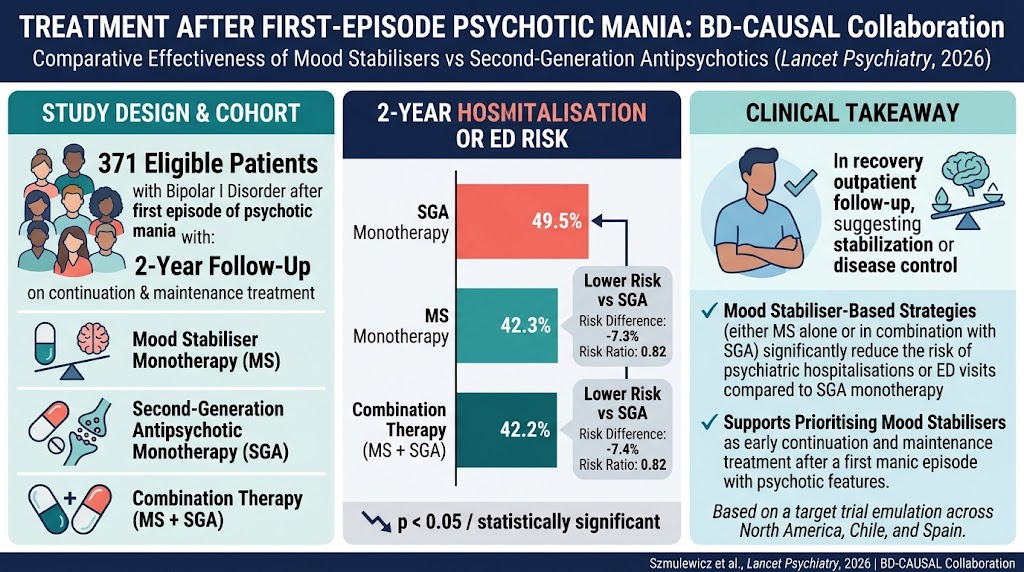
This target trial emulation examined continuation and maintenance treatments following a first episode of psychotic mania in bipolar I disorder. Mood stabiliser monotherapy and combination therapy demonstrated a significantly lower risk of psychiatric hospitalisations or emergency visits within two years compared to second-generation antipsychotic monotherapy. No significant risk difference was found between mood stabiliser monotherapy and combination therapy.
Study Background
Bipolar I disorder significantly impacts young adults, often presenting first with manic episodes featuring psychotic symptoms. This early stage is critical since optimal maintenance therapy can mitigate relapses, hospitalisations, and long-term morbidity. Despite clinical importance, evidence guiding the selection between mood stabilisers, second-generation antipsychotics (SGAs), or their combination in continuation and maintenance phases remains limited. Understanding comparative effectiveness of these regimens is paramount to improving outcomes and resource allocation, especially across diverse healthcare settings such as North America, Chile, and Spain.
Study Design
This observational study emulated a pragmatic target trial using the BD-CAUSAL Collaboration data set, encompassing cohorts from North America, Chile, and Spain from 2006 to 2021. Eligibility criteria included individuals aged 16 or older diagnosed with bipolar I disorder experiencing a first manic episode with psychotic features (per DSM-5 criteria), not currently hospitalised, no recent treatment with mood stabilisers or SGAs, and no history of severe adverse drug reactions.
Three treatment strategies initiated after the acute episode were compared: mood stabiliser monotherapy, second-generation antipsychotic monotherapy, and combination therapy. Follow-up lasted up to 2 years, with the primary endpoint being any psychiatric hospitalisation or emergency department visit during this period.
The study employed pooled logistic regression models to estimate intention-to-treat and per-protocol effects, adjusting for baseline and time-varying confounders. Treatment exposure was identified via linked outpatient and hospitalization prescription databases. Notably, patient lived experience was not incorporated in study design, analysis, or interpretation.
Key Findings
The cohort included 371 individuals with bipolar I disorder across 465 treatment initiations (230 males [62%], 141 females [38%]; median age 22 years [IQR 19–25]; 58% White, 42% non-White). Over a median 19.8 months follow-up, 42% were hospitalised or visited emergency departments for psychiatric reasons.
Two-year cumulative risk of relapse (hospitalisation or emergency visit) was highest under SGA monotherapy (49.5%; 95% CI 42.4–60.6), compared to mood stabiliser monotherapy (42.3%; 32.5–61.1) and combination therapy (42.2%; 33.3–52.5). Relative to SGA monotherapy, mood stabiliser monotherapy was associated with a statistically significant risk reduction (risk difference -7.3%; 95% CI -15.8 to -1.4; risk ratio 0.82; 0.63–0.97), as was combination therapy (risk difference -7.4%; -16.0 to -2.1; risk ratio 0.82; 0.63–0.91). No meaningful differences were observed between mood stabiliser monotherapy and combination therapy.
The analysis controlled for multiple confounders, reinforcing the robustness of findings. Safety profiles and adverse event rates were not extensively reported, though exclusion of individuals with prior severe side effects likely influenced tolerability considerations.
Expert Commentary
This emulation study provides valuable comparative effectiveness data on commonly employed maintenance pharmacotherapies after first episode psychotic mania, a period often challenged by sparse randomized evidence. The lower relapse risk associated with mood stabilisers—either alone or combined with SGAs—suggests these agents should be considered frontline in early maintenance regimens.
Mechanistically, mood stabilisers such as lithium and valproate modulate intracellular signaling pathways implicated in mood regulation, neuroprotection, and synaptic plasticity, potentially underpinning superior relapse prevention. SGAs, while effective in acute mania, may not sustain mood stability long term when used alone.
Nevertheless, as an observational target trial emulation, residual confounding and treatment selection bias cannot be excluded. Additionally, variations in healthcare delivery and medication adherence across regions may influence outcomes. Absence of patient input limits contextual interpretation of burden and preferences.
Conclusion
In patients recovering from a first episode of psychotic mania in bipolar I disorder, continuation and maintenance treatment with mood stabilisers—either as monotherapy or in combination with second-generation antipsychotics—offers a lower risk of psychiatric relapse compared to second-generation antipsychotic monotherapy. These findings endorse prioritizing mood stabilisers in early treatment strategies and highlight the urgent need for randomized clinical trials to confirm optimal maintenance treatments.
Clinicians should balance the benefits with individualized risk assessments, considering tolerability and patient preferences. This study contributes to refining evidence-based management and promoting improved long-term outcomes in bipolar disorder.
Funding and ClinicalTrials.gov
The study was funded by ASISA and the National Institute of Mental Health. No clinical trial registration was noted due to the observational study design.
References
1. Szmulewicz AG, Liang YH, Martínez-Alés G, et al. Comparative effectiveness of mood stabiliser monotherapy versus second-generation antipsychotic monotherapy versus combination therapy for continuation and maintenance treatment after a first episode of psychotic mania in North America, Chile, and Spain: a target trial emulation using data from the BD-CAUSAL Collaboration. The Lancet Psychiatry. 2026;13(10):861-869. PMID: 42716056.
2. Geddes JR, Miklowitz DJ. Treatment of bipolar disorder. Lancet. 2013;381(9878):1672-1682.
3. Yatham LN, Kennedy SH, Parikh SV, et al. Canadian Network for Mood and Anxiety Treatments (CANMAT) and International Society for Bipolar Disorders (ISBD) 2018 guidelines for the management of patients with bipolar disorder. Bipolar Disorders. 2018;20(2):97-170.