Highlight
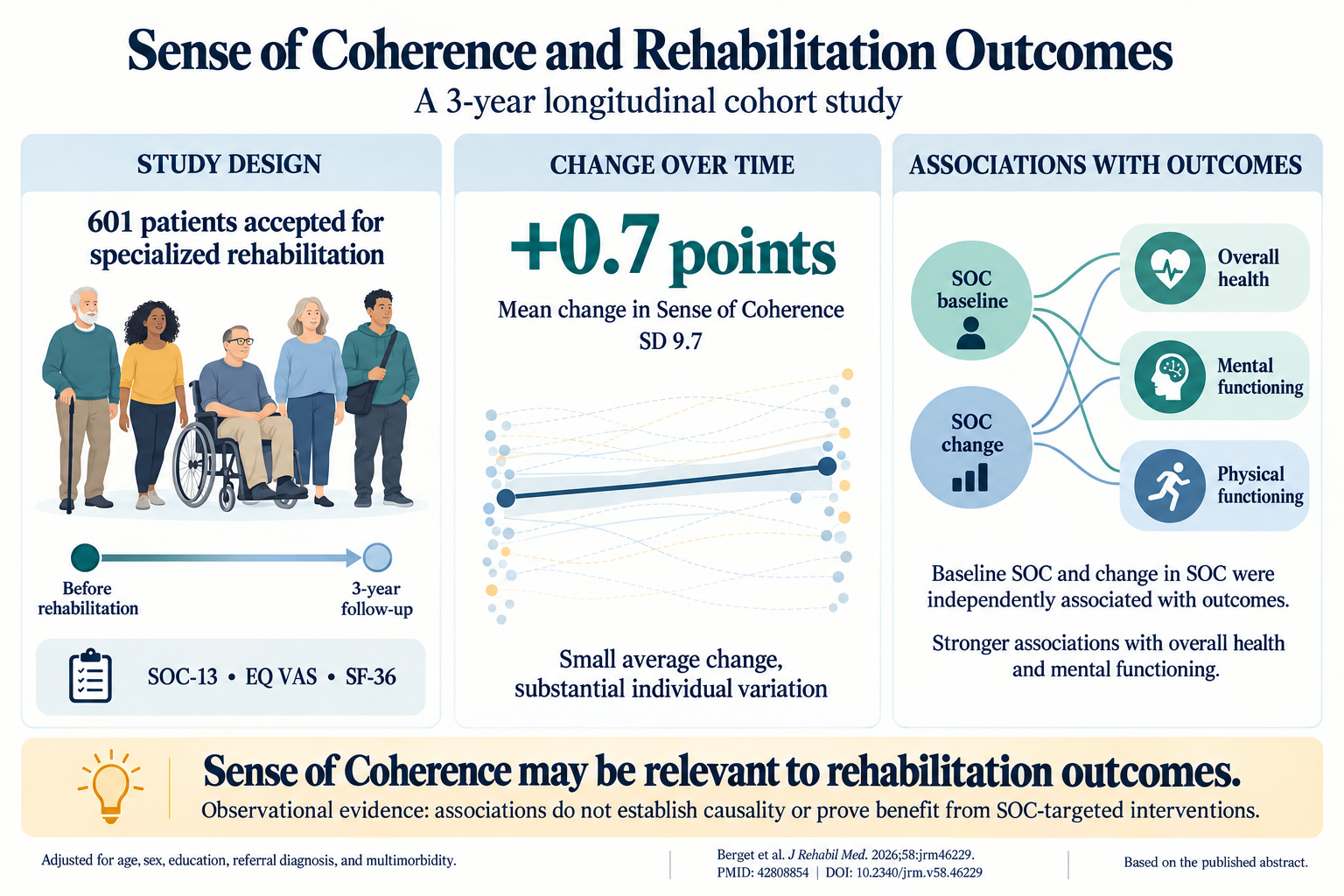
This 3-year longitudinal study of 601 patients underscores that baseline Sense of Coherence (SOC) and its longitudinal change are independently associated with rehabilitation outcomes. Patients reported lower SOC, health, and functioning compared to normative populations, with stronger associations observed for overall health and mental functioning than for physical functioning. These findings advocate for rehabilitation strategies focusing on enhancing SOC to improve patient outcomes.
Study Background
The concept of Sense of Coherence, introduced by Aaron Antonovsky, refers to an individual’s global orientation that expresses the extent to which one perceives life as comprehensible, manageable, and meaningful. SOC is recognized as a salutogenic factor—promoting health even when individuals face significant stressors or chronic illnesses. Rehabilitation medicine often addresses physical impairments and functional deficits; however, psychological resilience and coping mechanisms can critically influence recovery trajectories. Despite its theoretical importance, longitudinal data assessing how SOC evolves in rehabilitation patients and its influence on long-term outcomes remain scarce. This study aims to fill that gap by analyzing a specialized rehabilitation cohort over three years.
Study Design
This prospective, longitudinal cohort study enrolled 601 patients accepted for specialized rehabilitation. Data collection occurred at baseline, prior to rehabilitation intervention, and three years thereafter. The primary independent variable was Sense of Coherence measured using the validated 13-item SOC questionnaire. Rehabilitation outcomes, the dependent variables, encompassed self-reported health and functioning measured by the EuroQol visual analogue scale (EQ-VAS) and the Medical Outcomes Study Short Form 36 (SF-36), which includes domains assessing both mental and physical functioning.
Analyses employed analysis of covariance (ANCOVA) adjusted for potential confounders including age, sex, level of education, referral diagnosis, and multimorbidity status to discern the independent effects of baseline SOC and its change over time on rehabilitation outcomes.
Key Findings
Compared to reference populations, participants demonstrated significantly lower baseline SOC scores, as well as diminished health and functional measures. At the group level, the mean SOC change over the three-year follow-up was minimal (+0.7 points, SD 9.7), indicating relative stability in perceived coherence. However, individual trajectories varied substantially, suggesting that some patients experienced meaningful increases or decreases in their SOC.
Critically, both higher baseline SOC and positive changes in SOC over time were independently associated with improved rehabilitation outcomes. This relationship was most robust for overall self-rated health (measured by EQ-VAS) and mental functioning domains of the SF-36, such as emotional well-being and vitality. Associations with physical functioning were present but comparatively weaker.
The study controlled for socioeconomic and clinical factors, reinforcing that SOC itself exerts an independent influence on recovery outcomes. These data support that SOC is not merely a proxy for health status but is a modifiable psychological resource that can impact health perception and adaptive functioning.
Expert Commentary
These findings align with the growing recognition that mental and emotional dimensions are pivotal determinants of rehabilitation success. Enhancing SOC may equip patients with better coping skills, a clearer understanding of their health challenges, and greater motivation to engage actively in rehabilitation programs. Incorporating psychological interventions, such as cognitive behavioral therapy or resilience training tailored to bolster SOC components—comprehensibility, manageability, and meaningfulness—may accelerate recovery and improve quality of life.
Limitations include the observational design, which precludes causal inference, and potential selection bias as participants were already accepted for specialized rehabilitation. Additionally, variations in referral diagnoses and treatment modalities were adjusted for but may still confound associations. Further interventional trials are warranted to test whether deliberate enhancement of SOC translates into measurable improvements in rehabilitation outcomes.
Conclusion
This 3-year longitudinal study confirms that Sense of Coherence is a stable yet individually variable construct intimately linked with rehabilitation outcomes—particularly overall perceived health and mental functioning. Screening for low SOC at rehabilitation entry and implementing targeted interventions to strengthen SOC might optimize recovery pathways across diverse patient populations. Future research should focus on developing and validating SOC-enhancing strategies and integrating them into comprehensive rehabilitation protocols.
Funding and ClinicalTrials.gov
The study was supported by the Norwegian Health Authorities and conducted at Diakonhjemmet Hospital, Oslo, Norway. No clinical trial registration was reported.
References
- Antonovsky A. Unraveling the Mystery of Health: How People Manage Stress and Stay Well. Jossey-Bass; 1987.
- Eriksson M. The Sense of Coherence in the Salutogenic Model of Health. In: Mittelmark MB, Sagy S, Eriksson M, et al., editors. The Handbook of Salutogenesis. Springer; 2017:91-96.
- Berget AM, Hetlevik Ø, Hustoft M, Assmus J, Moen VP. Sense of coherence and rehabilitation outcomes: a 3-year longitudinal study. J Rehabil Med. 2026 Sep 29;58:jrm46229. doi: 10.2340/jrm.v58.46229.
- Ware JE Jr, Sherbourne CD. The MOS 36-item short-form health survey (SF-36): I. Conceptual framework and item selection. Med Care. 1992 Jun;30(6):473-83.
- Rabin R, de Charro F. EQ-5D: a measure of health status from the EuroQol Group. Ann Med. 2001 Jul;33(5):337-43.