Highlight
- Sonelokimab, a novel nanobody targeting IL-17A and IL-17F, was efficacious in moderate-to-severe hidradenitis suppurativa (HS) in the phase 2 MIRA trial.
- Both 120 mg and 240 mg doses of sonelokimab achieved significantly higher HiSCR75 response rates at week 12 compared to placebo.
- The treatment was well tolerated with no new safety signals detected through 24 weeks.
- Longer-term efficacy and safety remain to be confirmed in ongoing phase 3 studies.
Study Background and Disease Burden
Hidradenitis suppurativa (HS) is a chronic, debilitating inflammatory skin disorder characterized by painful nodules, abscesses, and sinus tract formation mainly in intertriginous areas such as the axillae and groin. HS significantly impairs quality of life through pain, scarring, and psychological sequelae. Treatment options are limited, particularly for moderate-to-severe disease, with only a handful of biologics, such as adalimumab, approved for use. However, many patients are suboptimally managed, underscoring an unmet need for novel therapies with improved efficacy and tolerability.
The interleukin-17 (IL-17) pathway, involving cytokines IL-17A and IL-17F, is increasingly recognized as central in HS pathogenesis. IL-17A/F contribute to neutrophil recruitment and sustaining inflammation in lesional skin. Thus, dual inhibition of these cytokines represents a promising therapeutic strategy.
Study Design
The MIRA trial was a global, randomized, double-blind, placebo-controlled phase 2 study evaluating the efficacy and safety of sonelokimab, a novel nanobody engineered to inhibit both IL-17A and IL-17F. The trial enrolled adults with moderate-to-severe HS, defined by standard criteria.
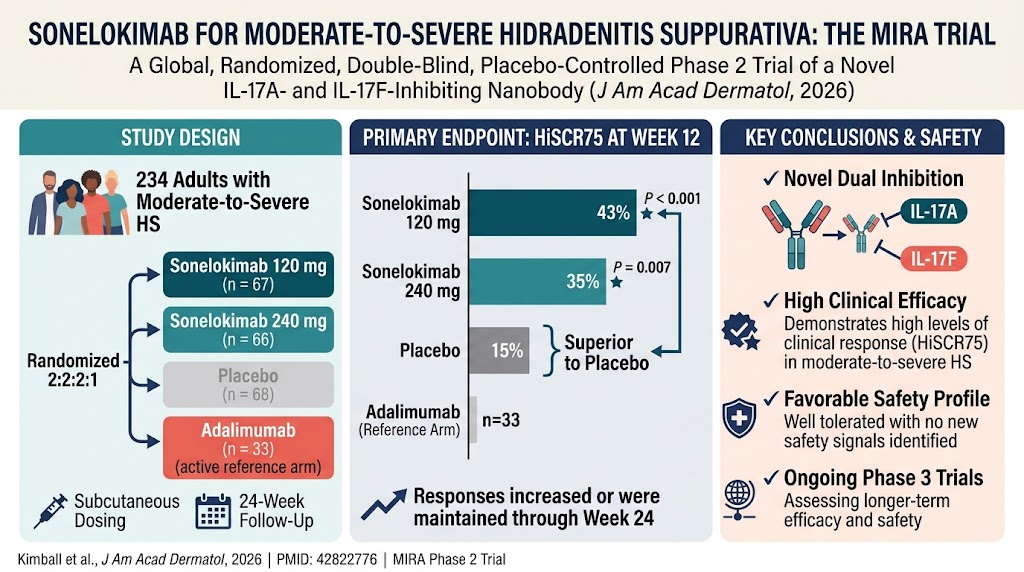
Participants (n=234) were randomized in a 2:2:2:1 ratio to receive either subcutaneous sonelokimab 120 mg, sonelokimab 240 mg, placebo, or adalimumab (active reference arm). The study duration was 24 weeks with primary endpoint assessment at week 12.
The primary efficacy endpoint was the proportion of patients achieving HS Clinical Response 75 (HiSCR75), defined as at least a 75% reduction from baseline in abscess and inflammatory nodule count without increase in abscess or draining fistula counts, compared to placebo. Analysis employed non-responder imputation in an intention-to-treat population.
Key Findings
Results demonstrated that sonelokimab at both doses significantly improved clinical response versus placebo at week 12. Specifically, 43% of patients receiving 120 mg and 35% receiving 240 mg attained HiSCR75 compared to 15% on placebo (P<0.001 and P=0.007, respectively). These responses were maintained or further improved through week 24, indicating sustained benefit.
The active reference arm with adalimumab showed expected efficacy consistent with prior HS trials, reinforcing study validity.
Regarding safety, sonelokimab was well tolerated. No new or unexpected adverse events emerged during the 24-week period. Common treatment-emergent adverse events were mild to moderate and balanced across groups. These findings support a favorable risk-benefit profile.
Expert Commentary
The MIRA study adds compelling evidence that targeting both IL-17A and IL-17F with sonelokimab may provide a novel therapeutic avenue for moderate-to-severe HS patients. By concurrently blocking these pivotal inflammatory mediators, sonelokimab addresses the pathogenic axis more comprehensively than agents solely targeting IL-17A or TNF-alpha.
Though the 120 mg dose exhibited a numerically higher HiSCR75 response than 240 mg, this divergence could be influenced by sample variability and warrants further exploration. The observed durable responses mark a clinical advance given HS’s refractory nature.
Limitations include the 24-week duration, leaving long-term efficacy and safety unaddressed. Ongoing phase 3 trials with extended follow-up will clarify sonelokimab’s enduring benefits and broader applicability.
Integration of sonelokimab into clinical practice could significantly broaden the HS therapeutic landscape. Mechanistic studies elucidating downstream immune modulation and biomarkers of response could optimize patient selection.
Conclusion
Sonelokimab, a dual IL-17A and IL-17F inhibiting nanobody, demonstrated meaningful clinical efficacy and was well tolerated in adults with moderate-to-severe hidradenitis suppurativa in the phase 2 MIRA trial. These promising results support further development of sonelokimab as a novel biologic for a disease with substantial unmet need. Confirmation in larger, longer-term phase 3 studies is awaited.
Funding and ClinicalTrials.gov
The MIRA trial was funded and supported by the developer of sonelokimab. Clinical trial registration details and identifiers are available on ClinicalTrials.gov for ongoing phase 3 studies.
References
1. Kimball AB, Bechara FG, Porter ML, et al. Sonelokimab, a novel IL-17A- and IL-17F-inhibiting nanobody for the treatment of moderate-to-severe hidradenitis suppurativa: a global, randomized, double-blind, placebo-controlled phase 2 clinical trial (MIRA). J Am Acad Dermatol. 2026 Oct 1; PMID: 42822776.
2. Alavi A, Kirsner RS. Hidradenitis suppurativa: An update on epidemiology, pathogenesis, and treatment. J Am Acad Dermatol. 2020;83(4):1029-1036.
3. Kimball AB, Okun MM, Williams DA, et al. Two Phase 3 Trials of Adalimumab for Hidradenitis Suppurativa. N Engl J Med. 2016;375(5):422-434.