Highlight
- This multi-center randomised controlled trial evaluated the Paro-ComPas digital companion app as an adjunct to standard periodontal therapy in adults with periodontitis.
- No significant differences were observed between the app and control groups in gingival bleeding index or other key clinical outcomes after systematic periodontal treatment.
- Exploratory analysis suggested that moderate users of the app exhibited significantly greater plaque reduction compared to low users, indicating potential benefits linked to engagement.
- Limitations such as low baseline inflammation, suboptimal app implementation fidelity, and variability among examiners may have hindered detection of subtle clinical benefits.
Study Background
Periodontitis is a prevalent chronic inflammatory disease affecting periodontal tissues, leading to tooth loss if untreated. Managing periodontitis relies heavily on systematic clinical interventions and rigorous oral hygiene maintenance. Digital health technologies, including smartphone companion apps, have been explored as adjuncts to reinforce patient adherence to oral hygiene and monitoring, potentially improving treatment outcomes. However, robust clinical evidence assessing their effectiveness remains limited. This randomized controlled trial aimed to investigate whether the Paro-ComPas app improves clinical periodontal outcomes when combined with systematic periodontal therapy in adults with established periodontitis.
Study Design
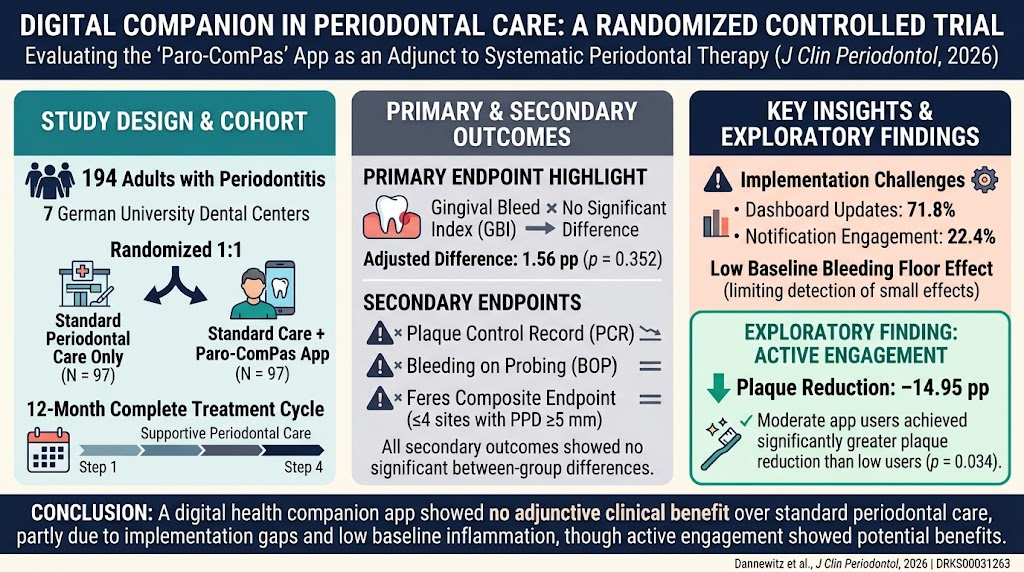
The trial was conducted across seven German university dental centers and enrolled 194 adult patients diagnosed with periodontitis. Participants were randomized to receive standard systematic periodontal therapy either alone (control group) or supplemented with the Paro-ComPas digital companion app. The app intended to support patient motivation and adherence through interactive features.
Primary endpoint was the gingival bleeding index (GBI), measured at baseline (T0), re-evaluation after therapy (T1), and during supportive periodontal care (T2). Secondary outcomes included plaque levels and bleeding on probing. Confirmatory analyses employed longitudinal mixed-effects regression models, while exploratory analyses stratified outcomes by degree of app usage.
Key Findings
Of the 180 participants who began the trial, 148 completed the follow-up assessments. Both intervention and control groups demonstrated substantial improvements in clinical periodontal parameters over time, confirming effectiveness of systematic periodontal therapy.
Unadjusted between-group comparison showed a slight advantage for the control group regarding GBI change from baseline to supportive care (7.70 percentage points difference), but after adjustment for confounders, no statistically significant difference was observed (adjusted difference 1.56 percentage points, p=0.352). Secondary endpoints including plaque accumulation and bleeding on probing similarly demonstrated no significant differences between groups.
App usage was variable with suboptimal adherence to the intervention protocol. Intriguingly, exploratory subgroup analysis revealed that moderate app users had significantly greater mean plaque reductions compared to low users (-14.95 percentage points, p=0.034), suggesting a dose-response relationship between app engagement and oral hygiene improvement.
Notably, baseline periodontal inflammation levels were generally low, potentially reducing the margin for detecting additional benefit from the app. Additionally, the trial faced challenges including inter-examiner variability and incomplete delivery of the app intervention, which may have further limited ability to identify small effect sizes.
Expert Commentary
The integration of digital health tools into periodontal care holds promise to enhance patient engagement and adherence, but this trial underscores the complexity of demonstrating their added value in well-managed clinical settings. The lack of significant overall benefit aligns with other recent evidence suggesting that digital companions might not substantially augment outcomes beyond standard care unless users are adequately engaged.
Implementation fidelity is a crucial factor; incomplete use of the app and variability in clinical assessment can mask potential advantages. Future studies might focus on mechanisms to boost user engagement and standardize clinical measurements to better ascertain efficacy.
Experts also emphasize considering patient-centered outcomes such as quality of life and motivation alongside traditional clinical endpoints to fully capture digital intervention benefits.
Conclusion
This multi-center RCT demonstrated that incorporating the Paro-ComPas digital companion app as an adjunct to systematic periodontal therapy in adults with periodontitis did not confer statistically significant additional benefit in primary clinical outcomes. Nevertheless, exploratory analyses suggest that moderate user engagement with the app may enhance plaque control, highlighting the potential for targeted integration of such digital tools.
Limitations including low baseline inflammation, suboptimal intervention adherence, and inter-examiner variability likely constrained detection of subtle effects. Future research should aim to improve implementation strategies and rigorously assess patient engagement to define the role of digital companions in periodontal maintenance.
Funding and Trial Registration
The trial was registered in the German Clinical Trial Register (DRKS00031263) on June 19, 2023. Funding sources were not detailed in the abstract.
References
- Dannewitz B, Deschner J, Dörfer C, et al. Clinical Outcomes of a Digital Companion in Periodontal Care: A Randomised Controlled Trial. J Clin Periodontol. 2026;53(10):1596-1609. doi:10.1111/jcpe.XXXX.
- Preshaw PM, Alba AL, Herrera D, et al. Periodontitis and Diabetes: A Two-Way Relationship. Diabetologia. 2012 Jan;55(1):21-31.
- Kumar S, Tadakamadla J, Johnson NW. Digital technology and its impact on periodontal health promotion: a systematic review. J Periodontal Res. 2020;55(3):319-329.