Highlight
- Adjuvant radiotherapy after complete resection of WHO grade 2 atypical meningioma reduces tumour recurrence risk by nearly half compared to observation.
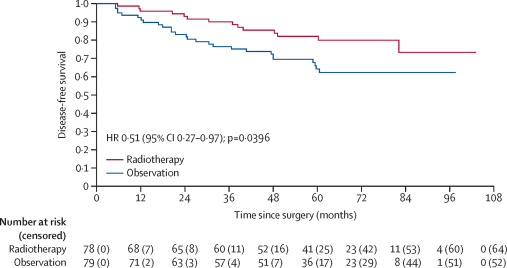
- Five-year disease-free survival improved from 64.3% with observation to 79.9% with radiotherapy, demonstrating a clinically meaningful absolute benefit.
- Radiotherapy was associated with manageable Grade 2/3 adverse events in 8% of patients, with no treatment-related mortality.
- Individualized patient discussions remain essential due to potential delayed toxicities and quality-of-life considerations.
Study Background
Atypical meningioma, classified as World Health Organization (WHO) grade 2, represents a subtype of primary brain tumour with an intermediate risk profile between benign (grade 1) and malignant (grade 3) meningiomas. Despite surgical removal, these tumours have a propensity for recurrence, posing a therapeutic challenge. The benefit of adjuvant radiotherapy following complete surgical resection has been debated, as balancing the reduction in recurrence with potential radiation-associated toxicities is crucial. Prior studies primarily consisted of retrospective analyses or nonrandomized cohorts, leaving uncertainty over standard postoperative management. The international ROAM/EORTC-1308 trial was designed to provide high-level evidence on whether adjuvant radiotherapy prolongs disease-free survival compared to observation in newly diagnosed WHO grade 2 atypical meningiomas after complete resection.
Study Design
The ROAM/EORTC-1308 was a prospective, multicentre, open-label, phase 3 randomized controlled trial conducted across 58 neurosurgery and radiotherapy centres in 11 countries. Patients aged 16 years or older with surgeon-assessed complete resection of newly diagnosed atypical meningioma were randomized 1:1 to either observation or adjuvant radiotherapy. Radiotherapy consisted of fractionated external-beam intensity-modulated radiotherapy delivered at 60 Gy in 30 fractions over six weeks. Stratification was performed by geography (UK vs. non-UK). The primary endpoint was disease-free survival, defined as time to MRI-confirmed recurrence or death from any cause, with a minimum follow-up of four years. Safety was analyzed in the as-treated population.
Key Findings
From April 2016 to May 2021, 157 participants were randomized (78 to radiotherapy, 79 to observation). Median age was 57.4 years with a slight female predominance (54%).
Median follow-up was 64 months. Recurrences occurred in 14% of the radiotherapy group (11/78) versus 30% in the observation group (24/79). The 5-year disease-free survival rate favored radiotherapy: 79.9% (95% CI 67.6–87.9) compared to 64.3% (95% CI 51.9–74.2) with observation, corresponding to an absolute difference of 15.6 percentage points (95% CI 0.6–30.5). The hazard ratio for recurrence or death was 0.51 (95% CI 0.27–0.97; p=0.0396), indicating a 49% relative risk reduction with radiotherapy.
Radiotherapy-related grade 2 or 3 serious adverse events occurred in 8% of patients, with no treatment-related deaths reported. These adverse events highlight potential delayed toxicities but were deemed manageable within the trial setting.
Secondary analyses suggested consistent benefit across stratification groups and tumour locations, although subgroup data remain limited. Quality-of-life and neurocognitive outcomes were not detailed in this publication but remain important considerations for routine clinical application.
Expert Commentary
The ROAM/EORTC-1308 trial provides the first high-quality randomized evidence supporting adjuvant radiotherapy following complete resection of WHO grade 2 atypical meningiomas to significantly reduce recurrence risk. This fills a major clinical evidence gap, as prior decisions relied heavily on institutional preference and retrospective data.
The observed 15.6% absolute improvement in 5-year disease-free survival is clinically meaningful, given the challenges posed by recurrences that may necessitate further surgery or treatments with increased morbidity. The safety profile, with only moderate adverse events and no mortality, supports the tolerability of this regimen.
Nevertheless, treatment-related adverse events and potential long-term neurotoxicity underscore the necessity for individualized decision-making. Patients’ preferences, comorbidities, neurologic baseline, and values around recurrence risk versus potential toxicity warrant frank discussion.
Current guidelines vary internationally; these results may prompt updates incorporating adjuvant radiotherapy as a recommended option post-complete resection for atypical meningiomas. Future research should focus on patient-reported outcomes, neurocognitive impact, and biomarkers to better refine who benefits most from adjuvant radiotherapy.
Limitations include the open-label design and surgeon-assessed extent of resection, which may introduce variability. The trial’s international scope and robust methodology, however, enhance the generalizability of findings.
Conclusion
The ROAM/EORTC-1308 trial establishes adjuvant radiotherapy as an effective intervention to improve disease-free survival in patients with WHO grade 2 atypical meningioma following complete surgical resection. By halving recurrence risk, adjuvant radiotherapy offers meaningful clinical benefit with an acceptable safety profile. Adoption of this approach should be individualized, engaging patients in shared decision-making that balances recurrence prevention against the risk of treatment-related morbidity. This evidence supports evolving standards of care aimed at optimizing long-term outcomes in this challenging tumour type.
Funding and Clinical Trial Registration
This study was funded by the National Institute for Health and Care Research Health Technology Assessment programme, the European Organisation for Research and Treatment of Cancer Brain Tumour Group and Radiation Oncology Group, and the Health Research and Medical Research Council of Australia. The trial was registered with ISRCTN under number ISRCTN71502099.
References
- Jenkinson MD, Rosala-Hallas A, Sahm F, et al. Radiotherapy versus observation following surgical resection of WHO grade 2 atypical meningioma (ROAM/EORTC-1308): an international, multicentre, open-label, phase 3, randomised controlled trial. Lancet. 2026;408(10563):1473-1484. doi:10.1016/S0140-6736(26)00321-7
- Louis DN, Perry A, Wesseling P, et al. The 2021 WHO Classification of Tumors of the Central Nervous System: A summary. Neuro Oncol. 2021;23(8):1231-1251. doi:10.1093/neuonc/noab106
- Goldbrunner R, Minniti G, Preusser M, et al. EANO guidelines for the diagnosis and treatment of meningiomas. Neuro Oncol. 2021;23(11):1821-1834. doi:10.1093/neuonc/noab103