Highlight
1. This randomized controlled trial provides the first high-quality evidence comparing first metatarsophalangeal joint (MTPJ) arthrodesis to conservative management (watchful waiting) in hallux rigidus.
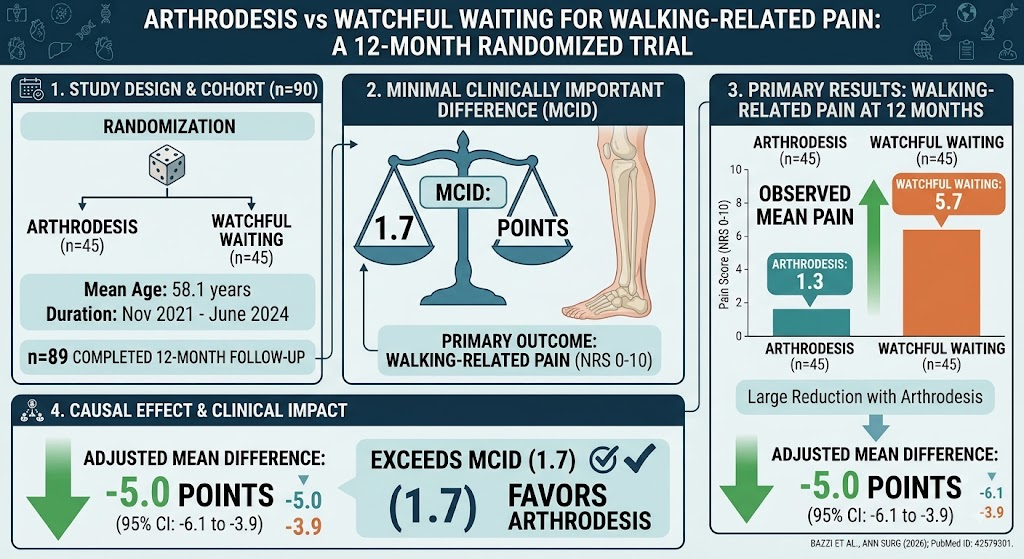
2. Surgery yielded a profound and clinically significant reduction in walking-related pain at 12 months compared to watchful waiting.
3. The arthrodesis group’s pain reduction exceeded the minimal clinically important difference by a large margin.
4. Single-center design limits generalizability, but findings strongly support arthrodesis as an effective treatment for symptomatic hallux rigidus.
Study Background
Hallux rigidus, osteoarthritis affecting the first metatarsophalangeal joint (MTPJ), is a prevalent cause of forefoot pain and disability, particularly in middle-aged and older adults. Characterized by progressive cartilage degeneration and stiffness, it impairs the ability to walk and limits quality of life. While various conservative and surgical treatments have been used, the evidence base comparing surgery with the natural progression of the disease remains insufficient. Arthrodesis of the first MTPJ is considered a standard surgical intervention for advanced hallux rigidus, aiming to relieve pain by fusing the joint and eliminating motion-induced symptoms. However, no randomized controlled trials (RCTs) have definitively established its superiority over watchful waiting, which encompasses symptom management without surgery. This study addresses this critical evidence gap by directly comparing these approaches with rigorous methodology.
Study Design
This study was a single-center, investigator-blinded, parallel-group randomized controlled superiority trial conducted at the orthopedic department of a tertiary care hospital in Finland. Adults aged 40 years or older with radiographically confirmed hallux rigidus (Coughlin-Shurnas grades I to III) and walking-related pain rated at least 4 on a 0–10 Numerical Rating Scale (NRS) lasting more than one year were enrolled. Patients with confounding conditions such as type 1 diabetes mellitus, rheumatoid arthritis, or hallux valgus deformity greater than 15° were excluded to maintain a homogeneous population.
Eligible participants (n=90) were randomized 1:1 to undergo surgical first MTPJ arthrodesis using lag screws and dorsal plating or to receive watchful waiting. The primary outcome was walking-related pain assessed by NRS at 12 months post-randomization, with a prespecified minimal clinically important difference (MCID) of 1.7 points. Secondary outcomes, if any, were not reported in the abstract. Follow-up was completed by 89 participants (99%).
Key Findings
The mean age of participants was 58.1 years, reflecting a typical demographic affected by hallux rigidus. At 12 months, the arthrodesis group demonstrated a mean walking pain of 1.3 on the NRS, whereas the watchful waiting group reported a substantially higher mean pain score of 5.7. The adjusted mean difference was -5.0 points (95% CI, -6.1 to -3.9), exceeding the MCID by nearly threefold, establishing both statistical and clinical superiority of arthrodesis.
The large effect size underscores that first MTPJ arthrodesis markedly improves pain-mediated function during walking compared with no surgical intervention. Nearly all patients completed follow-up, supporting data reliability. Although safety outcomes were not detailed in the abstract, arthrodesis is generally associated with risks such as nonunion, infection, and adjacent joint stress, which warrant consideration in clinical decision-making.
Expert Commentary
This trial is pivotal in benchmarking surgical versus conservative management for hallux rigidus, filling a critical knowledge gap previously reliant on observational data. The use of a well-defined patient population with validated outcome measures and an adequate sample size enhances the credibility of the findings.
However, the single-center design raises questions about extrapolation to other settings with differing surgical expertise or patient populations. The lack of reported secondary outcomes, including functional scores, quality of life measures, or longer-term follow-up, limits comprehensive evaluation of the intervention’s full impact. Future multicenter studies incorporating these parameters would be valuable.
In context, arthrodesis effectively abolishes painful joint motion, which biologically explains the superior pain relief. Yet, it results in permanent joint fusion, potentially altering gait mechanics and predisposing to adjacent joint degeneration. Therefore, personalized treatment decisions weighing symptom severity, patient preferences, and potential complications remain essential.
Conclusion
This rigorously conducted RCT establishes first MTPJ arthrodesis as a superior and clinically important intervention to reduce walking-related pain in adults with symptomatic hallux rigidus compared to watchful waiting at 12 months. These findings support arthrodesis as the preferred management strategy for patients with moderate to severe pain and radiographic disease. However, further research is needed to evaluate long-term functional outcomes, complications, and cost-effectiveness to optimize treatment algorithms.
Funding and ClinicalTrials.gov
The study was funded by the Suomen Lääketieteen Säätiö Foundation, Finland. It was registered at ClinicalTrials.gov (NCT04590313), ensuring transparency and adherence to research ethics.
References
1. Miettinen M, Sirola T, Lähdeoja T, Sandelin H, Nummela M, Repo JP, Ponkilainen V, Rämö L. Surgery Versus Watchful Waiting for First Metatarsophalangeal Joint Osteoarthritis : A Randomized Controlled Trial. Ann Intern Med. 2026 Aug 11. PMID: 42574728.
2. Coughlin MJ, Shurnas PS. Hallux rigidus: grading and long-term results of operative treatment. J Bone Joint Surg Am. 2003;85(11):2072-2088.
3. Roukis TS. Surgical treatment of hallux rigidus: a meta-analysis and literature review. J Foot Ankle Surg. 2013;52(6):720-729.
4. Shurnas PS. Surgical options for hallux rigidus. Foot Ankle Clin. 2014;19(3):567-586.