Highlight
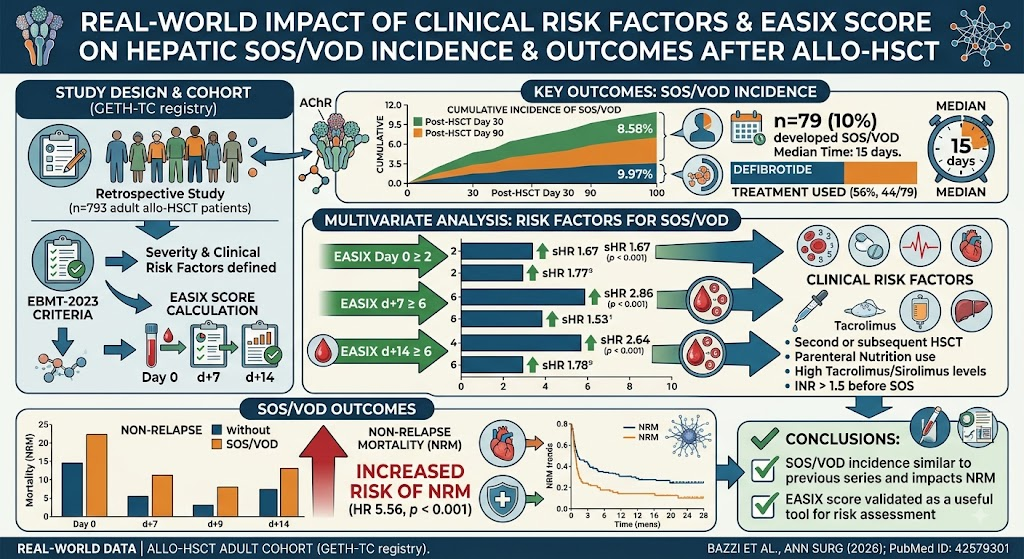
- The study of 793 adult allo-HSCT recipients found a 10% incidence of hepatic sinusoidal obstruction syndrome/veno-occlusive disease (SOS/VOD).
- Key clinical risk factors significantly associated with SOS/VOD include second or subsequent HSCT, parenteral nutrition, high tacrolimus/sirolimus levels, and elevated INR before onset.
- Sequential EASIX scores at day 0, day +7, and day +14 post-transplant independently predict SOS/VOD risk and correlate with patient outcomes.
- SOS/VOD markedly increases non-relapse mortality (NRM) risk, underscoring the need for early identification and intervention.
Study Background
Hepatic sinusoidal obstruction syndrome (SOS), also known as veno-occlusive disease (VOD), is a potentially life-threatening complication after allogeneic hematopoietic stem cell transplantation (allo-HSCT). It is characterized by hepatomegaly, weight gain, ascites, jaundice, and potentially multi-organ failure. Despite advances in transplant techniques and supportive care, SOS/VOD remains a significant clinical challenge due to its unpredictable onset, variable severity, and substantial mortality risk. Early diagnosis and risk stratification are crucial for timely treatment, with defibrotide being the only approved therapeutic agent for SOS/VOD.
Existing literature reports SOS incidence ranging broadly from 5% to 15%, often influenced by patient populations and transplant-related factors. However, there remains a need for real-world data examining the incidence, clinical predictors, and biomarker validation for SOS/VOD to optimize early risk recognition and management strategies. The European Group for Blood and Marrow Transplantation (EBMT) recently updated criteria (2023) for SOS/VOD diagnosis and severity grading, providing a standardized framework for assessment.
This Spanish Group of HSCT and Cell Therapy (GETH-TC) study presents one of the largest retrospective real-world analyses of adult allo-HSCT recipients, focusing on SOS/VOD epidemiology, clinical risk factors, and the dynamic prognostic utility of the EASIX (Endothelial Activation and Stress Index) score as a biomarker.
Study Design
This retrospective cohort study analyzed data from 793 adult patients who underwent allo-HSCT recorded in the GETH-TC registry. The inclusion criteria encompassed all adult recipients of allo-HSCT within the designated period, with follow-up focused on the first 90 days post-transplant to capture SOS/VOD incidence.
Clinical risk factors evaluated included transplant number (first versus second or subsequent transplants), use of parenteral nutrition, immunosuppressive drug levels (specifically tacrolimus and sirolimus), and coagulation parameters such as INR prior to SOS onset. SOS/VOD diagnosis and severity were classified according to EBMT-2023 guidelines.
The EASIX score, defined as lactate dehydrogenase (LDH) × creatinine / platelet count, was calculated at three pivotal time points: day 0 (transplant day), day +7, and day +14 post-HSCT. Thresholds of EASIX were pre-specified (day 0 EASIX ≥2, day +7 and +14 EASIX ≥6) for risk stratification.
Treatment interventions, including use of defibrotide, were recorded. Endpoints comprised SOS/VOD incidence at 30 and 90 days, non-relapse mortality (NRM), and hazard ratios (HR) for risk factors extracted via multivariate competing risk regression analysis.
Key Findings
The cumulative incidence of SOS/VOD was 8.58% at 30 days and rose slightly to 9.97% at 90 days post-HSCT, with median onset at 15 days. Out of 79 patients developing SOS/VOD, 56% (44 patients) received defibrotide treatment.
Significant clinical risk factors independently associated with increased SOS/VOD incidence included:
- Second or subsequent HSCT (reflecting prior endothelial and hepatic stress)
- Use of parenteral nutrition (potentially indicating severe mucosal injury and systemic inflammation)
- High therapeutic levels of tacrolimus or sirolimus (linked to endothelial toxicity)
- Prolonged INR >1.5 before SOS diagnosis, indicating coagulopathy and hepatic dysfunction
Biomarker analysis demonstrated that elevated EASIX scores significantly predicted SOS/VOD risk. Specifically, a day 0 EASIX ≥2 increased SOS risk (subdistribution hazard ratio [sHR] 1.67; p=0.036), while day +7 and +14 EASIX ≥6 conferred an even higher risk (sHR 2.86 and 2.87, respectively; p<0.01 for both). These findings validate the dynamic utility of EASIX as a biomarker reflecting endothelial injury progression in this setting.
Importantly, SOS/VOD was associated with a markedly elevated risk of non-relapse mortality (HR 5.56; p<0.001), confirming its detrimental impact on transplant outcomes.
Expert Commentary
This large-scale real-world study provides critical validation for the EBMT-2023 criteria in identifying clinical risk factors and highlights the robust prognostic performance of EASIX as a biomarker for SOS/VOD. The temporal assessment of EASIX at multiple post-transplant intervals offers a practical framework for ongoing risk monitoring. The inclusion of actionable variables such as immunosuppressant levels and early coagulation markers further supports integrated patient management strategies.
Limitations include the retrospective design with inherent biases and possible under-reporting of mild SOS/VOD cases. Additionally, while defibrotide use was noted, detailed treatment timing and outcomes relative to EASIX levels require prospective elucidation.
Mechanistically, endothelial activation and injury remain central to SOS/VOD pathogenesis, and EASIX directly quantifies this process via surrogate markers. This biological plausibility reinforces the score’s translational potential for guiding prophylaxis and early intervention.
Future studies should investigate integrating EASIX with emerging molecular biomarkers and evaluating personalized anti-endothelial strategies to improve SOS/VOD prevention and survival.
Conclusion
The incidence of SOS/VOD post-allo-HSCT in adults remains significant, with a profound impact on non-relapse mortality. This comprehensive GETH-TC registry analysis identifies key clinical predictors and confirms the value of the EASIX score measured serially after HSCT as an accessible and reliable risk biomarker.
These findings advocate for systematic incorporation of EASIX into routine post-transplant surveillance to enable early SOS/VOD risk stratification and timely therapeutic interventions, such as defibrotide. Enhanced risk recognition through clinical parameters and biomarkers will ultimately help mitigate morbidity and improve transplant outcomes.
Funding and Clinical Trials
The study was supported by the Spanish Group of HSCT and Cell Therapy (GETH-TC). There is no mention of a clinical trials registration number, reflecting its retrospective observational design.
References
1. Pérez-Martínez A, et al. Incidence, clinical risk factors, and biomarkers of SOS/VOD following allogeneic HSCT in adults. A real-life study by the Spanish group of HSCT and cell therapy (GETH-TC). Bone Marrow Transplant. 2026 Jul 17. doi:10.1038/s41409-026-. PMID: 42469395.
2. Mohty M, et al. Diagnosis and severity criteria for sinusoidal obstruction syndrome/veno-occlusive disease in adult patients: a report from the European Society for Blood and Marrow Transplantation. Bone Marrow Transplant. 2023;58(4):549-560.
3. Luft T, et al. EASIX Predicts Endothelial Complications and Mortality After Allogeneic Stem Cell Transplantation. J Clin Med. 2020;9(6):1714.
4. Richardson PG, et al. Defibrotide for the Treatment of Severe Hepatic Veno-Occlusive Disease: Final Results From the Treatment IND Program. Biol Blood Marrow Transplant. 2017.
5. Carreras E, et al. Hematopoietic Stem Cell Transplantation: Biology, Clinical Protocols and Immunology. CRC Press; 2016.