Highlights
- Stepped multilevel reminders directed at both primary care physicians and patients significantly enhance adherence to annual lung cancer screening (LCS) by 27.7 percentage points.
- Patient-directed health communication alone, including print and video messaging, did not improve and slightly reduced adherence, highlighting complexity in patient engagement strategies.
- The stepped reminder intervention demonstrated greater efficacy among current tobacco users compared to former users, emphasizing targeted opportunities for high-risk subgroups.
- Multilevel strategies leveraging electronic health record (EHR) infrastructure and coordinated care facilitate pragmatic implementation within primary care-led LCS programs.
Background
Lung cancer remains the leading cause of cancer-related mortality globally, with annual low-dose computed tomography (LDCT) screening recommended by the United States Preventive Services Task Force (USPSTF) for over a decade to enable early detection and improve survival outcomes. Despite strong guideline endorsement, adherence to annual LCS remains suboptimal, attenuating population-level benefits.
Barriers to adherence encompass patient-level factors such as limited knowledge, stigma related to tobacco use, and logistical challenges, alongside provider-level hurdles including workload constraints and fragmented screening workflows. Addressing these multilevel barriers through evidence-based interventions is crucial yet understudied in pragmatic clinical contexts.
Key Content
1. The Larch Study: A Landmark 2×2 Factorial Randomized Trial
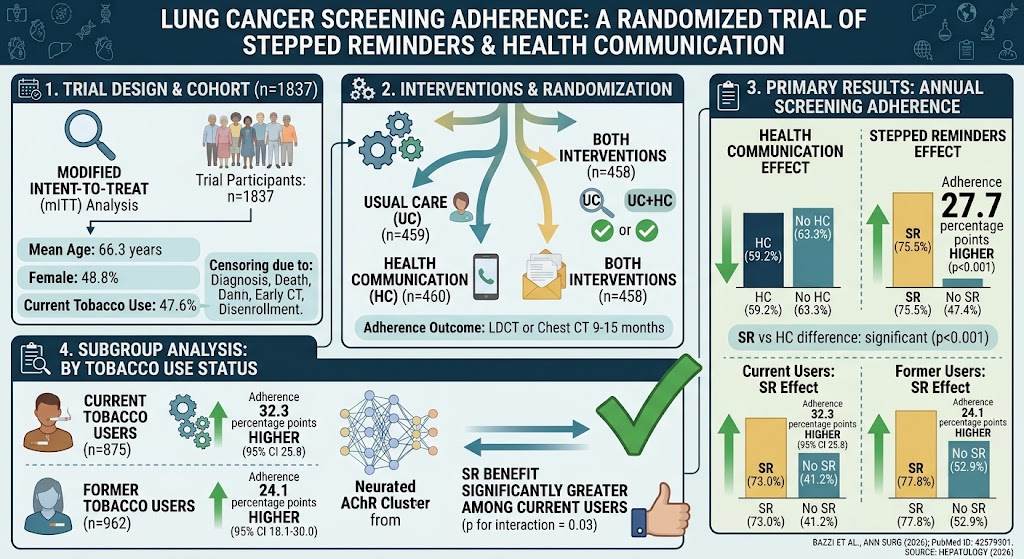
Wernli et al. conducted a pragmatic 2×2 factorial randomized clinical trial at Kaiser Permanente Washington between November 2022 and April 2024, enrolling 1,837 participants aged approximately 66 years who had completed LCS with normal findings. Participants were randomized into four arms: usual care, health communication intervention, stepped reminders intervention, or both interventions combined.
- Health Communication Intervention: Targeted print and video materials addressing knowledge gaps, normalizing LCS, providing timing reminders, and encouraging social engagement.
- Stepped Reminders Intervention: EHR-facilitated pendings of LDCT scan orders for primary care physicians (PCPs) and proactive patient outreach to schedule scans, coordinated by a system-level lung cancer screening coordinator.
2. Primary Outcome and Efficacy
The primary endpoint was guideline-concordant annual screening completion, defined as LDCT or chest CT performed within 9 to 15 months after the index LDCT. Key findings included:
- Stepped Reminders Benefit: Screening adherence significantly increased by 27.7 percentage points (75.5% vs 47.4%; relative risk [RR], 1.59; 95% CI, 1.47-1.72; P < .001) in participants receiving stepped reminders compared to those not receiving them.
- Health Communication Impact: Surprisingly, the health communication group exhibited a slight but statistically significant decrease in adherence by 4.7 percentage points (59.2% vs 63.3%; RR, 0.93; 95% CI, 0.86-1.00; P = .04) relative to participants not receiving this intervention.
- Tobacco Use Interaction: Current smokers receiving stepped reminders had a greater increase in adherence (73.0% vs 41.2%; risk difference 32.3 percentage points) compared with former smokers (77.8% vs 52.9%; risk difference 24.1 percentage points) indicating tailored effectiveness (P for interaction = .03).
3. Complementary Evidence and Broader Context
Other recent randomized trials reinforce the potential of multilevel interventions in lung cancer screening programs:
- The “Ready to Screen” trial in Australia explored bundled implementation strategies incorporating multilingual digital resources and clinician decision support, targeting intention to screen but with outcomes pending full publication (PMID: 41872901).
- The MyLungHealth trial evaluated integration of patient-centered EHR tools and clinical decision support, demonstrating improved identification of eligible patients and increased LDCT ordering, albeit with modest absolute effects (PMID: 41452617).
- The Larch Trial health communication sub-study showed improved patient knowledge of LCS timeliness but highlighted the lack of direct impact on adherence (PMID: 40939933), consistent with the main trial findings.
- Pragmatic trials in other cancer screenings such as breast cancer mammography reveal mixed effects of behavioral interventions, underscoring the need for tailored strategies and robust implementation frameworks (PMID: 41212556).
4. Mechanistic and Implementation Insights
The effectiveness of stepped reminders can be mechanistically explained by reducing cognitive load and system-level fragmentation:
- By pend ordering tasks to PCPs in EHR workflows, clinical inertia and oversight are minimized.
- Patient outreach with tailored scheduling reminders supports actionable steps and enhances engagement.
- Embedding interventions within existing clinical infrastructure emphasizes pragmatic scalability and sustainability.
Conversely, health communication alone may not suffice due to possible information overload, message fatigue, or pre-existing high baseline awareness in the studied population, requiring nuanced messaging strategies.
Expert Commentary
This landmark trial significantly advances the evidence base for multilevel interventions to enhance LCS adherence. The substantial adherence improvement with stepped reminders supports embedding system-facilitated, coordinated care approaches in primary care-driven LCS programs.
The counterintuitive finding that health communication alone decreased adherence suggests that knowledge augmentation without streamlined operational support may be insufficient or even detrimental, possibly due to unintended psychological or behavioral effects warranting further exploration.
Moreover, the differential effectiveness among current versus former tobacco users indicates the need for tailored interventions prioritizing populations with ongoing risk behaviors.
Clinical guidelines currently emphasize shared decision-making and informed consent for LCS but often lack detail on operational approaches to maximize adherence. This study provides pragmatic solutions aligned with ongoing healthcare digital transformation.
Limitations include a population predominantly White and insured within an integrated healthcare system, potentially limiting generalizability. Patient engagement metrics and qualitative assessments could further elucidate underlying behavioral mediators.
Conclusion
Adherence to annual lung cancer screening remains a critical public health challenge to realize screening benefits. Multilevel stepped reminder interventions, leveraging electronic health record integration and coordinated care, markedly improve annual LCS adherence in real-world primary care settings.
Standalone patient health communication alone may not improve adherence and can be counterproductive without accompanying system-level supports.
Future research should explore tailored, culturally sensitive multilevel interventions across diverse populations and healthcare systems, augmented by patient and provider engagement frameworks to optimize lung cancer screening uptake and equity.
References
- Wernli KJ, Anderson ML, Palazzo L, et al. Health Communication and Stepped Reminders Interventions for Lung Cancer Screening: A Randomized Clinical Trial. JAMA Intern Med. 2026;doi:10.1001/jamainternmed.2026.3666. PMID: 42574003
- Cameron LD, Turner RM, McCarthy M, et al. Effectiveness of Health Communication Intervention to Improve Knowledge on Timeliness to Return for Annual Lung Cancer Screening: The Larch Trial. Chest. 2026;169(2):550-561. doi:10.1016/j.chest.2025.07.4111. PMID: 40939933
- Yang H, Zhou Y, Su Y, et al. Enhancement of Patient-Centered Lung Cancer Screening: The MyLungHealth Randomized Clinical Trial. JAMA Oncol. 2026;12(2):167-176. doi:10.1001/jamaoncol.2025.5672. PMID: 41452617
- Kumar S, Conner M, Wilson J, et al. Ready to screen implementation trial protocol: a cluster randomized implementation trial comparing a bundled implementation strategy versus a simple implementation strategy to improve intention to screen in the Australian National Lung Cancer Screening Program. Implement Sci. 2026;21(1):29. doi:10.1186/s13012-026-01496-1. PMID: 41872901
- Rojas KE, Schroeder M, Lu M, et al. Pragmatic Interventions to Boost Surveillance Mammogram Uptake Among an Overdue Population: A Randomized Clinical Trial. JAMA Intern Med. 2026;186(1):27-35. doi:10.1001/jamainternmed.2025.5873. PMID: 41212556