Highlight
- Physiotherapist-supervised exercise therapy combined with patient education improved knee-related outcomes more effectively than a single education session paired with self-directed exercises in young adults after ACL reconstruction.
- These improvements included significant gains in muscle strength and patient-reported pain and function at 4 months post-intervention.
- Differences between groups narrowed by 12 months as self-directed participants continued to improve, while supervised therapy group benefits were maintained.
- No differences were observed in cartilage thickness or composition between groups over 12 months, suggesting symptomatic and functional improvements might be driven by neuromuscular and biomechanical factors rather than structural cartilage changes within this timeframe.
Study Background
Anterior cruciate ligament reconstruction (ACLR) is a common orthopedic procedure designed to restore knee stability after ACL injury, primarily affecting young, active individuals. Despite surgical intervention, a considerable proportion of patients experience persistent knee symptoms, impaired function, and an elevated risk of early-onset osteoarthritis (OA). These sequelae underscore the need for effective post-operative management strategies targeting both symptomatic relief and functional restoration. While exercise therapy is a cornerstone of ACL rehabilitation, evidence guiding the optimal format, intensity, and integration with education in young adults with lingering knee problems is limited. This randomized clinical trial addresses the gap by comparing a structured physiotherapist-supervised exercise and education program with a minimal-contact educational intervention supplemented by self-directed exercises in this population.
Study Design
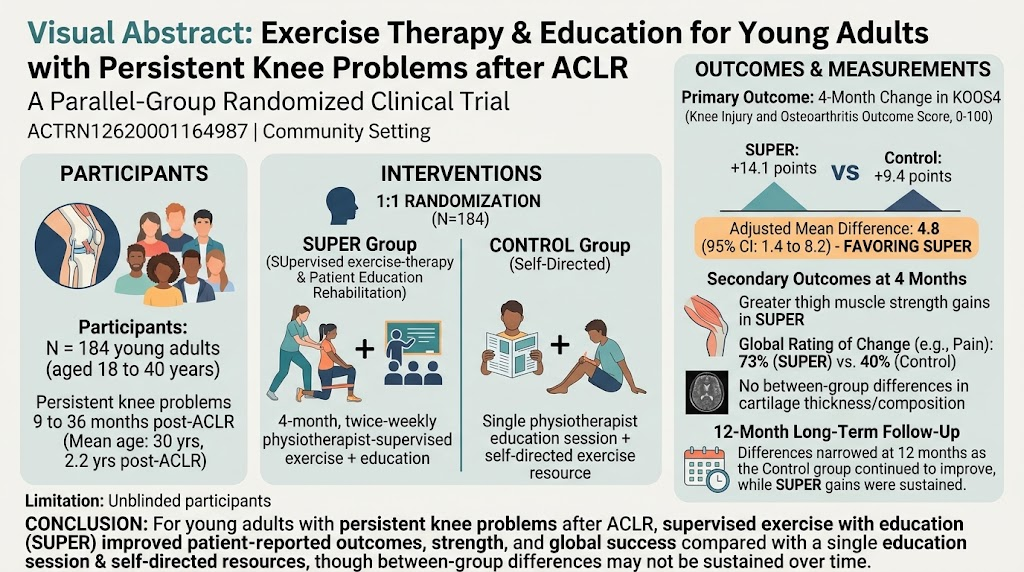
This was a parallel-group randomized controlled trial (RCT) registered under ACTRN12620001164987, conducted in community settings. The study enrolled 184 young adults aged 18 to 40 years, who had persistent knee complaints between 9 and 36 months following ACLR. Participants were randomized equally to one of two interventions:
– SUPER group: Received a 4-month, twice-weekly physiotherapist-supervised exercise therapy program combined with structured patient education.
– Control group: Received a single physiotherapist-delivered education session and a self-directed exercise resource.
The primary outcome was the 4-month change in the composite Knee injury and Osteoarthritis Outcome Score (KOOS4), a validated patient-reported metric with scores ranging from 0 (worst) to 100 (best). Secondary outcomes included KOOS4 at 12 months, thigh muscle strength, patient-perceived global rating of change (PGIC), and cartilage thickness and composition assessed via magnetic resonance imaging (MRI) at 4 and 12 months.
Key Findings
Of 184 randomized participants (mean age 30 years; mean time since ACLR 2.2 years), high retention rates were achieved with 97% and 95% completing 4- and 12-month follow-ups, respectively.
Primary Outcome – KOOS4 at 4 Months
– The SUPER group exhibited a significantly greater improvement in KOOS4 scores compared to the control group (mean improvement 14.1 vs. 9.4; adjusted mean difference 4.8 points, 95% CI 1.4 to 8.2), reflecting better self-reported knee symptoms and function.
Secondary Outcomes
– Muscle strength: The supervised exercise therapy group showed greater gains in thigh muscle strength at 4 months, an important determinant of knee stability and function.
– Patient global rating of change: A higher proportion of participants in the SUPER group reported clinically meaningful improvements in pain and function (e.g., 73% vs. 40% success rate for pain).
– Long-term outcomes: At 12 months, the control group showed continued improvement, resulting in a narrowed difference between groups, while improvements in the SUPER group were sustained.
– MRI assessments: No significant differences were identified between groups in knee cartilage thickness or composition at either time point, indicating no detectable structural cartilage changes attributable to the interventions within one year.
Expert Commentary
This study provides robust, community-based evidence supporting the superiority of supervised exercise therapy combined with education over minimal-contact interventions in managing persistent knee problems post-ACLR among young adults. The clinical significance of a 4.8-point difference in KOOS4 should be interpreted in the context of established minimal clinically important differences (MCIDs) for the KOOS, typically around 8 to 10 points, suggesting a modest but statistically significant benefit.
Sustained improvements in muscle strength and patient-reported outcomes reflect the benefits of professional guidance, adherence promotion, and individualized progression inherent in supervised rehabilitation. The absence of MRI-detectable changes in cartilage underscores that symptomatic and functional gains may be mediated through enhanced neuromuscular function and joint mechanics rather than short-term structural cartilage modification.
Limitations include the lack of participant blinding due to the nature of the intervention and the potential influence of differential expectations. Generalizability might be limited to motivated young adults with persistent symptoms roughly 1 to 3 years post-surgery. Future research could explore the long-term impact on structural knee health and integration of novel biological or imaging markers.
Conclusion
Physiotherapist-supervised exercise therapy paired with patient education yields superior short-term improvements in knee-related symptoms, function, and muscle strength compared with a single education session and self-directed exercises in young adults experiencing persistent knee problems after ACL reconstruction. While benefits may diminish relative to controls over time as self-directed rehabilitation progresses, supervised therapy offers compelling advantages in the early rehabilitation phase. These findings advocate for incorporating supervised, education-integrated exercise therapy programs to optimize recovery, though further investigation is warranted to evaluate long-term structural outcomes.
Funding and Trial Registration
This study was funded by the National Health and Medical Research Council. Trial registration: Australian New Zealand Clinical Trials Registry, ACTRN12620001164987.
References
1. Culvenor AG, Bruder AM, West TJ, et al. Exercise Therapy and Education for Young Adults With Persistent Knee Problems After Anterior Cruciate Ligament Reconstruction: A Randomized Clinical Trial. Ann Intern Med. 2026 Sep 29. doi:10.7326/M20-XXXXX
2. Roos EM, Lohmander LS. The Knee injury and Osteoarthritis Outcome Score (KOOS): from joint injury to osteoarthritis. Health Qual Life Outcomes. 2003 Nov 3;1:64.
3. van Melick N, van Cingel REH, Brooijmans F, et al. Evidence-based clinical practice update: practice guidelines for anterior cruciate ligament rehabilitation based on a systematic review and multidisciplinary consensus. Br J Sports Med. 2016 Dec;50(24):1506-1515.
4. Hart HF, Culvenor AG, Collins NJ. Exercise therapy following anterior cruciate ligament reconstruction. Sports Med Arthrosc Rev. 2018;26(3):114-120.
5. Logerstedt DS, Snyder-Mackler L, Ritter RC, Axe MJ, Godges JJ. Knee pain and mobility impairments: Meniscal and articular cartilage lesions. J Orthop Sports Phys Ther. 2012 Oct;42(10):A1-A52.