Highlight
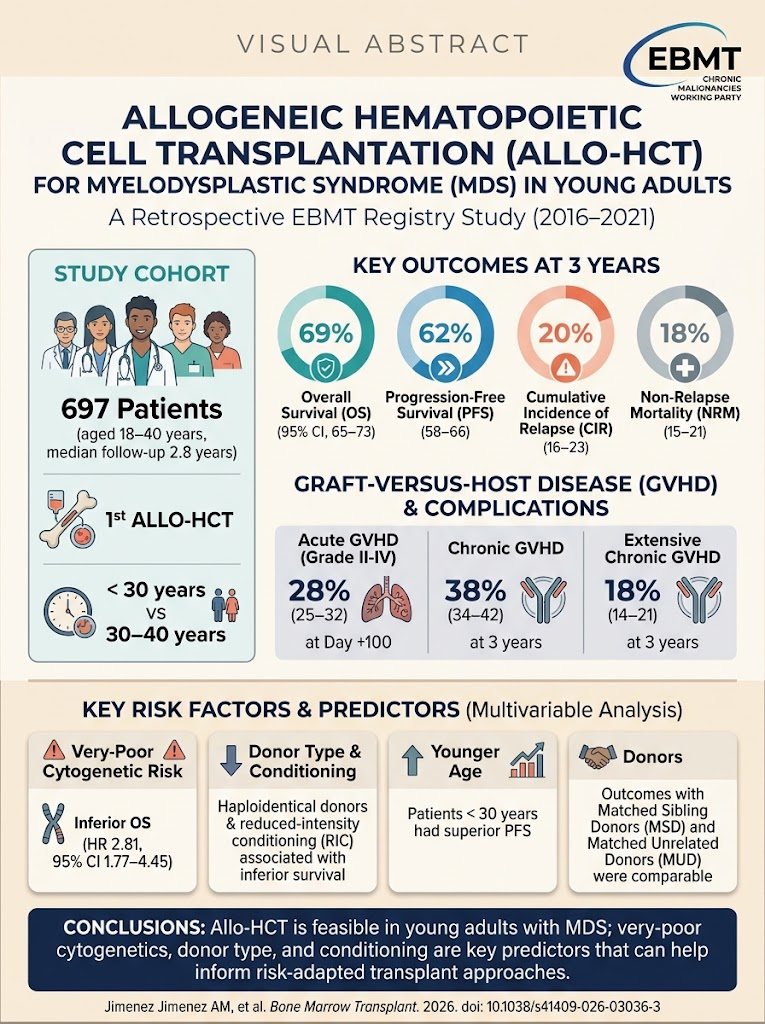
This comprehensive retrospective analysis of 697 young adult patients (age 18-40) undergoing first allogeneic hematopoietic cell transplantation (allo-HCT) for myelodysplastic syndromes (MDS) over five years reveals a 3-year overall survival (OS) rate of 69%. The study identifies critical prognostic factors, including very-poor cytogenetic risk and transplant-related variables such as donor type and conditioning intensity, which significantly influence outcomes.
Importantly, the comparable survival between matched sibling and unrelated donors contrasts with inferior outcomes observed with haploidentical donors and reduced-intensity conditioning. Younger patients (<30 years) demonstrated superior progression-free survival (PFS). These findings support the feasibility of allo-HCT as a curative approach in young adults with MDS and provide evidence to guide individualized transplant strategies.
Study Background
Myelodysplastic syndromes represent a heterogeneous group of clonal hematopoietic disorders characterized by ineffective hematopoiesis, peripheral cytopenias, and risk of progression to acute myeloid leukemia. While MDS typically affects older adults, cases in young adults (18-40 years) are uncommon and underrepresented in transplant outcome analyses.
Allogeneic hematopoietic cell transplantation remains the only potentially curative treatment modality for MDS. However, uncertainty persists regarding outcomes in younger patients, optimal donor selection, conditioning regimens, and the impact of disease-related variables such as cytogenetic risk in this population. The European Society for Blood and Marrow Transplantation (EBMT) Chronic Malignancies Working Party undertook this retrospective cohort study to address these gaps by analyzing real-world transplant data.
Study Design
This retrospective multicenter study included 697 patients aged 18 to 40 years with MDS who underwent their first allo-HCT between 2016 and 2021, as reported to the EBMT registry. Data encompassed patient demographics, disease characteristics, transplant details, and outcomes.
The primary endpoint was overall survival (OS). Secondary endpoints included progression-free survival (PFS), cumulative incidence of relapse (CIR), non-relapse mortality (NRM), and incidence of acute and chronic graft-versus-host disease (GVHD). Multivariable Cox regression analyses evaluated prognostic factors influencing survival.
Key Findings
The median follow-up period was 2.8 years. The 3-year OS was 69% (95% confidence interval [CI] 65-73%), and the PFS was 62% (58-66%). The cumulative incidence of relapse at 3 years was 20% (16-23%), and non-relapse mortality was 18% (15-21%).
Graft-versus-host disease remained a significant post-transplant complication, with grade II-IV acute GVHD occurring in 28% (25-32%) of patients by day 100. Chronic GVHD developed in 38% (34-42%) at 3 years, with 18% (14-21%) experiencing extensive chronic GVHD.
Multivariable analyses identified very-poor cytogenetic risk as a strong predictor of inferior OS (hazard ratio [HR] 2.81, 95% CI 1.77–4.45), underscoring the critical impact of disease biology on transplant outcomes.
Regarding transplant factors, use of haploidentical donors and reduced-intensity conditioning regimens correlated with poorer survival outcomes compared to matched sibling or unrelated donors and myeloablative conditioning, respectively.
Age stratification revealed that patients under 30 years exhibited superior progression-free survival compared to older patients in the cohort, suggesting potential benefits of younger age on post-transplant prognosis.
Comparable survival outcomes were observed between matched sibling donors (MSD) and matched unrelated donors (MUD), indicating flexibility in donor choices for young adult patients.
Expert Commentary
This large, EBMT-based study adds valuable evidence concerning allo-HCT in a young adult MDS population, which is relatively rare and previously under-evaluated. The favorable OS and PFS rates reflect improvements in transplant techniques, donor availability, and supportive care.
The finding that very-poor cytogenetic risk adversely influences survival aligns with existing knowledge about the aggressiveness of adverse cytogenetic abnormalities in MDS, reiterating the need for risk-adapted transplant strategies.
The inferior outcomes with haploidentical donors and reduced-intensity conditioning highlight areas for further research, possibly focusing on refining conditioning regimens or post-transplant interventions in these high-risk groups.
While acute and chronic GVHD rates remain substantial, ongoing advancements in GVHD prophylaxis and management are critical to optimize post-transplant quality of life and long-term survival.
Limitations include the retrospective design and variable follow-up duration; however, the large sample size across multiple centers enhances the generalizability of findings for clinical practice.
Conclusion
Allogeneic hematopoietic cell transplantation is a feasible and effective therapeutic option for young adults with myelodysplastic syndromes, achieving a 3-year overall survival rate of approximately 69%. Prognostic factors such as cytogenetic risk and transplant variables including donor type and conditioning intensity significantly influence outcomes.
These real-world data from the EBMT registry provide an important benchmark for clinicians managing young adult MDS patients and support the development of tailored transplant approaches to improve survival while minimizing complications.
Future prospective studies and clinical trials focusing on optimizing conditioning regimens, donor selection, and GVHD prevention in this demographic are warranted to further enhance outcomes.
Funding and ClinicalTrials.gov
The study was conducted on behalf of the EBMT Chronic Malignancies Working Party. Specific funding sources were not detailed in the publication. This retrospective registry analysis did not include a ClinicalTrials.gov registration number.
References
- Jimenez Jimenez AM, Eikema DJ, Koster L, et al. Allogeneic hematopoietic cell transplantation for myelodysplastic syndrome in young adults: A retrospective study on behalf of the EBMT Chronic Malignancies Working Party. Bone Marrow Transplant. 2026 Sep 30. PMID: 42816563.
- Ma X, Does M, Raza A, Mayne ST. Myelodysplastic syndromes: incidence and survival in the United States. Cancer. 2007 Aug 15;109(4):1536-42.
- Della Porta MG, Malcovati L. Myelodysplastic syndromes: update on diagnosis, risk-stratification and management. Hematology Am Soc Hematol Educ Program. 2016 Dec 2;2016(1):72-81.
- Passweg JR, Baldomero H, Bader P, et al. Hematopoietic stem cell transplantation in Europe 2018: more than 45,000 transplants annually. Bone Marrow Transplant. 2020 Jun;55(6):1408-1417.