Highlight
The PACER randomized clinical trial evaluated telehealth cognitive behavioral therapy (CBT) interventions versus primary care referral in patients discharged from the emergency department (ED) with low-risk chest pain (LRCP) and anxiety. Peer-supported internet-based CBT (iCBT) produced statistically significant anxiety reduction over 12 months compared with usual care, especially in patients with severe anxiety. Both therapist-delivered CBT and peer-supported iCBT were well received, demonstrating high patient satisfaction and therapeutic alliance.
Study Background
Chest pain is among the most common reasons for emergency department visits, yet most cases are classified as low-risk chest pain (LRCP) once acute coronary syndrome is excluded. Despite low cardiovascular risk, many patients with LRCP experience persistent anxiety, a condition often undiagnosed and undertreated. Anxiety in this population can adversely affect quality of life, healthcare utilization, and overall functional status. Cognitive behavioral therapy (CBT) is an evidence-based intervention for anxiety disorders, but access to CBT remains limited, especially after ED discharge. Telehealth delivery of CBT represents a scalable approach to improve access and outcomes.
Study Design
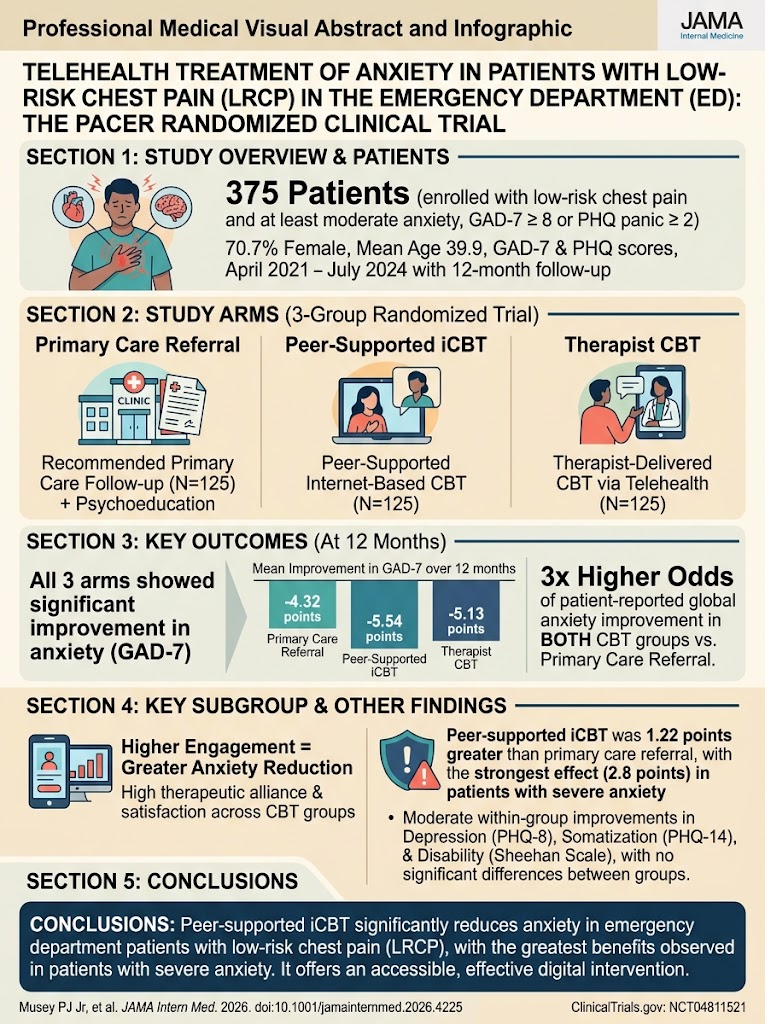
The Patient-Centered Treatment of Anxiety After Low-Risk Chest Pain in the Emergency Room (PACER) trial was a 3-arm randomized comparative effectiveness study conducted across six university-affiliated EDs between April 2021 and July 2024, with follow-up extending to July 2025. Adults discharged from the ED with LRCP and at least moderate anxiety, defined by a Generalized Anxiety Disorder-7 (GAD-7) score ≥8 or Patient Health Questionnaire (PHQ) panic screener score ≥2, were enrolled. Participants (N=375) were randomized to one of three groups: (1) recommended primary care follow-up with psychoeducation, (2) peer-supported internet-based CBT (iCBT) with psychoeducation, or (3) therapist-delivered CBT via telehealth plus psychoeducation. Outcomes were assessed at 3, 6, 9, and 12 months, with the primary endpoint being change in GAD-7 anxiety scores.
Key Findings
The cohort comprised predominantly female participants (70.7%), with a mean age of 39.9 years, and diverse racial/ethnic representation (33.3% Black, 7.5% Hispanic, 60.3% White, and 5.9% other). All three groups demonstrated significant improvements in anxiety over 12 months: adjusted mean GAD-7 reductions of 4.32 points for primary care referral, 5.54 points for peer-supported iCBT, and 5.13 points for therapist-delivered CBT. Importantly, peer-supported iCBT reduced anxiety scores by an additional 1.22 points compared to primary care (95% CI 0.01–2.43, effect size 0.25), a clinically meaningful effect size given the pooled baseline SD of 4.83. The effect was most pronounced among patients with severe baseline anxiety, with up to 2.8 points greater improvement.
Secondary outcomes including PHQ-8 depression scores, PHQ-14 somatization scores, and Sheehan Disability Scale scores improved modestly across all groups, with no statistically significant differences between interventions. Patient-reported global anxiety improvement odds were threefold higher in both CBT groups relative to primary care referral. Higher program engagement correlated with greater anxiety reduction, underscoring the importance of adherence. Therapeutic alliance and patient satisfaction ratings were high in both telehealth CBT groups, reflecting acceptability and feasibility of remote behavioral interventions.
Expert Commentary
The PACER trial provides impactful evidence supporting telehealth-delivered CBT, particularly peer-supported iCBT, as an effective modality for reducing anxiety in patients with LRCP post-ED discharge. This is clinically important given the high prevalence of anxiety in this population and barriers to accessing in-person mental health therapies. The modest but significant superiority of peer-supported iCBT over primary care referral challenges the conventional reliance on standard follow-up care and highlights potential scalability benefits of internet-based approaches, which can improve access while reducing healthcare system burdens.
Nevertheless, the lack of significant differences between therapist-delivered CBT and peer-supported iCBT suggests that the less resource-intensive peer model can be a practical alternative, especially for health systems with limited mental health workforce capacity. Limitations include the study population’s predominance of female and middle-aged adults, which may impact generalizability. Additionally, longer-term benefits beyond one year and effects on healthcare utilization metrics warrant further study.
Conclusion
The PACER randomized clinical trial establishes that telehealth-delivered cognitive behavioral therapy, particularly peer-supported internet-based CBT, significantly improves anxiety outcomes in patients with low-risk chest pain discharged from the emergency department. This intervention is especially impactful for patients with severe anxiety and demonstrates strong patient engagement and satisfaction. These findings support integrating telehealth CBT into post-ED care pathways to address anxiety, an often overlooked yet impactful comorbidity in this population. Future research should evaluate implementation strategies and long-term outcomes including health economics and quality of life measures.
Funding and ClinicalTrials.gov
The study was registered at ClinicalTrials.gov (Identifier: NCT04811521). Funding sources were not detailed in the abstract. The trial adhered to rigorous randomized clinical trial standards across multiple university-affiliated ED sites.
References
- Musey PI, Kroenke K, Connors JN, et al. Telehealth Treatment of Anxiety in Patients With Low-Risk Chest Pain in the Emergency Department: The PACER Randomized Clinical Trial. JAMA Intern Med. 2026 Sep 28. doi:10.1001/jamainternmed.2026.42804196.
- Kroenke K, Spitzer RL, Williams JB. The PHQ-9: validity of a brief depression severity measure. J Gen Intern Med. 2001 Sep;16(9):606-13.
- Donker T, Griffiths KM, Cuijpers P, Christensen H. Psychoeducation for depression, anxiety and psychological distress: a meta-analysis. BMC Med. 2009 Jul 17;7:79.
- Strecher VJ, McClure J, Alexander G, et al. Web-based smoking cessation programs: results of a randomized trial. Am J Prev Med. 2008 May;34(5):373-81.