Highlight
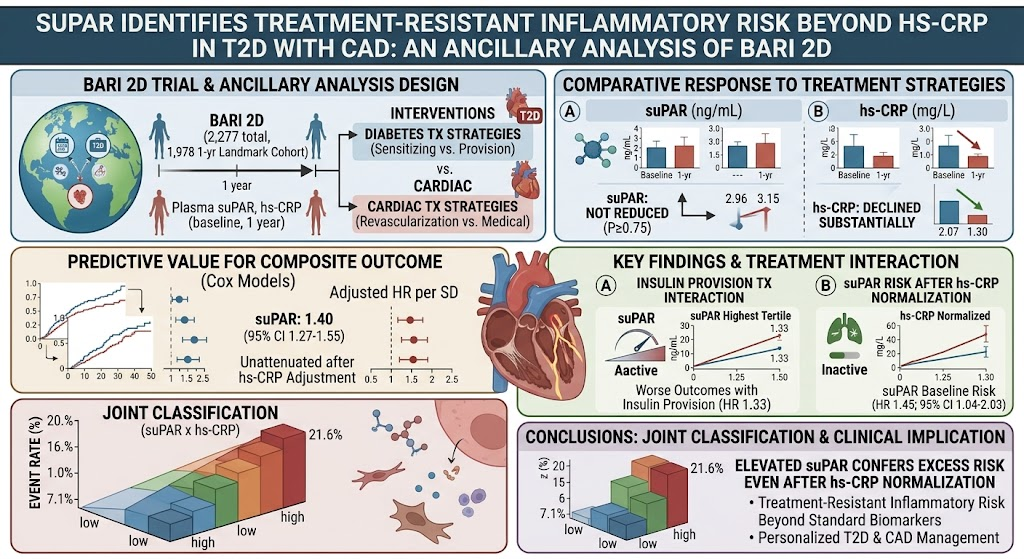
This ancillary analysis from the BARI 2D trial reveals that soluble urokinase plasminogen activator receptor (suPAR) remains elevated and is unaffected by diabetes or revascularization treatment strategies over one year in patients with type 2 diabetes and coronary artery disease, whereas hs-CRP levels significantly decline. suPAR independently predicts adverse cardiovascular outcomes beyond hs-CRP, and combined classification with hs-CRP identifies a high-risk group even after hs-CRP normalization, underscoring suPAR’s role as a marker of treatment-resistant inflammation.
Study Background
Inflammation plays a critical role in the pathogenesis and progression of atherosclerotic cardiovascular disease (CVD), particularly in patients with type 2 diabetes mellitus (T2DM), who have an elevated risk of coronary artery disease (CAD) and adverse cardiovascular events. High-sensitivity C-reactive protein (hs-CRP) is a well-established biomarker widely used to assess systemic inflammation and cardiovascular risk. However, residual inflammatory risk persists in many patients despite guideline-directed medical therapy, and alternative markers may identify this treatment-resistant inflammatory risk.
Soluble urokinase plasminogen activator receptor (suPAR), a circulating immune activation marker, has emerged as a potential biomarker that might capture inflammatory pathways not reflected by hs-CRP. Understanding how suPAR behaves in treated T2DM patients with CAD and its prognostic value beyond hs-CRP is of clinical relevance, especially for tailoring therapies targeting residual risk.
Study Design
This ancillary analysis utilizes plasma samples from the Bypass Angioplasty Revascularization Investigation 2 Diabetes (BARI 2D) trial, a multicenter randomized controlled trial involving patients with T2DM and documented CAD. The original trial compared treatment strategies involving diabetes management (insulin sensitization versus insulin provision) and cardiac intervention (prompt revascularization versus medical therapy alone).
In this analysis, suPAR and hs-CRP concentrations were measured at baseline in 2,277 participants and again at one year in 1,978 participants (landmark cohort). The study evaluated the changes in suPAR and hs-CRP levels in response to randomized diabetes and CAD treatment strategies over one year. The primary composite endpoint comprised all-cause mortality, nonfatal myocardial infarction (MI), or nonfatal stroke.
Associations between biomarker levels and outcomes were assessed using sequentially adjusted Cox proportional hazards models. Exploratory analyses evaluated whether suPAR modified the effect of diabetes treatment on outcomes and whether combined suPAR and hs-CRP classification refined cardiovascular risk prediction.
Key Findings
Biomarker Changes over One Year
Over the first year, suPAR concentrations showed no significant change regardless of diabetes treatment strategy (insulin sensitizing versus insulin provision) or cardiac treatment (revascularization versus medical therapy). The median suPAR levels remained stable, ranging from 2.96 to 3.15 ng/mL with nonsignificant P values (≥ 0.75) across treatment arms.
In contrast, hs-CRP levels declined substantially, with median values dropping from 2.07 to 1.30 mg/L, indicating effective systemic inflammation reduction with standard medical optimization.
Prognostic Value of suPAR and hs-CRP
Higher baseline suPAR concentrations were independently associated with increased risk of the composite cardiovascular outcome. Specifically, each standard deviation increase in suPAR conferred a 40% higher risk (adjusted hazard ratio [HR] 1.40; 95% confidence interval [CI], 1.27 to 1.55), persisting even after adjusting for hs-CRP levels.
This indicates that suPAR captures residual inflammatory risk beyond what is reflected by hs-CRP.
Interaction with Diabetes Treatment Strategy
An exploratory interaction analysis revealed that suPAR levels modified the effect of diabetes treatment on outcomes (P-interaction = 0.005). In the highest tertile of suPAR, patients on insulin provision therapy experienced significantly worse cardiovascular outcomes compared with insulin sensitization (HR 1.33; 95% CI 1.03 to 1.72). This suggests that suPAR may identify a subgroup more vulnerable to specific diabetes treatments.
Risk Stratification Using Combined suPAR and hs-CRP
Among participants whose hs-CRP normalized after one year, baseline suPAR remained a significant predictor of cardiovascular events (HR 1.45; 95% CI 1.04 to 2.03), highlighting suPAR’s capacity to discern residual risk despite apparent resolution of systemic inflammation shown by hs-CRP.
Joint classification by suPAR and hs-CRP revealed a threefold gradient in event rates, ranging from 7.1% in those with low levels of both markers to 21.6% in those with elevated suPAR irrespective of hs-CRP level. Elevated suPAR conferred excess risk even when hs-CRP levels normalized, illustrating the complementary and additive value of these biomarkers in risk stratification.
Expert Commentary
The findings position suPAR as a promising biomarker reflecting treatment-resistant inflammatory pathways that hs-CRP does not capture in T2DM patients with CAD. This has important clinical implications, as conventional therapies that reduce hs-CRP may not sufficiently address suPAR-related pathways of immune activation, potentially explaining persistent cardiovascular risk despite optimized treatment.
The observation that insulin provision increases risk in patients with elevated suPAR suggests that inflammation-dependent diabetes management personalization could enhance outcomes. However, the exploratory nature of these interaction findings warrants further investigation.
Mechanistically, suPAR is released from activated immune cells and has been implicated in endothelial dysfunction, atherosclerosis progression, and plaque instability — processes not fully captured by acute phase reactants like CRP. Thus, suPAR may better reflect chronic, low-grade inflammation and immune activation relevant in high-risk diabetic populations.
Limitations include the observational ancillary design, which limits causal inferences, and the focus on a specific high-risk cohort, possibly limiting generalizability. Further prospective studies and clinical trials are needed to validate suPAR’s utility in guiding therapies and to explore targeted anti-inflammatory interventions for suPAR-positive patients.
Conclusion
This ancillary analysis of the BARI 2D trial demonstrates that suPAR identifies a treatment-resistant inflammatory risk phenotype beyond hs-CRP in patients with type 2 diabetes and coronary artery disease. While current diabetes and CAD treatment strategies effectively lower hs-CRP, suPAR levels remain unchanged and continue to predict adverse cardiovascular events. Integrating suPAR and hs-CRP improves residual risk stratification and may guide personalized therapeutic approaches targeting persistent inflammation. These findings advocate for further research into suPAR-guided interventions to reduce cardiovascular morbidity and mortality in this high-risk population.
Funding and Clinical Trials Registry
The BARI 2D trial was supported by grants from the National Heart, Lung, and Blood Institute. The ancillary biomarker analyses were conducted under the auspices of the original trial consent and institutional protocols. The clinical trial is registered under ClinicalTrials.gov identifier NCT00000620.
References
- Ismail A, Huang Y, Ghazzal B, et al. suPAR Identifies Treatment-Resistant Inflammatory Risk Beyond hs-CRP in Type 2 Diabetes With Coronary Artery Disease: An Ancillary Analysis of BARI 2D. Diabetes Care. 2026 Aug 11. PMID: 42579565.
- Ridker PM, Cushman M, et al. Inflammation, aspirin, and the risk of cardiovascular disease in apparently healthy men. N Engl J Med. 1997;336(14):973-9.
- Hayek SS, Sever S, Ko YA, et al. Soluble urokinase receptor and chronic kidney disease. N Engl J Med. 2015;373(20):1916-25.
- Thygesen K, Alpert JS, Jaffe AS, et al. Third universal definition of myocardial infarction. Circulation. 2012;126(16):2020-35.