Introduction to Adrenarche and Its Molecular Regulation
Adrenarche is a critical developmental phase typically occurring in mid-childhood, marked by the maturation of the adrenal zona reticularis (ZR), which leads to increased secretion of adrenal androgens. Despite its clinical significance as a precursor to puberty, the precise molecular mechanisms orchestrating this maturation remain incompletely understood. Emerging evidence suggests microRNAs (miRNAs), small non-coding RNA molecules that regulate gene expression post-transcriptionally, may play important roles in adrenal development and function.
Objective of the Study
This study aimed to explore whether specific circulating miRNAs are associated with the maturation of the adrenal ZR during adrenarche and to characterize how candidate miRNAs affect adrenal steroid hormone production (steroidogenesis) at the cellular level. Understanding these mechanisms could provide novel insights into adrenal gland development and disorders related to premature or delayed adrenarche.
Study Design and Participants
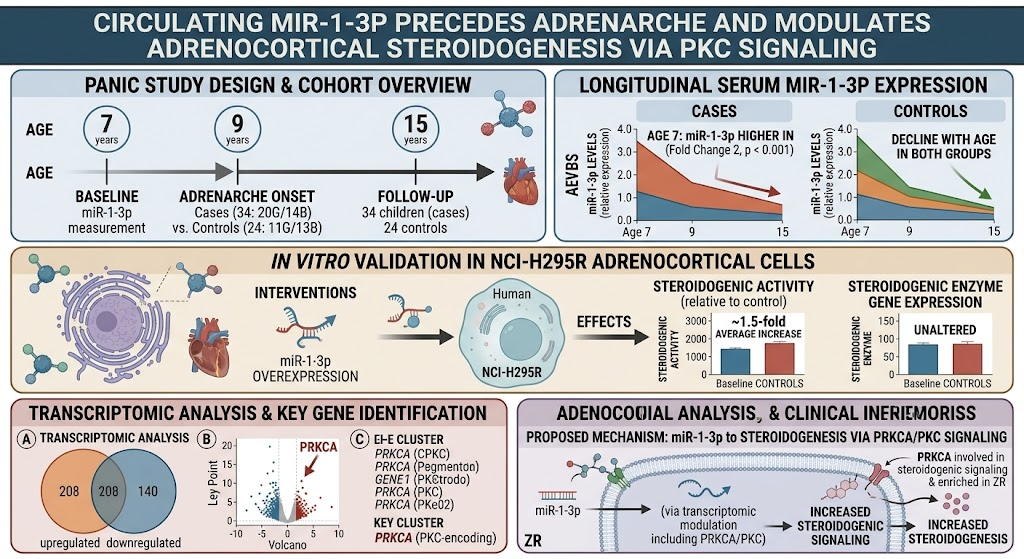
The investigation was conducted as a prospective cohort nested within the population-based PANIC (Physical Activity and Nutrition in Children) study, with serial follow-ups at ages 7, 9, and 15 years. The study population comprised 34 children (20 girls) who exhibited clinical and/or biochemical signs of adrenarche at age 9 years, forming the ‘cases’ group, and 24 matched controls (11 girls) without these signs. This design allowed longitudinal analysis of serum miRNA levels preceding and during adrenarche.
Methods: Measuring miRNAs and Functional Testing In Vitro
Serum samples from participants were analyzed to quantify miRNA expression levels longitudinally over childhood and adolescence. Among candidate miRNAs, miR-1-3p showed a notable increase in cases before clinical signs of adrenarche.
To assess the functional role of miR-1-3p, in vitro experiments were performed using the human adrenocortical carcinoma cell line NCI-H295R, a well-established model for investigating adrenal steroidogenesis. Cells were manipulated to overexpress miR-1-3p, and effects on steroid hormone production and gene expression were measured. Transcriptome-wide analyses identified genes regulated by miR-1-3p, including those involved in signal transduction pathways relevant to adrenal function.
Key Results
– Circulating serum levels of miR-1-3p were significantly elevated approximately twofold in children who later developed clinical signs of adrenarche at age 7, preceding overt hormonal changes (p < 0.001).
– In both the adrenarche cases and controls, miR-1-3p levels gradually declined through progressing adrenarche and puberty.
– Overexpression of miR-1-3p in NCI-H295R cells stimulated steroidogenic activity by about 1.5 times but did not alter the expression of the classical steroidogenic enzyme genes directly.
– Transcriptomic analysis demonstrated a broad regulatory impact, with 208 genes upregulated and 140 downregulated by miR-1-3p. Among these was the PRKCA gene, encoding protein kinase C alpha (PKCα), a signaling molecule enriched in the zona reticularis and instrumental in steroidogenic signaling.
Interpretation and Implications
This study provides the first evidence that higher circulating levels of miR-1-3p precede the clinical onset of adrenarche, suggesting its potential as an early biomarker. Functionally, miR-1-3p enhances adrenal steroid hormone biosynthesis not by altering canonical steroidogenic enzymes but likely through modulation of intracellular signaling pathways, particularly involving PKC. The gradual decline in circulating miR-1-3p with advancing puberty supports its role in the temporal regulation of adrenal maturation.
Protein kinase C signaling is known to affect multiple facets of adrenal cortical cell function, including steroidogenesis. MiR-1-3p’s regulation of PRKCA highlights a non-canonical pathway by which adrenal function can be fine-tuned beyond gene expression of steroidogenic enzymes.
Broader Context and Future Directions
Understanding mechanisms governing adrenarche is essential, as aberrant timing can contribute to disorders such as premature adrenarche linked to polycystic ovary syndrome (PCOS) and other endocrine abnormalities. MiRNAs offer promising targets for diagnostic and therapeutic strategies due to their stability in circulation and regulatory versatility.
Future research should investigate the clinical utility of measuring miR-1-3p as a predictor of adrenarche onset and explore therapeutic modulation of this miRNA or its downstream pathways in adrenal disorders. Additional studies are needed to clarify whether miR-1-3p directly regulates PRKCA translation or affects upstream regulatory networks.
Conclusion
Elevated circulating miR-1-3p serves as an early marker preceding clinical adrenarche and enhances adrenal steroidogenesis through modulation of protein kinase C signaling pathways. These findings advance our understanding of adrenal gland maturation and highlight miR-1-3p’s potential role in regulating the functional transition of the adrenal zona reticularis during childhood development.
Reference
Liimatta J, Altinkilic EM, du Toit T, Raitoharju E, Augsburger P, Vögel CD, Perren A, Jääskeläinen J, Lakka TA, Flück CE. Circulating miR-1-3p precedes adrenarche and modulates adrenocortical steroidogenesis via protein kinase C signaling. J Clin Endocrinol Metab. 2026 Aug 19:dgag341. doi: 10.1210/clinem/dgag341. Epub ahead of print. PMID: 42615123.