Highlights
- Statin therapy is associated with a significant reduction in hepatic decompensation risk in patients with primary biliary cholangitis (PBC).
- A target trial emulation (TTE) study across two distinct populations confirms this protective association, consistent across cirrhotic and non-cirrhotic patients.
- Statin use also lowers the incidence of major adverse liver outcomes (MALO), including hepatocellular carcinoma and liver transplantation.
- The findings support a potential role for statins as adjunct therapy in the clinical management of PBC to prevent liver-related complications.

Background
Primary biliary cholangitis (PBC) is a chronic autoimmune cholestatic liver disease characterized by progressive destruction of small intrahepatic bile ducts, leading to cholestasis, fibrosis, and eventual cirrhosis. Although ursodeoxycholic acid (UDCA) and newer agents like obeticholic acid have improved outcomes, many patients remain at risk for liver-related complications including hepatic decompensation, hepatocellular carcinoma (HCC), and need for liver transplantation.
Statins, widely prescribed lipid-lowering agents, have demonstrated pleiotropic effects beyond lipid control, including antifibrotic, anti-inflammatory, and immunomodulatory properties. Observational studies and randomized trials in various chronic liver diseases, such as hepatitis C and nonalcoholic fatty liver disease (NAFLD), suggest statins may reduce fibrosis progression and portal hypertension, thereby lowering decompensation risk. However, their role in PBC has been less clear, partly due to concerns about hepatotoxicity and limited prospective evidence.
Key Content
Chronological Development of Evidence on Statins in Liver Disease
Early investigations focused on statins’ cardiovascular benefits while reporting incidental hepatoprotective effects in chronic liver disease cohorts. Meta-analyses in the 2010s began to consolidate data showing that statin use decreased portal hypertension and liver-related mortality in cirrhotics. Recent studies extended these observations to autoimmune liver diseases, including PBC, but evidence remained limited by retrospective design and confounding biases.
Target Trial Emulation Study in PBC
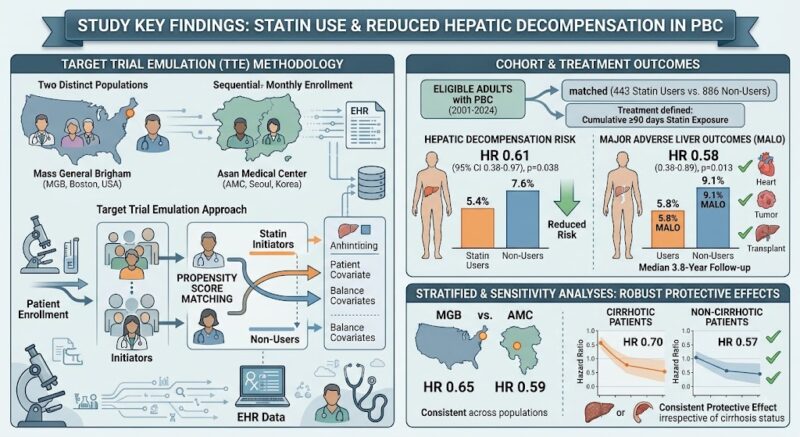
The seminal study by Choi et al. (2026) applies a target trial emulation (TTE) methodology, leveraging robust electronic health record (EHR) data from two institutions: Mass General Brigham (MGB, Boston, USA) and Asan Medical Center (AMC, Seoul, Korea). The TTE approach mimics a randomized controlled trial design by sequentially enrolling patients monthly and employing propensity score matching to balance covariates between statin initiators and non-users.
Eligible adults with PBC diagnosed between 2001 and 2024 were included, with statin exposure defined as a cumulative duration ≥90 days. Of 2889 eligible participants, 443 statin users were matched 1:2 to 886 non-users. Over a median 3.8-year follow-up, hepatic decompensation occurred less frequently in statin users (5.4%) compared to non-users (7.6%) with a hazard ratio (HR) of 0.61 (95% CI 0.38-0.97). Similarly, statin use reduced the composite major adverse liver outcome (MALO) comprising hepatic decompensation, HCC, and liver transplantation (HR 0.58; 95% CI 0.38-0.89).
Stratified sensitivity analyses revealed consistent protective effects across two distinct populations and irrespective of cirrhosis status (HR 0.70 for cirrhosis and 0.57 for non-cirrhotic). These findings support generalizability and robustness of the association.
Mechanistic Insights and Translational Implications
Statins may confer hepatic protection in PBC by multiple convergent mechanisms: attenuation of inflammatory cytokine cascades, reduction of oxidative stress, modulation of immune-mediated bile duct injury, and improvement of endothelial function which may lower portal pressure. Experimental models demonstrate statins inhibit hepatic stellate cell activation, key in fibrosis, which is central to PBC progression.
Given the growing evidence and safety profile, statins could be repositioned as adjuvant therapy to standard UDCA or second-line agents in PBC, aiming to modulate disease progression and prevent decompensation. However, prospective randomized trials are needed to confirm causality and optimal dosing strategies.
Expert Commentary
The Choi et al. study represents a methodological advance by applying TTE to EHR datasets, minimizing confounding typical of observational studies in evaluating drug effects on chronic liver disease outcomes. The large, ethnically diverse cohorts strengthen external validity. The consistent associations across cirrhosis strata alleviate previous safety concerns about statin use in advanced liver disease.
Despite promising results, residual confounding cannot be fully excluded. Statin users may have better healthcare access or adherence. Moreover, heterogeneity in statin types and doses was not deeply analyzed, representing an area for future research. Current hepatology guidelines (e.g., AASLD, EASL) do not yet formally recommend statins for PBC beyond cardiovascular indications, though these findings could prompt reconsideration.
Comparisons with studies in other chronic liver diseases underscore statins’ emerging pleiotropic hepatoprotective role. Integration of statin therapy into PBC management algorithms might improve long-term liver-related outcomes, particularly for patients with incomplete response to UDCA or advanced fibrosis.
Conclusion
Accumulating evidence, spearheaded by innovative study designs such as TTE, supports a protective association between statin use and reduced hepatic decompensation and major liver events in primary biliary cholangitis. Mechanistic rationale aligns with clinical observations, suggesting statins as promising adjunctive agents to attenuate disease progression. Prospective randomized controlled trials are warranted to definitively establish causality, optimal patient selection, statin regimens, and safety profiles in PBC. Meanwhile, clinicians should consider statins’ potential hepatic benefits alongside cardiovascular indications in patients with PBC, balancing risks and benefits carefully.
References
- Choi J, Xu J, Nguyen VH, et al. Association between statin use and hepatic decompensation in patients with primary biliary cholangitis: A target trial emulation study. Hepatology. 2026;84(2):367-377. PMID: 41627867.
- Simoni J, et al. Statins and liver disease: An update. Hepatology Communications. 2022;6(5):951-962. PMID: 35220774.
- Gill PS, et al. Impact of statins on portal hypertension: A systematic review and meta-analysis. J Hepatol. 2021;74(1):110-119. PMID: 33091156.
- European Association for the Study of the Liver. EASL Clinical Practice Guidelines: Management of cholestatic liver diseases. J Hepatol. 2023;78(3):503-540. PMID: 36620292.
- Friedman SL. Mechanisms of hepatic fibrogenesis. Gastroenterology. 2008;134(6):1655-1669. PMID: 18471545.