Highlight
- Sotatercept as add-on therapy improved WHO functional class in over half of pediatric pulmonary hypertension (PH) patients without clinical worsening.
- Significant improvements were seen in exercise capacity (6-minute walk distance), NT-proBNP levels, mean pulmonary artery pressure, and pulmonary vascular resistance.
- Side effects were notable but manageable; bleeding events occurred in 23% with no deaths, clinical worsening hospitalizations, or lung transplants during treatment.
- Parenteral prostacyclin therapy could be reduced or discontinued in some patients, indicating potential for therapy simplification.
Study Background
Pulmonary hypertension (PH) in children, particularly pulmonary arterial hypertension (PAH, WHO Group 1 PH), is a serious and progressive disease marked by elevated pulmonary vascular resistance leading to right heart failure and premature death. Unlike adults, children with PH face unique pathophysiologic and developmental challenges, necessitating tailored therapeutic approaches. Current treatment options include vasodilators such as endothelin receptor antagonists, phosphodiesterase-5 inhibitors, and prostacyclins, often in combination, but outcomes remain suboptimal with high morbidity and mortality.
Sotatercept, a fusion protein that acts as a ligand trap for transforming growth factor-beta (TGF-β) superfamily members, has emerged as a promising agent in adults with PAH. By modulating signaling pathways implicated in vascular remodeling, sotatercept can reduce pulmonary vascular resistance and improve exercise tolerance. However, pediatric data on safety, efficacy, and tolerability are limited.
Study Design and Methods
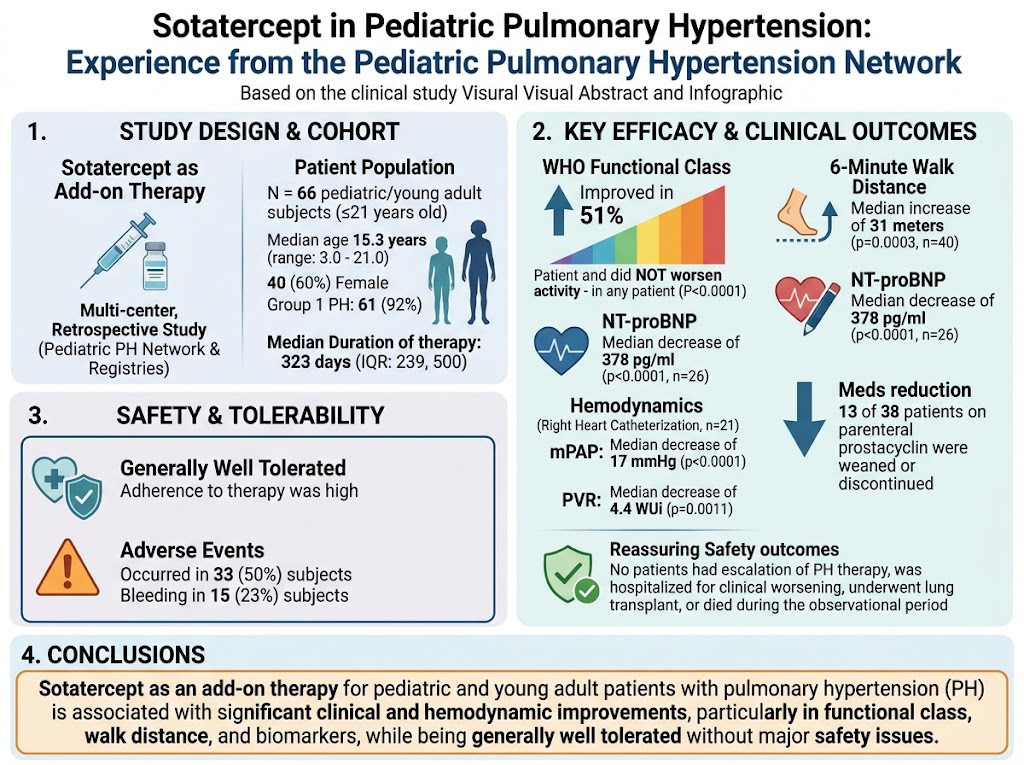
The study is a multicenter, retrospective analysis conducted across specialized pediatric PH programs within the Pediatric Pulmonary Hypertension Network and institutional registries. It involved 66 children and young adults aged ≤ 21 years receiving sotatercept as an add-on to standard PH therapy. Baseline demographics, clinical characteristics, and hemodynamic parameters were collected prior to and after initiation of sotatercept therapy.
Primary endpoints included changes in WHO functional class and six-minute walk distance (6MWD). Secondary endpoints were biomarkers (NT-proBNP), invasive hemodynamics (mean pulmonary artery pressure (mPAP), pulmonary vascular resistance (PVR)), and treatment escalation or discontinuation. Safety was assessed by adverse event frequency and severity.
Key Findings
Patients had a median age of 15.3 years (range 3.0 to 21.0) and were predominantly female (60%). A majority (92%) had WHO Group 1 PH. Sotatercept was administered for a median duration of 323 days.
Clinical Improvements:
– WHO Functional Class: 51% of patients improved, while no patients experienced worsening (p<0.0001), indicating significant functional benefit.
– Six-Minute Walk Distance: Median increase of 31 meters was statistically significant (p=0.0003, n=40), reflecting enhanced exercise capacity.
– NT-proBNP Levels: Median decrease of 378 pg/ml (p<0.0001, n=26), suggesting reduced cardiac strain.
– Hemodynamics: Mean pulmonary artery pressure showed a median drop of 17 mmHg (p<0.0001, n=21), and PVR decreased by a median of 4.4 Wood units indexed (p=0.0011, n=21), confirming improved pulmonary vascular load.
Therapeutic Implications:
– Among patients on parenteral prostacyclin (n=38), 13 were able to wean or discontinue this therapy, potentially reducing treatment burden.
Safety and Tolerability:
– Adverse events were observed in 50% of patients; bleeding was the most frequent specific event, occurring in 23%.
– Importantly, there were no hospitalizations for clinical worsening, escalation of PH therapy, lung transplants, or deaths during the study period.
Expert Commentary
This study represents a significant contribution to pediatric PH literature, providing the largest multicenter evaluation to date of sotatercept in young patients. The findings align with adult trial data showing improvements in pulmonary vascular hemodynamics and functional outcomes. The ability to improve WHO functional class and six-minute walk distance without observed clinical worsening suggests sotatercept may alter disease trajectory in a population with limited therapeutic options.
The bleeding risk highlights the need for careful monitoring, consistent with the known effects of sotatercept on hematologic parameters and vascular integrity. The capacity to reduce prostacyclin use is clinically notable given the challenges related to parenteral prostacyclin administration.
Limitations of the retrospective design include potential selection bias and incomplete data, particularly limited hemodynamic follow-up numbers. Prospective randomized trials are needed to confirm efficacy and elaborate safety profiles, including long-term outcomes and optimal timing of therapy initiation.
Biologically, the inhibition of TGF-β superfamily signaling by sotatercept targets the pathogenic vascular remodeling central to pediatric PAH, a mechanism distinct from vasodilation alone and potentially disease-modifying.
Conclusion
In pediatric patients with pulmonary hypertension, sotatercept as add-on therapy demonstrated meaningful improvement in functional status and key clinical and hemodynamic indicators with a manageable safety profile. These real-world findings underscore sotatercept’s potential as an important new therapeutic modality in pediatric PH management.
Further prospective and controlled studies are warranted to establish definitive clinical guidelines and long-term safety, optimize dosing, and understand impacts on survival and quality of life. Nonetheless, this study provides encouraging evidence supporting sotatercept use in children and young adults suffering from this complex, life-limiting disease.
Funding and Registration
The referenced study did not specify dedicated funding sources or clinical trial registration in the provided abstract.
References
Critser PJ, Krishnan US, Avitabile CM, et al. Sotatercept in Pediatric Pulmonary Hypertension: Experience from the Pediatric Pulmonary Hypertension Network. Chest. 2026 Oct 5. PMID: 42833549.
Humbert M, et al. Sotatercept for the treatment of pulmonary arterial hypertension. N Engl J Med. 2021;384(13):1204-1215.
Abman SH, et al. Pediatric pulmonary hypertension: guidelines from the American Heart Association and American Thoracic Society. Circulation. 2015.
McLaughlin VV, et al. Pulmonary arterial hypertension: epidemiology and registries. Prog Cardiovasc Dis. 2013.
The illustration of sotatercept’s mechanism in relation to TGF-β signaling pathways and its effects on pulmonary vascular remodeling could enhance educational impact if included.