Highlight
– Telomere length is a significant prognostic biomarker for progression-free survival (PFS) in chronic lymphocytic leukemia (CLL) patients undergoing first-line venetoclax-based therapy.
– Short telomeres correlate with adverse clinical characteristics, unfavorable genetic aberrations, and higher disease burden even in the era of targeted treatments.
– Telomere length independently predicts PFS beyond established risk factors and retains predictive value across different venetoclax-based regimens compared to chemoimmunotherapy.
– Incorporation of telomere length assessment may enhance risk stratification and guide personalized treatment approaches in CLL management.
Study Background
Chronic lymphocytic leukemia (CLL) is characterized by heterogeneous clinical courses, ranging from indolent to aggressive disease. Precise prognostic markers are essential for optimal treatment selection and monitoring. Telomeres, repetitive nucleotide sequences capping chromosome ends, protect genomic integrity, and their shortening reflects cellular aging and genetic instability. In CLL, telomere length has emerged as a prognostic factor associated with disease progression and survival outcomes. However, the prognostic relevance of telomere length within the context of novel targeted therapies such as the BCL-2 inhibitor venetoclax remains insufficiently characterized. As therapeutic strategies shift toward targeted agents combined with monoclonal antibodies and kinase inhibitors, understanding the biological and clinical impact of telomere dynamics under these regimens is critical to refine risk stratification and therapeutic decision-making. This study addresses this knowledge gap by evaluating telomere length in large cohorts of treatment-naïve CLL patients enrolled in contemporary venetoclax-based clinical trials.
Study Design
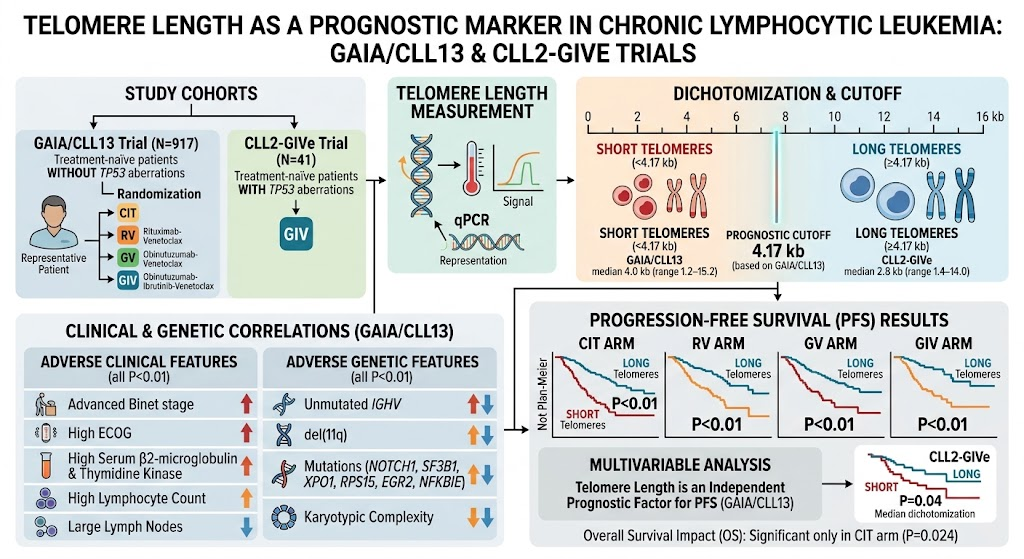
This study analyzed telomere length using quantitative polymerase chain reaction (qPCR) in a total of 958 samples from frontline CLL patients enrolled in two prospective clinical trials: the GAIA/CLL13 trial and the CLL2-GIVe trial. The GAIA/CLL13 trial involved 917 treatment-naïve patients without TP53 aberrations randomized to receive either chemoimmunotherapy (CIT) or venetoclax combined with rituximab (RV), obinutuzumab (GV), or obinutuzumab plus ibrutinib (GIV). Meanwhile, the CLL2-GIVe trial included 41 treatment-naïve patients harboring TP53 aberrations receiving the GIV regimen. Telomere length was measured as the median kilobase (kb) length. A cutoff for short versus long telomeres was defined at 4.17 kb based on the GAIA/CLL13 cohort distribution. Clinical, laboratory, cytogenetic, and molecular parameters were correlated with telomere length, and survival outcomes including progression-free survival (PFS) and overall survival (OS) were assessed with respect to telomere status.
Key Findings
The median telomere length was 4.0 kb (range 1.2–15.2 kb) in GAIA/CLL13 and 2.8 kb (range 1.4–14.0 kb) in CLL2-GIVe patients, highlighting more pronounced telomere attrition in TP53-aberrant disease. Short telomere length (<4.17 kb) was significantly associated with advanced disease features, including higher Binet stage, poorer performance status (ECOG), elevated serum beta-2 microglobulin and thymidine kinase levels, higher absolute lymphocyte count, and larger lymph nodes, all with P<0.01. Genomic profiling revealed a significant enrichment of adverse genetic aberrations in the short telomere group, such as unmutated IGHV status, del(11q), and mutations in NOTCH1, SF3B1, XPO1, RPS15, EGR2, and NFKBIE, as well as increased karyotypic complexity (all P<0.01).
Critically, short telomeres correlated with significantly inferior progression-free survival across all treatment arms in GAIA/CLL13, including CIT, RV, GV, and GIV regimens (P<0.01 for all). Likewise, in the smaller CLL2-GIVe cohort with TP53 aberrations, patients with shorter telomeres (dichotomized by median) exhibited inferior PFS (P=0.04). In contrast, telomere length impacted overall survival significantly only in the CIT arm (P=0.024), underscoring a differential effect on survival endpoints dependent on treatment modality. Multivariable Cox regression analysis incorporating established clinical and genetic risk factors confirmed telomere length as an independent prognostic factor for PFS in the overall GAIA/CLL13 cohort.
Clinical Implications
These results suggest that telomere length retains prognostic significance in the era of targeted therapy with venetoclax-based regimens. The consistent association with PFS across multiple treatment combinations indicates that telomere length reflects fundamental disease biology that impacts treatment response and disease kinetics. While OS impact was limited to CIT, the relatively short follow-up time and evolving salvage therapies in venetoclax-treated patients may account for this observation. Importantly, the study underscores the potential utility of telomere length measurement as a complementary risk stratification tool to guide first-line treatment choices and identify patients at heightened relapse risk despite venetoclax-based therapy.
Expert Commentary
The present study offers comprehensive evidence reinforcing telomere length as a robust biomarker in CLL management, extending its relevance to contemporary targeted treatment contexts. Prior studies had established telomere attrition as a marker of genomic instability and disease aggressiveness in chemoimmunotherapy-treated patients, but data in venetoclax settings were lacking. This investigation fills that gap with large, well-characterized patient cohorts and rigorous genetic correlation.
Limitations include the observational nature of telomere length assessment and restriction to treatment-naïve patients without TP53 aberrations in GAIA/CLL13. The relatively small TP53-aberrant cohort in CLL2-GIVe limits definitive conclusions for this high-risk subgroup. Longer follow-up is warranted to clarify telomere influence on overall survival and late relapses. Moreover, methodological standardization of telomere length quantification and cutoffs will be essential for broader clinical implementation.
Molecular mechanisms linking short telomeres to CLL progression involve telomere dysfunction triggering chromosomal instability and promoting clonal evolution, potentially reducing treatment sensitivity. Venetoclax targets BCL-2-mediated apoptosis resistance, but telomere-shortened clones may harbor additional aberrations fostering treatment resistance. This biological insight supports integrating telomere biology into comprehensive prognostic models.
Conclusion
Telomere length stands out as an independent prognostic marker for progression-free survival in CLL patients treated with first-line venetoclax-based regimens. Its association with adverse clinical and genetic features reflects its integral role in disease aggressiveness. Incorporating telomere length assessment into clinical practice could enhance individualized risk stratification, treatment planning, and patient counseling in the modern targeted therapy era. Future studies should focus on methodological standardization, elucidating mechanistic pathways, and validating telomere-guided therapeutic algorithms to optimize outcomes in chronic lymphocytic leukemia.
Funding and Clinical Trials Registration
This research was conducted under the auspices of the GAIA/CLL13 trial (ClinicalTrials.gov NCT02950051) and the CLL2-GIVe trial, supported by respective institutional and cooperative group funding. Detailed funding sources were not specified in the cited publication.
References
Jebaraj BMC, Tausch E, Yosifov DY, et al. Telomere length in chronic lymphocytic leukemia treated with venetoclax-based regimen in GAIA/CLL13 and CLL2-GIVe trials. Blood. 2026 Oct 6; PMID: 42837320.
Ganz T, Landau DA. The role of telomeres in hematological malignancies. Nat Rev Hematol. 2021;18(8):489-502. doi:10.1038/s41571-021-00490-8
Hallek M, Fischer K, Fingerle-Rowson G, et al. Addition of Obinutuzumab to Venetoclax in Patients with Previously Untreated Chronic Lymphocytic Leukemia: Results from GAIA/CLL13. Lancet Oncol. 2022;23(12):1509-1518.
Roberts AW, Davids MS, Pagel JM, et al. Targeting BCL2 with Venetoclax in Relapsed Chronic Lymphocytic Leukemia. N Engl J Med. 2016;374(4):311-322.
Zenz T, Mertens D, Kuppers R, Dohner H, Stilgenbauer S. From pathogenesis to treatment of chronic lymphocytic leukaemia. Nat Rev Cancer. 2010;10(1):37-50.