Introduction and Context
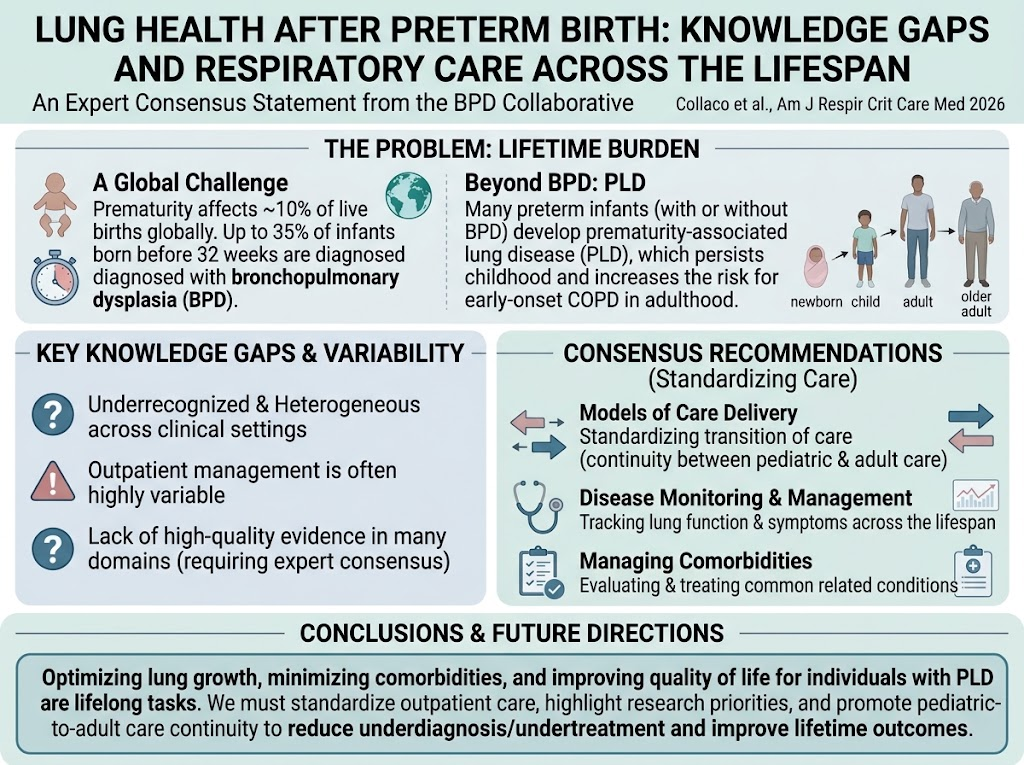
Preterm birth affects roughly 10% of live births worldwide and remains a major contributor to acute neonatal morbidity and life-long respiratory disease. Improving neonatal survival has shifted attention from in-hospital care to the lifelong respiratory consequences of prematurity. In 2026 the BPD Collaborative Outpatient Committee (Collaco et al.) published an expert consensus statement, “Lung Health after Preterm Birth: Knowledge Gaps and Respiratory Care Across the Lifespan” (Am J Respir Crit Care Med. 2026; PMID: 42826512), to address the wide variability in recognition and outpatient management of bronchopulmonary dysplasia (BPD) and the broader construct of prematurity-associated lung disease (PLD).
This consensus was issued because: (1) survival of extremely preterm infants continues to rise; (2) many individuals born preterm—both with and without neonatal BPD—develop persistent deficits in lung function and higher risk of early-onset COPD; (3) outpatient care is fragmented and inconsistently applied; and (4) evidence gaps require pragmatic, expert-driven guidance to standardize care and prioritize research.
Key historical reference points include the classic 2001 definition of BPD (Jobe AH, Bancalari E. Am J Respir Crit Care Med. 2001) and growing epidemiologic evidence of long-term pulmonary sequelae of preterm birth (Blencowe et al., Lancet 2012). The 2026 consensus reframes care around PLD across the life course rather than limiting attention to neonatal diagnoses alone.
New Guideline Highlights
Major themes and takeaways for clinicians:
– Adopt a life-course approach: identify individuals with PLD risk at discharge and ensure structured follow-up into childhood, adolescence, and adulthood.
– Standardize surveillance: implement age-appropriate monitoring (growth, respiratory symptoms, lung function testing, oxygenation, and comorbidity screening) at defined intervals.
– Create multidisciplinary care models: neonatal-to-pediatric transition clinics and pediatric–adult handoffs are prioritized for those with BPD/PLD.
– Use pragmatic, evidence-informed management: immunizations, RSV prevention for high-risk infants, individualized trials of bronchodilators or inhaled corticosteroids, targeted nutritional and developmental supports.
– Recognize knowledge gaps and grade recommendations accordingly: many recommendations are expert consensus (low-level evidence) and the statement calls for prioritized research.
Key actionable points
– Discharge planning should include written PLD-specific follow-up plans and identification of a medical home.
– All infants born <32 weeks or with neonatal respiratory support should have a documented respiratory follow-up strategy; those with BPD require earlier and more intensive surveillance.
– Transition to adult care should be proactive; adults born preterm should be counseled on COPD risk and offered baseline lung function testing if not previously performed.
Updated Recommendations and Key Changes
What changes from past practice?
– Terminology: the consensus endorses the term “prematurity-associated lung disease (PLD)” to capture the spectrum of later lung disease beyond the neonatal BPD label.
– Lifespan emphasis: explicit recommendations for adolescent and adult surveillance and transition of care—an expansion beyond earlier perinatal/NICU-focused guidance.
– Standardized outpatient pathways: recommended minimum follow-up intervals and core assessments at each life stage.
– Explicit call for standardized outcome measures: routine use of spirometry once feasible, exercise tolerance assessment in older children/adults, and incorporation of quality-of-life/patient-reported outcomes.
Why the updates? Evidence linking preterm birth to later fixed airflow obstruction and early COPD-like phenotypes has matured, and clinical care needs to adapt by following patients throughout life rather than discharging them after infancy or early childhood.
Topic-by-Topic Recommendations
The consensus organizes recommendations by care domains. Where possible, recommendations indicate strength and evidence level; however, the authors note that many are expert-opinion-based given limited trial data.
A. Identification and Diagnostic Framework
– Who should be labeled at-risk for PLD? All individuals born <32 weeks gestation, any infant diagnosed with BPD (oxygen or respiratory support at 36 weeks PMA), and infants born later but who required prolonged ventilation or had recurrent respiratory hospitalizations.
– Diagnostic approach in older children/adults: PLD is a clinical diagnosis based on history of prematurity with persistent or recurrent respiratory symptoms and/or objective lung function deficits (spirometric obstruction, reduced FEV1, abnormal diffusion) not entirely explained by alternative diagnoses.
– Recommendation grade: Expert consensus (predominantly low-level evidence).
B. Models of Care and Care Delivery
– Neonatal discharge plan: include designated outpatient respiratory follow-up, primary care coordination, RSV prevention plan, and clear instructions for oxygen weaning if applicable.
– Recommended clinic models: (1) neonatal follow-up clinics with respiratory expertise for infancy; (2) dedicated BPD or PLD multidisciplinary clinics for preschool/school-age; (3) planned pediatric–adult transition clinics for adolescents with moderate-to-severe PLD.
– Personnel: pediatric pulmonologist, respiratory therapist, nurse coordinator, developmental pediatrics/neurology, dietitian, and social work.
– Recommendation grade: Consensus (pragmatic recommendation based on implementation experience).
C. Monitoring and Surveillance
– Infancy (0–2 years): growth and feeding assessment at every visit; oxygen saturation monitoring where indicated; review of hospitalizations and infections. Consider infant PFTs when available in specialized centers.
– Preschool (3–5 years): symptom review, growth, and developmental screening at least annually. Chest radiography only for selected clinical indications—not routine.
– School-age (6–12 years): baseline spirometry as soon as the child can reliably perform testing (typically ≥5–6 years); repeat at least annually if symptomatic or more frequently with decline; consider bronchodilator testing.
– Adolescence/adulthood: spirometry at transition and at least every 1–3 years thereafter depending on severity; consider diffusion capacity and exercise testing if symptomatic or abnormal spirometry.
– Screening for pulmonary hypertension: echocardiography if unexplained hypoxemia, exercise intolerance, or signs/symptoms of right heart strain.
– Recommendation grades: Variable—infant monitoring (consensus), spirometry frequency (expert-based, supported by cohort data showing progressive deficits).
D. Therapeutic Management
– Immunization and infection prevention: routine immunizations plus annual influenza vaccination; consider RSV monoclonal prophylaxis (e.g., palivizumab or next-generation agents) for high-risk infants per national RSV guidance and individual risk assessment.
– Oxygen therapy: titrate to maintain age-appropriate saturation targets; ensure clear home-oxygen plans and follow-up for weaning.
– Bronchodilators: a monitored trial of short-acting bronchodilators is reasonable in symptomatic children; continued use should be based on clinical response and objective testing.
– Inhaled corticosteroids (ICS): consider selective use for children with recurrent wheeze and demonstrated steroid responsiveness rather than routine use for all PLD patients; monitor growth and side effects.
– Systemic corticosteroids: avoid prolonged systemic steroids due to adverse effects; reserve for acute, severe exacerbations or specific indications with specialist oversight.
– Pulmonary rehabilitation/exercise prescription: recommend activity encouragement from early childhood; structured programs for adolescents/adults with exercise limitation.
– Surgical airway/airway clearance: chest physiotherapy and airway clearance techniques individualized; surgical interventions reserved for specific anatomic problems.
– Recommendation grades: Mostly conditional/consensus; evidence supports immunization and oxygen strategies, but long-term pharmacologic therapies need trials.
E. Comorbidity Evaluation and Management
– Growth and nutrition: routine nutritional assessment; early involvement of dietitians for faltering growth to support lung development.
– Neurodevelopmental surveillance: integrate developmental screening and early intervention services given high rates of neurodevelopmental comorbidities.
– Sleep-disordered breathing: screen by questionnaire and consider polysomnography in symptomatic children or those with persistent hypoxemia.
– Gastroesophageal reflux and aspiration: evaluate when clinical signs suggest contribution to respiratory morbidity.
– Mental health and quality of life: screen and provide referrals; chronic respiratory symptoms can affect schooling, employment, and mental health.
– Recommendation grades: consensus/recommendation based on known comorbidity burden.
F. Transition to Adult Care
– Start transition planning in early adolescence with progressive transfer of self-care responsibilities.
– Provide a written transition summary, including neonatal course, BPD status, lifetime respiratory events, therapies used, vaccination history, and current medications.
– Offer adult baseline spirometry and counseling about COPD risk, smoking avoidance, and occupational exposures.
– Recommendation grade: strong consensus.
Expert Commentary and Insights
The consensus committee emphasized several points:
– PLD is heterogeneous: severity ranges widely, and trajectories differ—some children improve with lung catch-up growth while others develop persistent airflow obstruction.
– Evidence gaps remain large: few randomized trials address outpatient pharmacologic therapies, the role of chronic inhaled corticosteroids in PLD, or long-term effects of early-life interventions on adult outcomes.
– Priority research areas: longitudinal cohort studies bridging childhood to adulthood; randomized trials of inhaled agents, bronchodilators, and anti-inflammatory strategies targeted to defined phenotypes; biomarkers to stratify risk and predict progression; and trials testing strategies to optimize transition of care.
Controversies and divergent views highlighted by the panel:
– Routine use of inhaled corticosteroids: some experts favor targeted trials and limiting use to steroid-responsive phenotypes; others argue for cautious empiric use in frequent wheezers.
– RSV prevention: evolving RSV monoclonal and maternal vaccine strategies complicate blanket recommendations—guidance should follow up-to-date national policies and individual risk assessment.
– Imaging and invasive testing: balancing need for diagnostic clarity with radiation exposure and limited yield—recommend selective use.
Practical Implications for Clinicians and Systems
– Implementing the consensus requires system-level supports: clinic infrastructure, care coordinators, and processes for transition planning.
– Primary care providers: play a central role in longitudinal monitoring—ensure awareness of PLD risk and clear referral pathways to pediatric/adult pulmonology when needed.
– Health systems should consider registries for PLD/BPD to track outcomes and facilitate research and quality improvement.
– Patient and family education: emphasize lifelong implications, the importance of vaccinations, avoidance of tobacco exposure, and the need for periodic lung function testing.
Patient vignette: Emma
Emma was born at 26 weeks and required 6 weeks of mechanical ventilation and supplemental oxygen, meeting neonatal BPD criteria. At NICU discharge she was enrolled in a neonatal follow-up program with a written PLD plan. At age 6 she performed spirometry showing reduced FEV1 (70% predicted) with partial bronchodilator response. Her care team (pediatric pulmonologist, nutritionist, school nurse) implemented an exercise plan, optimized inhaled therapies after an objective trial, and arranged transition planning. At age 18 she had baseline adult spirometry and counseling about smoking avoidance. The structured handover allowed continuity of care and surveillance into early adulthood.
Recommendations Table (Summary)
– Identification: Screen all infants <32 weeks or those with significant neonatal respiratory support for PLD risk. (Consensus)
– Follow-up frequency: Neonatal follow-up at discharge, infancy visits every 1–3 months as needed; annual respiratory review thereafter with spirometry beginning ~5–6 years. (Consensus)
– Multidisciplinary clinics: Recommended for moderate-to-severe PLD; care coordination required. (Consensus)
– Immunization/RSV prevention: Annual influenza vaccine for all; RSV prophylaxis per national guidance for high-risk infants. (Guideline-aligned/Consensus)
– Pharmacologic therapy: Individualized bronchodilator trials; selective ICS use if steroid-responsive; avoid chronic systemic steroids. (Conditional/Expert opinion)
– Transition: Structured transition plan with adult baseline spirometry and counseling. (Strong consensus)
Research Priorities Highlighted
– Randomized trials of long-term inhaled therapies in PLD and identification of subphenotypes that predict treatment response.
– Longitudinal studies following cohorts from neonatal period through adulthood to define trajectories and determinants of early-onset COPD.
– Development and validation of risk stratification tools and biomarkers.
– Health services research to identify best models of transitional and multidisciplinary care and evaluate cost-effectiveness.
References
1. Collaco JM, Abman SH, Moore PE, Nelin LD, Cristea AI, Ingledow L, Janvier A, Kelly MM, Kirkby SE, Kotecha S, Neptune ER, Polverino F, McGrath-Morrow SA; BPD Collaborative Outpatient Committee. Lung Health after Preterm Birth: Knowledge Gaps and Respiratory Care Across the Lifespan. Am J Respir Crit Care Med. 2026 Oct 1. PMID: 42826512. https://pubmed.ncbi.nlm.nih.gov/42826512/
2. Jobe AH, Bancalari E. Bronchopulmonary dysplasia. Am J Respir Crit Care Med. 2001;163(7):1723–1729.
3. Blencowe H, Cousens S, Oestergaard MZ, Chou D, Moller AB, Narwal R, Adler A, Garcia-Corzo P, et al. National, regional, and worldwide estimates of preterm birth rates in the year 2010 with time trends since 1990: a systematic analysis. Lancet. 2012;379(9832):2162–2172.
4. Bancalari E, Claure N. Clinical phenotypes of chronic lung disease of prematurity. J Pediatr. 2015;166(6):1402–1409.e1.
5. Doyle LW, Halliday HL, Ehrenkranz RA. Bronchopulmonary dysplasia: is it time to retire the name? J Pediatr. 2017;190:5–7.
(Note: The consensus document explicitly notes that many recommendations are based on expert opinion because of limited trial evidence; clinicians should combine guideline recommendations with individualized clinical judgment.)