Introduction
Diabetes mellitus, particularly type 2 diabetes, is a major risk factor for the development of atherosclerosis and cardiovascular disease. High-density lipoprotein (HDL) is known for its protective role against atherosclerosis, chiefly through reverse cholesterol transport, anti-inflammatory, and antioxidant activities. However, in diabetic patients, HDL function is often impaired, which contributes to accelerated atherosclerotic processes. One proposed molecular mechanism underlying this impairment is the glycation of apolipoprotein AI (apo AI), the major protein component of HDL. Glycation, a non-enzymatic modification caused by chronic hyperglycemia, alters protein structure and function, but the detailed landscape of apo AI glycation, its specific sites, clinical implications, and contribution to diabetic atherosclerosis remain incompletely characterized.
Study Objectives
This study aims to define the site-specific glycation pattern of apo AI in patients with type 2 diabetes, examine the clinical relevance of these modifications to coronary atherosclerosis (CAS), and elucidate the mechanisms by which apo AI glycation impairs HDL function and promotes atherosclerosis. The researchers also sought to develop and validate a glycation index predictive of diabetic atherosclerosis and to explore potential therapeutic strategies by engineering a glycation-resistant apo AI mutant.
Methods
The research employed comprehensive site-resolved glycation proteomics in plasma samples from 860 patients with type 2 diabetes and documented coronary atherosclerosis and 294 diabetic controls without CAS. Using integrated unsupervised and supervised analytical approaches, researchers identified glycation signatures associated with diabetic CAS. They then created an Apo AI Glycation Index via least absolute shrinkage and selection operator (LASSO) regression and validated it across multiple cohorts.
To interrogate functionality, a glycation-resistant apo AI mutant with cross-linked lysine residues (apo AICL) was engineered to prevent glycation at key sites. Functional assays, including surface plasmon resonance for binding affinity, in vitro and in vivo reverse cholesterol transport assays, HDL remodeling analyses, and atherosclerosis models in diabetic mice, were carried out. Molecular mechanisms involving macrophage pathways were studied through RNA sequencing, macrophage-specific knockout mice, receptor-binding assays, signaling inhibition, and rescue experiments focused on cholesterol efflux.
Key Findings
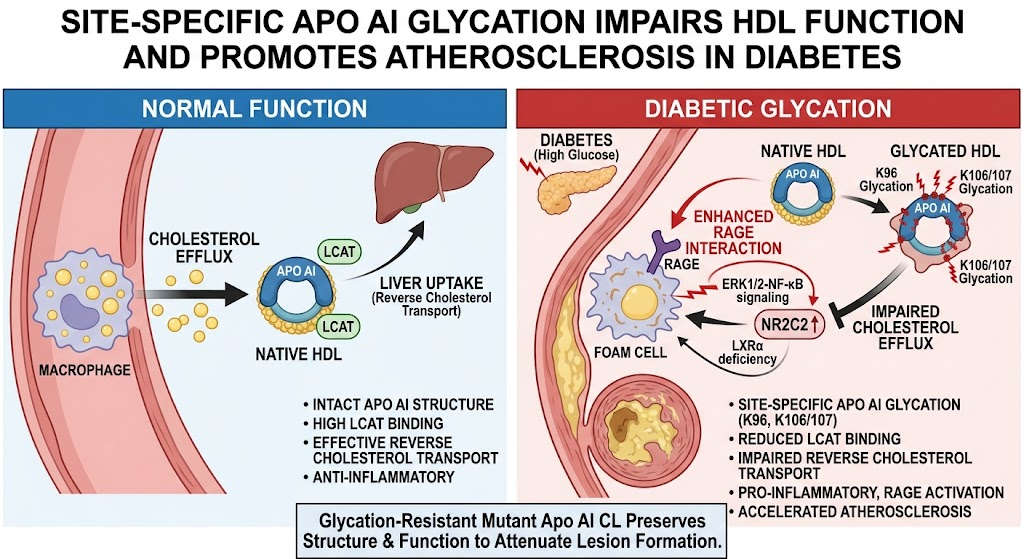
The researchers discovered distinct apo AI glycation patterns differentiating diabetic patients with CAS from those without. Lysine residues K96 and K106/107 were identified as prominent glycation sites linked with disease severity. Higher Apo AI Glycation Index scores correlated independently with the presence of CAS and established coronary artery disease in the diabetic population.
Functionally, the index negatively correlated with HDL-mediated reverse cholesterol transport efficiency and lecithin-cholesterol acyltransferase (LCAT) activity, critical for HDL maturation and function. Apo AICL, compared to native apo AI, demonstrated resistance to glycation at these key residues, maintained structural stability, exhibited increased affinity for LCAT, and supported improved HDL function under glycation stress.
In diabetic mouse models, apo AICL treatment led to marked reductions in HDL dysfunction and significantly decreased the development of atherosclerotic lesions compared to glycated apo AI-treated controls.
Mechanistic Insights
Mechanistic studies revealed that glycated apo AI interacts more strongly with the receptor for advanced glycation end products (RAGE), initiating signaling cascades via extracellular signal-regulated kinase (ERK1/2) and nuclear factor kappa B (NF-κB)/p65 pathways. This activation upregulates nuclear receptor NR2C2, which in turn influences the liver X receptor alpha (LXRα), a key regulator of cholesterol homeostasis in macrophages.
Importantly, both pharmacologic activation of LXRα and genetic deficiency of macrophage NR2C2 restored cholesterol efflux capacity in macrophages exposed to glycated apo AI, highlighting a novel regulatory axis responsible for impaired HDL function in diabetes.
Clinical Implications
This comprehensive mapping of apo AI glycation presents the Apo AI Glycation Index as a promising biomarker for coronary atherosclerosis risk stratification in diabetic patients. By identifying specific glycation sites driving HDL dysfunction, the study offers a new perspective on the pathogenesis of diabetic cardiovascular disease.
Glycation-resistant apo AI mutants like apo AICL demonstrate therapeutic potential by preserving HDL functionality and mitigating atherosclerotic progression, suggesting novel avenues for intervention beyond traditional lipid-lowering therapies.
Conclusion
This study establishes site-specific apo AI glycation as a mechanistically significant contributor to HDL dysfunction and atherosclerosis in diabetes. The findings emphasize the role of RAGE-associated NR2C2-LXRα signaling pathways in mediating macrophage cholesterol efflux impairment caused by glycation modifications.
Interventions targeting apo AI glycation or its downstream signaling may represent an innovative strategy to reduce cardiovascular risk in diabetic populations. Future clinical translation may focus on developing glycation-resistant HDL analogs or pharmacologic modulators of the identified signaling pathways.
Registration
This clinical research is registered at ClinicalTrials.gov with the identifier NCT05659043, providing transparency and allowing for further data access.
References
Dai Y, Li Q, Ding F, et al. Site-Specific Apo AI Glycation Impairs HDL Function and Promotes Atherosclerosis in Diabetes. Circulation. Published August 25, 2026. PMID: 42639673. Available at https://pubmed.ncbi.nlm.nih.gov/42639673/