Highlights
- Adherence to multiple healthy dietary patterns post-myocardial infarction (MI) is associated with significantly lower total and cardiovascular mortality.
- Improvement in diet quality from pre- to post-MI further reduces mortality risk among survivors.
- Consistent beneficial associations are observed across dietary indices emphasizing plant-based foods, Mediterranean components, anti-inflammatory and insulin-sensitizing profiles.
- Secondary prevention strategies should incorporate comprehensive dietary guidance focusing on overall diet quality rather than isolated nutrients or foods.
Background
Myocardial infarction remains a leading cause of mortality and morbidity worldwide, with survivors facing substantial risks of recurrent events and premature death. Secondary prevention strategies traditionally focus on pharmacologic interventions and lifestyle modifications, yet the role of diet quality after MI continues to evolve. Current dietary guidelines primarily derive from studies in general populations, and limited data exist regarding the impact of adherence to various dietary patterns on survival after MI. Understanding which dietary patterns optimize post-MI outcomes is critical for refining recommendations and improving prognosis in this high-risk group.
Key Content
Chronological Development and Core Evidence
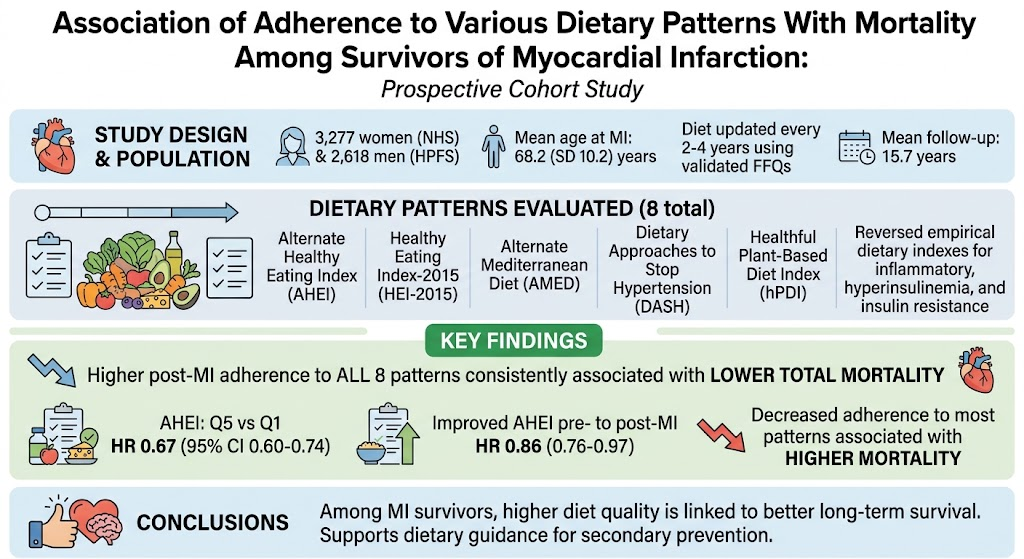
A landmark study by Ma et al. (2026) combined data from 3,277 women and 2,618 men surviving nonfatal MI within the Nurses’ Health Study and Health Professionals Follow-Up Study cohorts. With a mean diagnosis age of 68 years and up to 15.7 years of follow-up, the study assessed adherence to eight diet quality indices post-MI, including the Alternate Healthy Eating Index (AHEI), Healthy Eating Index-2015 (HEI-2015), Alternate Mediterranean Diet Score (AMED), Dietary Approaches to Stop Hypertension (DASH), Healthful Plant-Based Diet Index (HPDI), and three reversed empirical indices related to inflammation and insulin metabolism.
Across all eight dietary patterns, the highest adherence quintiles corresponded to substantially lower hazard ratios (HR) for total mortality, ranging from 0.66 to 0.77 compared with the lowest adherence quintile after adjustment for confounders. Similar inverse associations were demonstrated for cardiovascular mortality and recurrent nonfatal MI. Notably, individuals who improved adherence to AHEI from pre- to post-MI exhibited a 14% reduction in mortality risk (HR 0.86), whereas decreased adherence was associated with increased mortality. These findings highlight the dynamic nature of diet quality and the potential benefits of dietary improvements following MI.
Dietary Indices Evaluated and Nutritional Themes
– Alternate Healthy Eating Index (AHEI) and Healthy Eating Index-2015 (HEI-2015): Emphasize nutrient-dense foods rich in fruits, vegetables, whole grains, nuts, and healthy fats while limiting added sugars and saturated fats.
– Alternate Mediterranean Diet Score (AMED): Focuses on high intake of vegetables, legumes, fruits, nuts, whole grains, fish, and monounsaturated fats with moderate alcohol consumption.
– DASH Diet: Centers on fruits, vegetables, low-fat dairy, whole grains, and reduced sodium intake.
– Healthful Plant-Based Diet Index (HPDI): Prioritizes consumption of healthy plant foods (whole grains, fruits, vegetables, nuts, legumes) with limited animal products and less healthy plant foods.
– Empirical dietary inflammatory and insulin resistance indices: Reflect dietary patterns that reduce systemic inflammation and improve insulin sensitivity, important in modulating cardiovascular risk.
Ma et al.’s study robustly demonstrates consistent protective effects across these diverse yet overlapping dietary patterns, reinforcing that high overall diet quality—rather than specific foods—is paramount in post-MI survival.
Complementary Evidence and Mechanistic Insights
Additional cohort studies provide external validation and mechanistic context. For example, research from the Women’s Health Initiative (2026) identified that lower diet quality by HEI-2015 scores in postmenopausal women post-first MI was linked to increased mortality risk, confirming the prognostic value of overall diet quality. Moreover, inflammatory and insulin resistance pathways emerge as important mediators of diet’s effects on cardiovascular outcomes, supported by studies employing dietary inflammatory index and insulin-related empirical dietary scores.
Nutritional components such as higher intakes of whole grains, fruits, vegetables, and fish exert anti-inflammatory and metabolic regulatory effects, which may attenuate atherosclerotic progression and myocardial remodeling. Plant-based dietary components enhance endothelial function and improve lipid profiles, while reductions in pro-inflammatory and hyperinsulinemic dietary patterns reduce cardiovascular strain. These mechanistic pathways support the epidemiologic findings linking diet quality and post-MI mortality.
Broader Dietary Context and Secondary Prevention Framework
Convergent evidence from population-based studies highlights that diet quality indices correlating with plant-forward, low-inflammatory, and insulin-sensitizing profiles contribute to cardiovascular risk reduction globally. The Life’s Essential 8 metric additionally integrates diet with other health behaviors and biological factors, emphasizing the multifactorial nature of cardiovascular health maintenance.
Emerging data regarding ultraprocessed food and red meat intake indicate increased atherosclerotic risk and mortality, reinforcing recommendations to limit processed meats and high ultra-processed food consumption in post-MI patients.
Guideline bodies such as the American Heart Association have increasingly incorporated these insights, advocating for comprehensive dietary patterns that emphasize plant foods, healthy fats, whole grains, and micronutrient diversity rather than focusing on isolated macronutrients or foods.
Expert Commentary
The study by Ma et al. exemplifies high-quality prospective cohort methodology applied to a robust dataset integrating repeated dietary assessments and long follow-up periods. Strengths include large sample size, diverse dietary indices, rigorous outcome ascertainment, and adjustment for potential confounders.
However, inherent observational study limitations persist, including residual confounding, reliance on self-reported dietary data, and potential reverse causation. Intervention studies or randomized controlled trials explicitly targeting dietary change post-MI remain limited but are warranted to confirm causality.
Clinically, these findings reinforce the centrality of dietary counseling in secondary prevention programs, highlighting that improvements in overall diet quality after MI diagnosis confer survival benefits. Healthcare providers should prioritize patient education on adopting and maintaining high-quality dietary patterns within individualized, culturally appropriate frameworks.
Biologically, the convergence on diet quality and anti-inflammatory/insulin-sensitizing pathways aligns with the pathophysiology of post-MI remodeling and recurrent ischemic risk, suggesting that diet is a modifiable target influencing key intermediate mechanisms.
Outstanding controversies include optimal timing and intensity of dietary interventions post-MI, interactions with pharmacotherapy, and how best to integrate genetic and metabolic phenotyping to personalize nutritional guidance.
Conclusion
Current evidence firmly supports that adherence to various healthy dietary patterns after myocardial infarction is associated with substantially better long-term survival and reduced cardiovascular events. Improvement in diet quality from pre- to post-MI further enhances prognosis, underscoring the importance of dynamic lifestyle modification.
These insights advocate for dietary guidelines that emphasize comprehensive, nutrient-dense, plant-forward dietary patterns as central components of secondary prevention for MI survivors. Future research should focus on randomized trials assessing the efficacy and implementation strategies of diet quality improvement interventions, and mechanistic studies to deepen understanding of biological pathways mediating these benefits.
References
- Ma L, Hu Y, Liu G, Rexrode KM, Manson JE, Hu FB, Rimm EB, Sun Q. Association of Adherence to Various Dietary Patterns With Mortality Among Survivors of Myocardial Infarction: A Prospective Cohort Study. Circulation. 2026 Aug 25; PMID: 42639679.
- Shah ASV et al. Survival After the First Myocardial Infarction in Older Women: A Prospective Cohort Analysis From the WHI. J Am Heart Assoc. 2026 Apr 7;15(7):e046790. PMID: 41848053.
- Guasch-Ferré M, Hu FB. Plant-Based Dietary Patterns and Cardiovascular Health. Circ Res. 2020;126(12):1614-1636. doi:10.1161/CIRCRESAHA.120.317136.
- Chiuve SE, Fung TT, Rimm EB, Hu FB. Alternative dietary indices both strongly predict risk of chronic disease. J Nutr. 2012;142(6):1009-1018. doi:10.3945/jn.111.157222.
- American Heart Association. Dietary Recommendations for Healthy Children and Adolescents. Circulation. 2005;112(13):2061-2075.