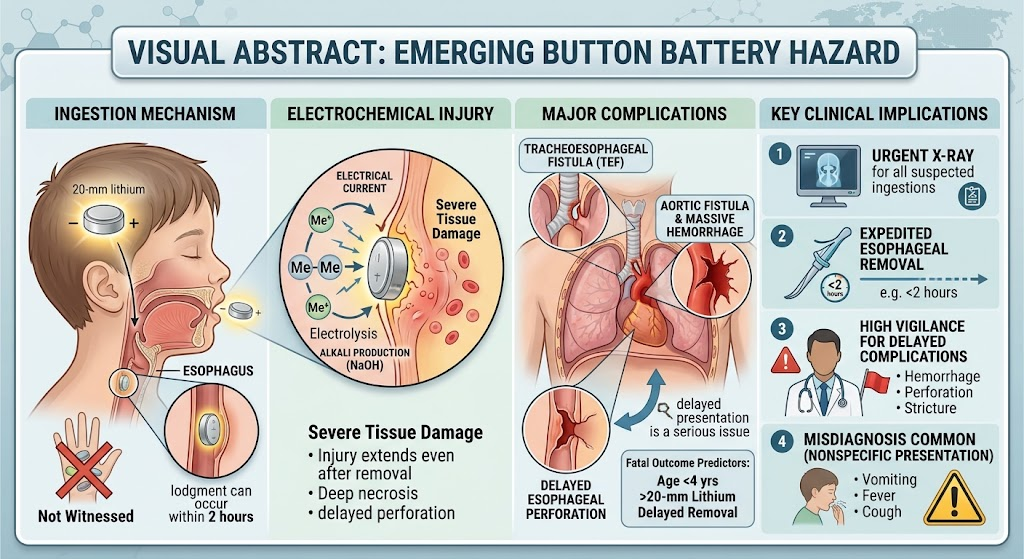
Highlight
Button battery (BB) ingestion incidents in children have risen between 2010-2015 and 2020-2025 periods.
Esophageal impaction is the most common and dangerous location for BBs, with exposure times largely determined by delays prior to hospital presentation.
Greater caregiver awareness significantly reduces the total duration of BB exposure and potential tissue damage.
Improved public health education is imperative to prevent morbidity and life-threatening complications associated with BB ingestions.
Study Background and Disease Burden
Button batteries (BBs), small disc-shaped batteries widely used in household electronics, pose a significant hazard to pediatric populations due to their propensity for accidental ingestion or insertion. BB ingestion represents a true surgical emergency given the rapid and potentially catastrophic mucosal injury caused by electrical discharge and alkaline leakage once lodged in the esophagus or other parts of the aerodigestive tract.
The frequency and severity of BB ingestion incidents in children have encouraged ongoing research and institutional reviews to identify trends, risk factors, and effective prevention strategies. Tissue damage can escalate within hours, leading to serious complications such as tracheoesophageal fistula, strictures, or even fatal outcomes from delayed recognition and treatment.
Study Design
This retrospective observational study was conducted at a tertiary pediatric care center, reviewing all foreign body operative retrievals over two distinct five-year intervals: 2010-2015 (Time Period 1, TP1) and 2020-2025 (Time Period 2, TP2). The study included 1914 foreign body incidents, identifying 62 cases (3.2%) involving button batteries. Data collected encompassed patient demographics, battery characteristics (including diameter), site of impaction, caretaker suspicion and estimated exposure time prior to emergency department (ED) presentation, in-hospital time to intervention, and short- and long-term patient outcomes.
Key Findings and Results
The study demonstrated a statistically significant increase in the proportion of BB ingestions relative to all foreign body cases, from 2.3% in TP1 to 4.1% in TP2 (p = 0.03). Moreover, the average diameter of retrieved BBs increased significantly from 13.8 mm during TP1 to 19.3 mm in TP2 (p = 0.007), which aligns with a higher risk of esophageal impaction due to larger battery size.
The esophagus was the predominant site of impaction, accounting for 32 cases overall — 8 in TP1 and 24 in TP2 — highlighting a shift toward more severe presentations. Caregiver suspicion of a BB ingestion prior to ED arrival was low in both periods (approximately 60%), with no significant improvement over time (p = 0.54). This lack of early recognition contributed to prolonged exposure times, as caretaker-estimated time before ED presentation was long and alarmingly increased from 1404 minutes in TP1 to 3306 minutes in TP2 (p = 0.72), accounting for over 85% of the total BB exposure duration in TP1 and over 94% in TP2.
Time from ED triage to operation room (OR) was not significantly reduced across the two periods (233 min in TP1 vs 192 min in TP2, p = 0.16), indicating hospital response times have remained relatively steady but are a smaller contributor to total exposure time compared to pre-hospital delay.
Multivariate analysis revealed that older children (> age threshold not specified) and caregiver suspicion of BB ingestion were independently associated with shorter overall exposure time (OR = 3.35 and 2.33 respectively; p = 0.02 and p = 0.03), emphasizing the importance of awareness and age-related presentation patterns.
Post-removal management was favorable for most, with two-thirds discharged within two days under observation without complications. Nevertheless, serious long-term morbidity or mortality occurred in 9.4% (3/32) of esophageal impaction cases, including one tracheoesophageal fistula, one esophageal stricture, and one fatal delayed tracheotomy tube obstruction, underscoring the life-threatening potential of BB ingestion.
Expert Commentary
This study highlights a concerning upward trend in pediatric BB ingestion cases and significantly longer exposure times primarily due to pre-hospital delays. Despite advances in hospital emergency response, the limiting factor for mitigating tissue injury remains caregiver recognition and prompt presentation. BB diameter increasing over time likely reflects market trends favoring larger batteries, heightening the risk of esophageal lodgment and injury severity.
Current guidelines from the National Capital Poison Center and related bodies emphasize immediate medical evaluation and removal, but this study suggests that without widespread caregiver education, timely hospital presentation will remain a major challenge. Public health campaigns should prioritize raising awareness about the dangers and emergent nature of BB ingestions, proper battery storage, and recognizing symptoms to encourage faster emergency consultation.
While the study is limited by its retrospective design and single-center scope, it contributes valuable longitudinal insight. Future multi-institutional research and policy interventions could elucidate additional factors, such as socioeconomic or educational influences on timely care seeking. Moreover, advances in battery manufacturing to reduce hazardous exposures could complement clinical and public health efforts.
Conclusion and Summary
Button battery ingestion in children is an increasing cause of potentially life-threatening emergencies, especially with a rising proportion of esophageal impactions involving larger batteries. The critical determinant of tissue damage and adverse outcomes is the duration of exposure, predominantly prolonged by caregivers’ delays in recognizing ingestion and seeking emergency care.
Hospital response times have not significantly improved, but represent a minor part of overall exposure time compared to pre-hospital delay. Therefore, clinical practitioners must maintain urgency in management while advocating for robust public health campaigns targeted at caregivers to improve awareness, prevention, and early recognition.
Interdisciplinary efforts involving pediatricians, otorhinolaryngologists, emergency physicians, and policymakers are essential to curb this growing problem. Such initiatives will ultimately reduce exposure times, minimize morbidity and mortality, and improve long-term healthcare outcomes for affected children.
References
1. Litovitz T, Whitaker N, Clark L, White NC, Marsolek M. Emerging Battery-Ingestion Hazard: Clinical Implications. Pediatrics. 2010;125(6):1168-1177.
2. Jatana KR, Litovitz T, Reilly JS, Schunk JE, Skinner ML, Manara CA. Pediatric Button Battery Injuries: 10-Year Review of National Poison Data System. Ann Otol Rhinol Laryngol. 2013;122(11):1028-1033.
3. National Capital Poison Center Button Battery Ingestion Recommendations. https://www.poison.org/battery/guideline
4. Ramasamy S, Sick J, Lukish A, Behzadpour HK, Preciado DA, Joo L, Bauman NM. Button Battery Ingestion and Removal Trends 2010-2015 Versus 2020-2025 at a Tertiary Care Pediatric Center. The Laryngoscope. 2026 Aug 17. PMID: 42608646.