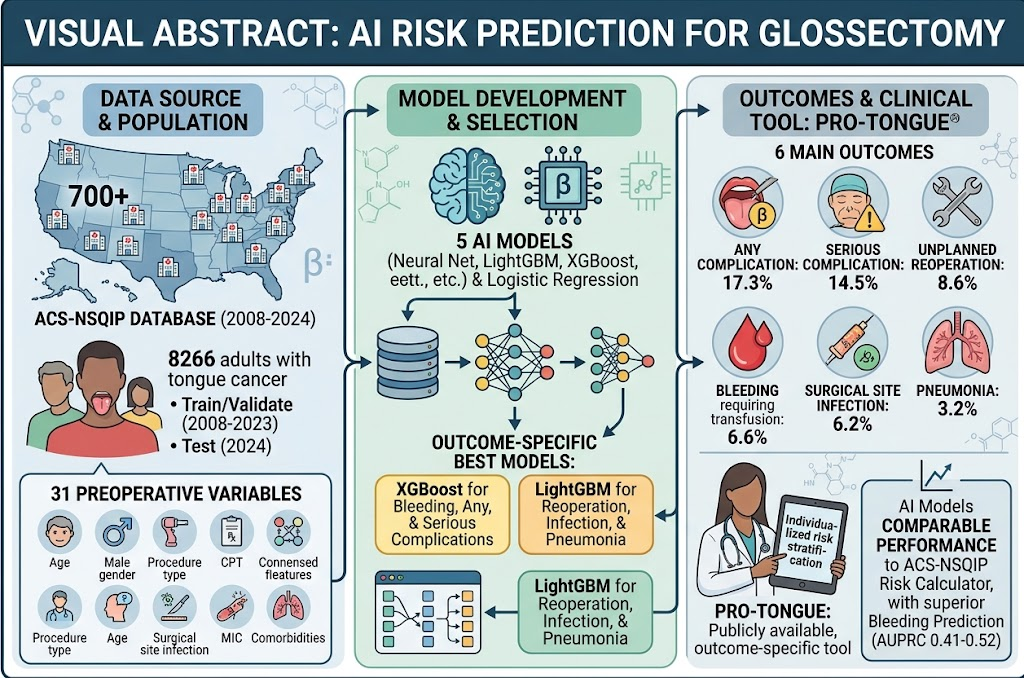
Highlight
- Development of PRO-TONGUE, an AI-based risk prediction tool for individualized 30-day postoperative complication risk after tongue cancer surgery.
- Use of advanced machine learning techniques, including XGBoost and LightGBM, to enhance accuracy across multiple complication outcomes.
- Performance of ML models comparable or superior to the ACS-NSQIP risk calculator, especially for bleeding requiring transfusion prediction.
- PRO-TONGUE offers interpretable, outcome-specific risk estimates to assist preoperative planning and shared decision-making.
Study Background
Tongue cancer presents a significant clinical challenge due to its morbidity and impact on critical functions such as speech and swallowing. Surgical resection, including glossectomy and reconstruction, remains a cornerstone treatment approach. However, these procedures carry substantial risks of postoperative complications, which can impair recovery, prolong hospitalization, and affect long-term outcomes. Traditional risk stratification tools, like the American College of Surgeons National Surgical Quality Improvement Program (ACS-NSQIP) risk calculator, provide population-based estimates but lack individualized precision for this complex patient group. Consequently, there is an unmet need for predictive models that can offer personalized risk assessments to guide preoperative planning and perioperative care.
Study Design
This retrospective cohort study utilized data from the ACS-NSQIP database covering years 2008 to 2024, incorporating information from over 700 predominantly US-based hospitals. The study population included 8,266 adult patients who underwent glossectomy for malignant tongue tumors. Thirty-one preoperative clinical variables were used to train multiple predictive models: logistic regression and five machine learning (ML) models (neural network, support vector machine classifier, LightGBM, XGBoost, and stacked generalization).
Data from 2008 to 2023 were split into an 85% training and 15% validation set, with an independent test set comprising data from 2024. Key outcomes evaluated at 30 days post-surgery included surgical site infection, bleeding requiring transfusion, pneumonia, unplanned reoperation, any complication, and serious complications. Model performance was compared against the ACS-NSQIP risk calculator using metrics such as area under the receiver operating characteristic curve (AUROC), area under the precision-recall curve (AUPRC), calibration using Brier score, and clinical utility through risk stratification (lift).
Key Findings
The study population had a median age of 63 years, predominantly male (59.2%). Partial glossectomy was the most common procedure (74.2%), followed by minor excisions (15.4%), composite/extended glossectomy (9.5%), and total glossectomy (4.1%). Postoperative complications were not uncommon, with 17.3% experiencing any complication and 14.5% experiencing serious complications within 30 days. Specific adverse events included unplanned reoperation (8.6%), surgical site infection (6.2%), bleeding requiring transfusion (6.6%), and pneumonia (3.2%).
The optimal predictive models varied by outcome: XGBoost performed best for predicting bleeding, serious complications, and any complications, while LightGBM was superior for unplanned reoperation, surgical site infection, and pneumonia. Overall, ML models demonstrated excellent discriminative performance (AUROC ranges 0.88-0.90 for bleeding requiring transfusion) and comparable or improved precision-recall metrics relative to logistic regression and the ACS-NSQIP calculator. Notably, bleeding requiring transfusion prediction—a novel outcome not addressed by the existing ACS-NSQIP tool—showed the highest model performance.
The newly developed PRO-TONGUE tool integrates these ML models to provide outcome-specific, individualized risk predictions, enhancing clinical interpretability and applicability for surgical decision-making.
Expert Commentary
The integration of machine learning into perioperative risk prediction for tongue cancer surgery represents a significant advancement. Compared to traditional risk calculators, ML models can capture complex nonlinear interactions among clinical variables, thereby improving accuracy. The PRO-TONGUE tool’s publicly available nature allows clinicians to incorporate data-driven insights into patient counseling, surgical planning, and postoperative care pathways.
However, caution is warranted regarding generalizability outside the ACS-NSQIP database population, as well as the inherent retrospective nature of the study. Prospective and external validation studies are necessary to confirm robustness across diverse clinical settings and patient demographics. Moreover, transparency and clinician education on interpreting ML-derived risk estimates remain essential to avoiding misapplication.
Biologically, the ability of ML models such as XGBoost to prioritize features related to coagulopathy, nutritional status, and tumor extent offers opportunities for mechanistic understanding and targeted perioperative optimization.
Conclusion
This large-scale, representative study demonstrates that machine learning models can accurately predict major 30-day postoperative complications after glossectomy for tongue cancer. The PRO-TONGUE risk calculator, leveraging outcome-specific optimized algorithms, provides individualized, interpretable risk estimates that may improve preoperative risk stratification and guide clinical decision-making. Future research should focus on prospective validation, incorporation of additional biomarkers and imaging data, and integration of AI tools into multidisciplinary head and neck oncology care pathways to enhance patient outcomes.
Funding and ClinicalTrials.gov
The study did not specify external funding sources. ClinicalTrials.gov registration was not applicable for this retrospective cohort analysis.
References
1. Matar DY, et al. Artificial Intelligence-Based Risk Prediction Models for Complications After Tongue Cancer Surgery. JAMA Otolaryngol Head Neck Surg. 2026;152(8):797-809. doi:10.1001/jamaoto.2026.3412
2. Bilimoria KY, et al. Development and Evaluation of the American College of Surgeons NSQIP Surgical Risk Calculator: A Decision Aid and Informed Consent Tool for Patients and Surgeons. J Am Coll Surg. 2013;217(5):833-42.
3. Lundberg SM, et al. A Unified Approach to Interpreting Model Predictions. Advances in Neural Information Processing Systems. 2017;30:4765-4774.
4. Wulff-Burchfield E, et al. Machine Learning-based Prediction Models for Head and Neck Cancer Outcomes: A Systematic Review. Oral Oncol. 2022;131:106083.