Highlight
- Balanced crystalloids used before ICU admission in sepsis are associated with significantly lower 30-day mortality compared to saline.
- The mortality benefit remains robust after adjustment methods and across key patient subgroups, including age, sex, and disease severity.
- Balanced crystalloids also reduce the need for renal replacement therapy and improve ventilator-free days.
- This study emphasizes the critical impact of initial fluid choice during pre-ICU resuscitation on sepsis outcomes.
Study Background
Sepsis, a life-threatening organ dysfunction caused by dysregulated host response to infection, remains a major global health burden with high mortality and morbidity. Early fluid resuscitation is a cornerstone of sepsis management aimed at restoring tissue perfusion and preventing organ failure. However, the optimal type of intravenous crystalloid fluid for initial resuscitation has been debated. The two main types are balanced crystalloids (e.g., lactated Ringer’s solution or Plasma-Lyte) and 0.9% sodium chloride (saline).
Saline has been traditionally used but is associated with higher chloride content, which may contribute to hyperchloremic metabolic acidosis and renal vasoconstriction, potentially worsening outcomes. Balanced crystalloids have electrolyte compositions more comparable to plasma and might reduce these risks. Nonetheless, most prior studies have focused on fluid administration within the intensive care unit (ICU), leaving uncertainty regarding the effects of crystalloid choice during the critical early phase before ICU admission.
Study Design
This investigation was a nationwide, multicenter, retrospective cohort study conducted in South Korea by the Korean Sepsis Alliance (KSA) from September 2019 to December 2023. The study enrolled adult patients diagnosed with sepsis who received initial intravenous fluid resuscitation prior to ICU admission. Patients were categorized based on the type of crystalloid fluid they received pre-ICU: balanced crystalloids or 0.9% sodium chloride (saline).
The primary endpoint was 30-day all-cause mortality. Secondary outcomes included the requirement for continuous renal replacement therapy (CRRT) during ICU stay, renal replacement therapy at ICU discharge, and ventilator-free days at 28 days.
Key Findings
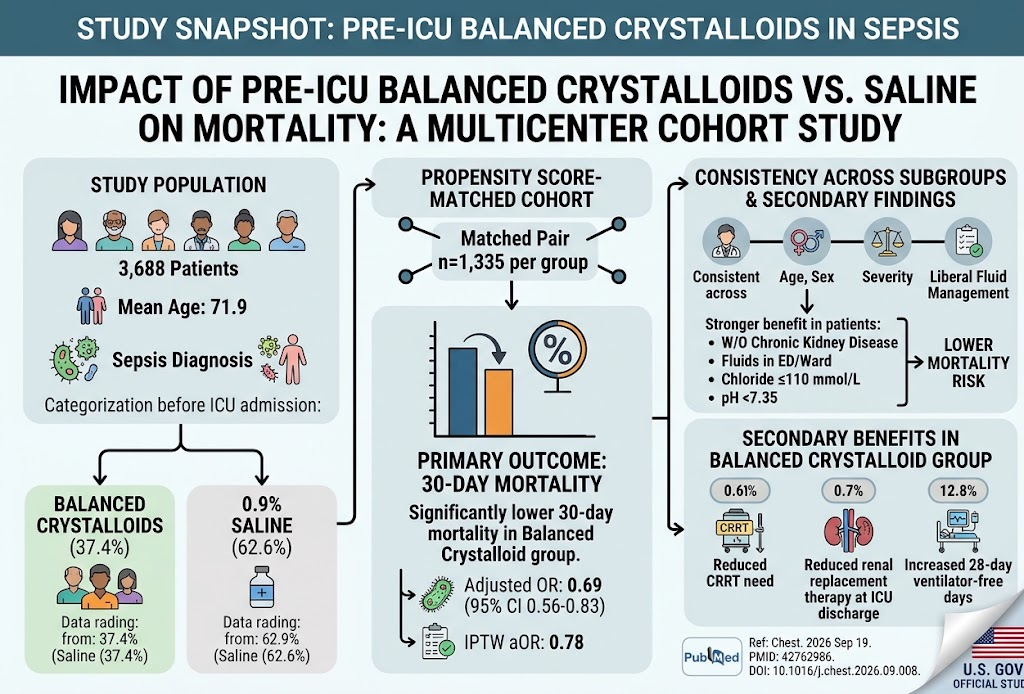
The study comprised 3,688 patients (mean age 71.9 ± 13.8 years; 58% male). Among these, 1,381 patients (37.4%) received balanced crystalloids and 2,307 patients (62.6%) received saline before ICU admission. To reduce confounding effects, propensity score matching was employed, resulting in 1,335 patients in each matched group.
Analysis showed that balanced crystalloid use was associated with a significantly lower 30-day mortality compared to saline. The adjusted odds ratio (aOR) for mortality was 0.69 (95% confidence interval [CI] 0.56–0.83) after propensity score matching. Results remained consistent following inverse probability of treatment weighting, with an aOR of 0.78 (95% CI 0.69–0.88).
The mortality benefit persisted across multiple prespecified subgroups, including age groups, sexes, various levels of disease severity, high fluid volumes administered pre-ICU (>30 mL/kg), and pre-ICU vasopressor use.
Notably, certain patient characteristics modified the association, with balanced crystalloids providing greater survival benefit in patients without chronic kidney disease, those receiving fluids outside the operating room (emergency department or general wards), patients with baseline serum chloride ≤110 mmol/L, and those with acidemia at baseline (pH < 7.35).
Secondary outcomes also favored balanced crystalloids. Their use was linked to reduced need for continuous renal replacement therapy during ICU admission, a lower proportion of renal replacement therapy at ICU discharge, and significantly more ventilator-free days within the first 28 days.
Expert Commentary
This large real-world evidence study strengthens the growing body of literature supporting balanced crystalloids over saline for fluid resuscitation in sepsis. The pre-ICU period is critical as early resuscitation influences downstream organ function and mortality risk.
The use of advanced statistical techniques like propensity score matching and inverse probability treatment weighting enhances the robustness of findings by addressing confounding that plagues observational studies.
Mechanistically, balanced crystalloids may mitigate hyperchloremia-induced renal vasoconstriction and acidosis, which contribute to acute kidney injury and poorer outcomes, both crucial in sepsis pathophysiology.
Limitations include retrospective design, possible residual confounding, and lack of randomization. Variations in fluid administration protocols across centers and the specific types of balanced solutions used were not detailed, which could affect generalizability. Additionally, the study population predominantly included elderly patients, warranting cautious extrapolation to younger cohorts.
These results align with recent randomized controlled trials and meta-analyses favoring balanced fluids but uniquely highlight the importance of fluid selection before ICU admission, emphasizing emergency department and ward management phases.
Conclusion
This propensity score-matched multicenter cohort study demonstrates that balanced crystalloids administered before ICU admission are associated with a significant reduction in 30-day mortality in patients with sepsis compared to saline. The benefits extend to renal outcomes and ventilator dependency, underscoring the importance of early fluid choice in sepsis management.
Clinicians should consider prioritizing balanced crystalloids for initial resuscitation in sepsis, especially in patients without chronic kidney disease and those presenting with acidemia or normal chloride levels.
Further prospective randomized trials focusing on the pre-ICU resuscitation phase are warranted to confirm causality and optimize fluid management protocols in sepsis.
Funding and Registration
No specific funding information is provided in the publication. The study was conducted by the Korean Sepsis Alliance (KSA) Investigators. Clinical trial registration details were not reported.
References
- Kim TW, Kim Y, Baek MS, et al. Impact of pre-ICU balanced crystalloids versus saline on mortality in sepsis: a propensity score-matched multicenter cohort study. Chest. 2026 Sep 19. PMID: 42762986.
- Semler MW, Self WH, Wanderer JP, et al. Balanced crystalloids versus saline in critically ill adults. N Engl J Med. 2018;378(9):829-839.
- Young P, Bailey M, Beasley R, et al. Effect of a buffered crystalloid solution vs saline on acute kidney injury among patients in the intensive care unit: the SPLIT randomized clinical trial. JAMA. 2015;314(16):1701-1710.
- Krajčová A, et al. Hyperchloremic acidosis as a risk factor for acute kidney injury in sepsis. Crit Care. 2019;23(1):300.