Highlight
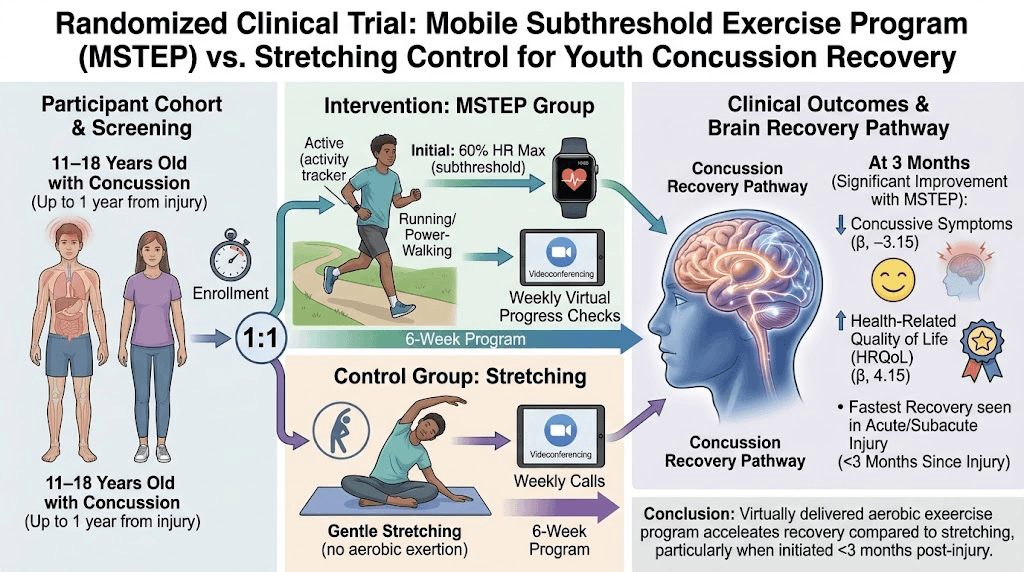
This randomized clinical trial evaluated the efficacy of a Mobile Subthreshold Exercise Program (MSTEP) delivered virtually to adolescents recovering from concussion. The study demonstrated that MSTEP accelerated symptom resolution and improved health-related quality of life compared to a stretching control, particularly in youth within three months of injury. Secondary outcomes such as sleep, depression, and anxiety improved in all participants but were not different between groups.
Study Background
Concussion, a form of mild traumatic brain injury common in youth, often leads to prolonged symptoms including headaches, cognitive disturbances, and emotional difficulties. While aerobic exercise is recognized as beneficial in concussion recovery, prior research predominantly targeted the acute phase post-injury and relied on in-person interventions, limiting accessibility and scalability. Extended symptom duration beyond the acute window remains a clinical challenge, with few robust interventions tailored for this population. Addressing this gap, the Mobile Subthreshold Exercise Program was designed to provide remote, individualized aerobic exercise aimed at subthreshold physical exertion to optimize recovery.
Study Design
This multi-state randomized clinical trial enrolled 210 participants aged 11 to 18 years who were experiencing prolonged concussion recovery, defined as symptoms persisting up to one year post-injury. Recruitment occurred across outpatient settings in Washington, Utah, Wisconsin, and Oregon between March 2021 and October 2025. Participants were randomized to either the MSTEP intervention or a control group receiving stretching exercises. The MSTEP involved exercise initiation at 60% of individual maximal heart rate, progressively advancing over six weeks under weekly videoconference supervision. Controls received equivalent-duration calls and stretching routines to control for attention and engagement. Primary endpoints included concussive symptoms and health-related quality of life (HRQoL), measured longitudinally with follow-up to six months. Secondary outcomes assessed sleep quality, depressive symptoms, and anxiety. Exploratory analyses evaluated moderation effects by sex, age, and time since injury.
Key Findings
The cohort was predominantly female (58.1%) with a mean age of 15.1 years and an average of approximately 73 days since injury at enrollment. Adjusted regression analyses revealed significant clinical benefits of MSTEP over control at 3 months: concussive symptoms were reduced (β = -3.15; 95% CI, -6.05 to -0.25; adjusted P = .04) and HRQoL improved (β = 4.15; 95% CI, 0.64-7.66; adjusted P = .04). No significant group differences were detected at 6 months, indicating the effect was most pronounced in earlier recovery phases.
Nonlinear mixed-effects modeling employing exponential decay functions demonstrated that symptom resolution occurred significantly faster in the MSTEP group compared to controls (difference in recovery rates = -0.68; 95% CI, -2.22 to -0.04; P = .002). Secondary outcomes, including sleep, depression, and anxiety measures, improved similarly across both groups without statistical differentiation, suggesting the intervention’s primary effect was on core concussion recovery rather than broader psychosocial domains.
Subgroup analyses showed that the intervention’s efficacy was confined to participants less than three months post-injury, with stronger effect sizes for symptom reduction (β = -4.44; 95% CI, -7.99 to -0.90; unadjusted P = .01) and HRQoL enhancement (β = 6.64; 95% CI, 2.55-10.72; unadjusted P = .002). This temporal moderation underscores the clinical relevance of timely initiation of aerobic exercise post-concussion. There was no statistical evidence that sex, age, or other factors moderated treatment response.
Expert Commentary
This trial provides compelling evidence supporting the safety and efficacy of remotely delivered subthreshold aerobic exercise for youth with persistent concussion symptoms. The remote approach addresses a critical barrier of accessibility, allowing patients in diverse geographic locations to obtain structured exercise guidance without frequent clinic visits. The physiological basis likely involves enhancement of cerebral blood flow, autonomic regulation, and neuroplasticity promoted by measured aerobic activity.
Limitations include the reliance on self-reported symptoms and quality-of-life instruments, potential variability in participant adherence despite monitored tracking, and the absence of biomarker assessments to elucidate mechanistic pathways. The lack of sustained effects at 6 months highlights that aerobic exercise is likely one component of a multifactorial recovery strategy rather than a standalone cure. Future work will benefit from integrating cognitive rehabilitation and psychological support within personalized concussion care models.
Conclusion
The Mobile Subthreshold Exercise Program demonstrates that a virtual, progressive aerobic exercise regimen can expedite recovery in youth with concussion, most notably when started within three months post-injury. These findings support incorporation of remote aerobic exercise protocols into post-concussion management plans, improving accessibility and potentially reducing healthcare utilization linked to prolonged symptomatology. Further investigations should explore long-term outcomes, optimize exercise parameters, and combine multimodal therapeutic approaches to enhance recovery trajectories.
Funding and Trial Registration
This study was funded by supported grants and institutions (not detailed in abstract). The randomized clinical trial is registered under ClinicalTrials.gov Identifier NCT04688255.
References
Chrisman SPD, Bollinger BJ, Flaat A, et al. Mobile Subthreshold Exercise Program (MSTEP) for Youth With Prolonged Concussion Recovery: A Randomized Clinical Trial. JAMA Pediatr. 2026;doi:10.1001/jamapediatrics.2026.42895728.
Additional evidence supporting aerobic exercise in concussion recovery can be found in: Leddy JJ, Master CL, Mannix RC, et al. Early Subthreshold Aerobic Exercise for Sport-Related Concussion: A Randomized Clinical Trial. JAMA Pediatr. 2019;173(4):319–325.
McCrea M, Guskiewicz KM, Marshall SW, et al. Acute Effects and Recovery Time Following Concussion in Collegiate Football Players: The NCAA Concussion Study. JAMA. 2003;290(19):2556–2563.
Ellis MJ, Cordingley D, Vis S, et al. Exercise in the Management of Persistent Postconcussion Symptoms. Curr Sports Med Rep. 2017;16(3):180–184.