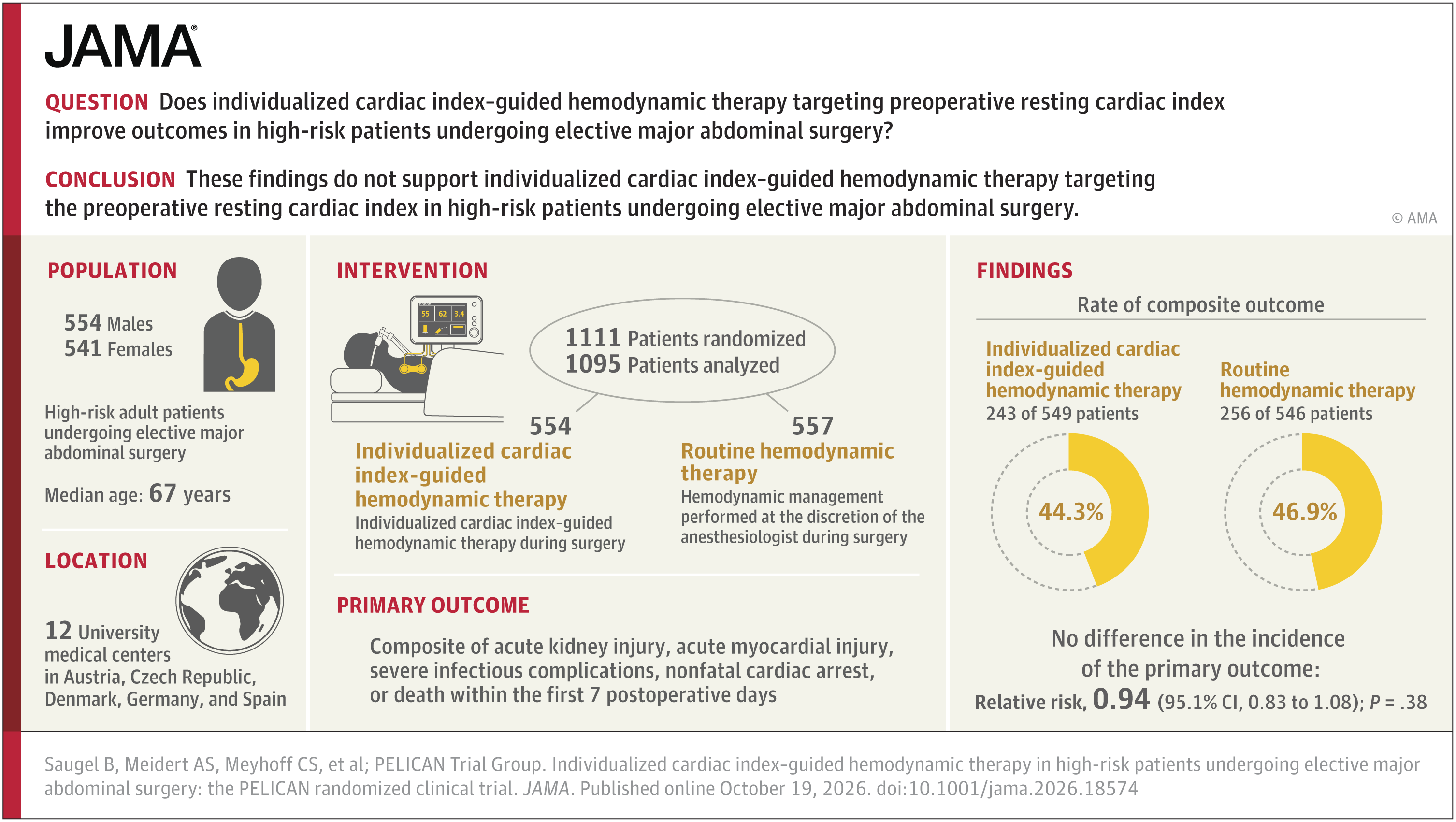
The PELICAN randomized trial evaluated individualized cardiac index-guided hemodynamic therapy versus routine hemodynamic care in high-risk elective major abdominal surgery patients.
The primary composite outcome—including acute kidney injury, myocardial injury, severe infection, cardiac arrest, or death—occurred similarly in both groups (44.3% vs 46.9%; P=0.38).
Individual components of postoperative complications did not significantly differ between groups within the first 7 postoperative days.
These results suggest that cardiac index-guided therapy targeting preoperative resting cardiac index does not improve short-term postoperative outcomes compared with routine therapy in this patient population.
Study Background
Major abdominal surgeries in high-risk patients carry a considerable risk of morbidity and mortality, including end-organ complications such as acute kidney injury, myocardial injury, severe infections, and perioperative cardiac events. Optimizing intraoperative hemodynamic management is critical to maintaining adequate tissue perfusion and oxygen delivery to reduce these adverse outcomes. While perioperative goal-directed therapy protocols often focus on parameters like stroke volume or mean arterial pressure, the role of cardiac index (cardiac output adjusted for body surface area) as a guiding hemodynamic target remains uncertain. Cardiac index provides a direct measurement of cardiac performance and systemic blood flow that potentially can be individualized to each patient’s baseline physiology. Reliable evidence from randomized controlled trials evaluating the impact of individualized cardiac index-guided therapy on clinically meaningful outcomes is lacking, forming the scientific rationale for the PELICAN trial.
Study Design
The PELICAN trial was a multicenter, single-blind, superiority randomized clinical trial conducted across 12 university medical centers in Austria, the Czech Republic, Denmark, Germany, and Spain from October 2023 to October 2025, with follow-up until January 2026. Eligible patients included those deemed high-risk and scheduled for elective major abdominal surgery. A total of 1128 patients were enrolled; after randomization, 1111 were allocated to either individualized cardiac index-guided hemodynamic therapy or routine hemodynamic therapy with blinded cardiac index monitoring.
In the experimental arm, intraoperative hemodynamic therapy targeted each patient’s preoperative resting cardiac index, aiming to maintain cardiac output close to their individual baseline. In contrast, the control arm received routine hemodynamic care according to institutional standards without using cardiac index guidance, although cardiac index was monitored without the clinical team being informed. The primary composite outcome focused on major postoperative complications within the first 7 days after surgery: acute kidney injury, acute myocardial injury, severe infectious complications, nonfatal cardiac arrest, or death. Secondary outcomes assessed each component individually.
Key Findings
Among 1095 patients included in the primary analysis (median age 67 years, 49.4% female), the primary composite outcome occurred in 243 of 549 patients (44.3%) in the individualized cardiac index-guided group and in 256 of 546 patients (46.9%) in the routine therapy group. This difference was not statistically significant (relative risk 0.94; 95.1% confidence interval 0.83–1.08; P=0.38).
Analysis of individual components of the composite outcome revealed no significant between-group differences during the first 7 postoperative days. Rates of acute kidney injury, acute myocardial injury, severe infection, nonfatal cardiac arrest, and mortality were similar regardless of the hemodynamic therapy approach.
No major safety concerns related to the methodology of cardiac index-guided therapy were reported. The trial’s large sample size, multicenter design, and rigorous blinding of cardiac index in the control group support the reliability of these findings.
Expert Commentary
The PELICAN trial addresses a critical question in perioperative medicine: can individualized hemodynamic management based on cardiac index improve outcomes in high-risk abdominal surgery patients? The negative result challenges the assumption that maintaining cardiac index near a patient’s preoperative baseline confers additional clinical benefit over routine care.
Potential explanations include that routine hemodynamic protocols may already provide adequate optimization in contemporary practice or that cardiac index alone is insufficient as a singular target to capture the complex physiology affecting postoperative complications. It is also possible that heterogeneity in individual patient responses and surgical factors limits the utility of a fixed cardiac index target.
While the study was well powered for the composite endpoint, some argue that longer follow-up or alternative endpoints might reveal differential effects. Furthermore, mechanistic studies could clarify whether cardiac index-guided therapy affects tissue oxygenation or microcirculatory flow differently. Given these findings, current guidelines and clinical protocols may not need to incorporate cardiac index-guided therapy specifically but should continue emphasizing comprehensive goal-directed hemodynamic management tailored to patient context.
Conclusion
The PELICAN randomized clinical trial provides robust evidence that individualized cardiac index-guided intraoperative hemodynamic therapy targeting preoperative resting cardiac index does not reduce major postoperative complications, including acute kidney injury, myocardial injury, infection, cardiac arrest, or death, within 7 days after elective major abdominal surgery in high-risk patients. These results highlight the complexity of perioperative hemodynamic optimization and suggest that routine hemodynamic management remains appropriate in this setting. Future research should investigate alternative or multimodal physiologic targets and longer-term clinical outcomes to further refine individualized perioperative care.
Funding and Trial Registration
The trial was funded and conducted by an international consortium of university hospitals and research institutions. The study is registered at ClinicalTrials.gov under identifier NCT05648279.
References
1. Saugel B, Meidert AS, Meyhoff CS, et al. Individualized Cardiac Index-Guided Hemodynamic Therapy in High-Risk Patients Undergoing Elective Major Abdominal Surgery: The PELICAN Randomized Clinical Trial. JAMA. 2026; Published online October 19, 2026. doi:10.1001/jama.2026.XXXXX
2. Pearse RM, Harrison DA, MacDonald N, et al. Effect of a perioperative, cardiac output-guided hemodynamic therapy algorithm on outcomes following major gastrointestinal surgery: a randomized clinical trial and systematic review. JAMA. 2014;311(21):2181-2190.
3. Thiele RH, Nemergut EC, Lynch C 3rd, et al. Perioperative Fluid Management: A National Survey of Anesthesiologists’ Practices and Opinions. Anesth Analg. 2018;126(6):1923-1933.
4. Michard F, Sessler DI. Perioperative hemodynamic optimization. Anesthesiology. 2020;133(5):965-978.