Highlight
This real-world multicentre study examined 24-month treatment persistence of Janus kinase inhibitors (JAKi) in rheumatoid arthritis (RA) patients comparing reduced versus standard dosing strategies. Results showed similar drug retention and disease control in patients with preserved renal function. Treatment persistence was influenced by poor prognostic factor (PPF) burden and renal function status, highlighting individualized dosing considerations.
Background
Rheumatoid arthritis (RA) is a chronic autoimmune inflammatory disorder characterized by persistent synovitis, joint destruction, and systemic complications, imposing significant morbidity and healthcare burden worldwide. Janus kinase inhibitors (JAKi) have emerged as effective targeted synthetic disease-modifying antirheumatic drugs (DMARDs) that disrupt intracellular cytokine signaling pathways pivotal to RA pathogenesis. While standard-dose JAKi regimens are efficacious, concerns over safety and tolerability, particularly in patients with compromised renal function or comorbidities, have led to clinical use of reduced dosing schedules. However, evidence supporting the comparative effectiveness, retention, and impact of poor prognostic factors on dosing strategies remains limited, especially from real-world clinical settings.
Study Design
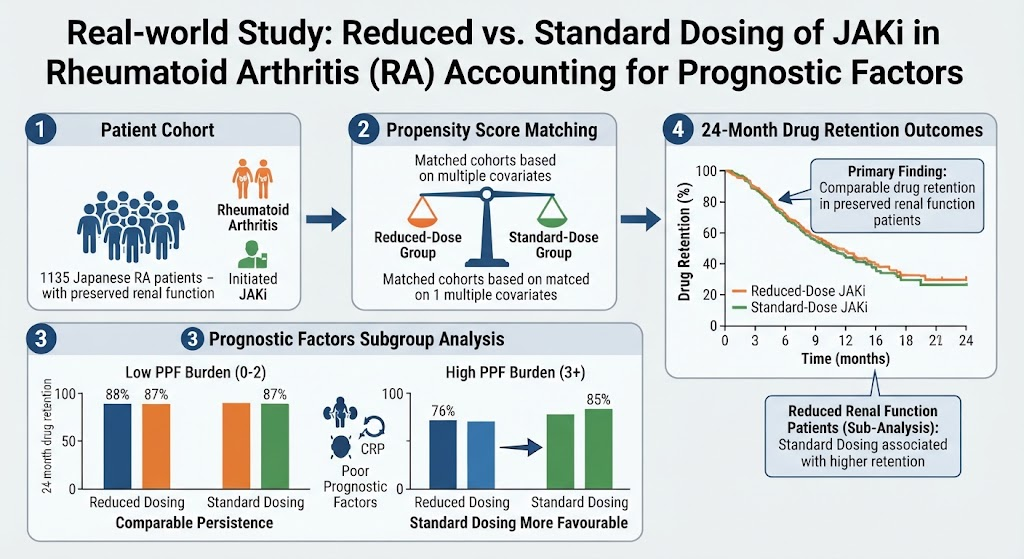
This multicentre observational study utilized a Japanese real-world RA registry to evaluate 1135 patients who initiated JAKi therapy between 2013 and 2025. Patients were categorized based on initial dosing of JAKi: standard dose versus reduced dose. The primary analysis focused on patients with preserved renal function, reflecting discretionary clinical dosing decisions uninfluenced by renal impairment. To adjust for confounding by indication, investigators used propensity score matching. The primary endpoint was 24-month drug retention, assessed through Kaplan-Meier survival analysis and Cox proportional hazards models. Subgroup analyses stratified patients by poor prognostic factor (PPF) burden (0-2 versus 3-4 factors) and also included exploratory analyses in patients with reduced renal function for comparative safety and efficacy insights.
Key Findings
In the matched cohort of patients with preserved renal function, 24-month retention rates for reduced-dose and standard-dose JAKi were statistically comparable, indicating no significant difference in treatment persistence. Disease activity improvements, as measured by standard RA activity indices, were equivalent between groups. Importantly, glucocorticoid usage remained low and stable over the follow-up period, without compensatory escalations in the reduced-dose group, suggesting effective disease control.
When stratified by PPF burden, reduced dosing performed similarly to standard dosing in patients with low PPFs (0-2), implying adequate efficacy in less severe disease profiles. However, in patients with multiple poor prognostic factors (3-4), initial standard-dose JAKi initiation was associated with more favorable drug retention, suggesting that patients with more aggressive or refractory disease may benefit from standard dosing to improve persistence.
In patients with impaired renal function, standard dosing correlated with higher drug retention rates compared to reduced dosing, contrasting with findings in the preserved renal function subgroup. This suggests that renal impairment influences drug pharmacokinetics and clinical outcomes, and standard dosing may be preferable despite renal concerns in maintaining treatment adherence and effectiveness. However, these observations warrant cautious interpretation due to potential residual confounders and need for prospective validation.
Expert Commentary
This study provides important real-world evidence on dosing strategies for JAK inhibitors in RA, a rapidly evolving therapeutic domain. The use of propensity score matching strengthens causal inference by balancing baseline characteristics, yet residual confounding cannot be fully excluded. The nuanced influence of poor prognostic factors on treatment persistence emphasizes the need for individualized therapy considering disease severity and patient-specific risk profiles.
While dose reduction may improve safety or cost-effectiveness, it should be balanced against potential risks of suboptimal disease control, particularly in patients with aggressive RA phenotypes. The findings also raise critical questions regarding the optimal approach in patients with renal dysfunction, where pharmacokinetic alterations complicate dosing decisions.
Current clinical guidelines support JAKi use with monitoring for adverse effects, but real-world evidence like this offers practical insights into optimizing dosing regimens. Future prospective studies and randomized trials are needed to validate these observations and elucidate mechanisms behind dose-dependent treatment persistence variations.
Conclusion
In RA patients with preserved renal function, reduced-dose JAK inhibitor regimens yield comparable 24-month drug retention and disease activity control to standard dosing, especially in those with fewer poor prognostic factors. However, patients with a higher burden of poor prognostic factors and those with renal impairment appear to benefit from standard dosing to improve treatment persistence. These findings advocate for a personalized approach to JAKi dosing that incorporates renal function and prognostic indicators to optimize long-term therapeutic outcomes. Ongoing research is imperative to refine dosing strategies and address safety and efficacy in diverse patient subgroups.
Funding and Trial Registration
The study was supported by multiple Japanese academic and governmental bodies as detailed in the original publication. This analysis utilized data from a real-world registry without formal clinical trial registration.
References
- Nozaki Y, Shiga T, Ri J, et al. Reduced versus standard dosing of Janus kinase inhibitors in rheumatoid arthritis: a propensity score-matched real-world study accounting for poor prognostic factors. Ann Rheum Dis. 2026;85(10):1920-1930. PMID: 42049606.
- van Vollenhoven RF. Treatment strategies in rheumatoid arthritis: balancing efficacy and safety. Nat Rev Rheumatol. 2020;16(3):131-139.
- Fisher MC, Cronstein BN. Janus kinase inhibitors in rheumatoid arthritis: clinical development and future perspectives. Nat Rev Rheumatol. 2021;17(2):74-85.
- Kremer JM et al. Long-term safety and effectiveness of Janus kinase inhibitors in RA patients: Real-world data and post-marketing surveillance. Arthritis Care Res (Hoboken). 2022;74(4):541-550.