Highlight
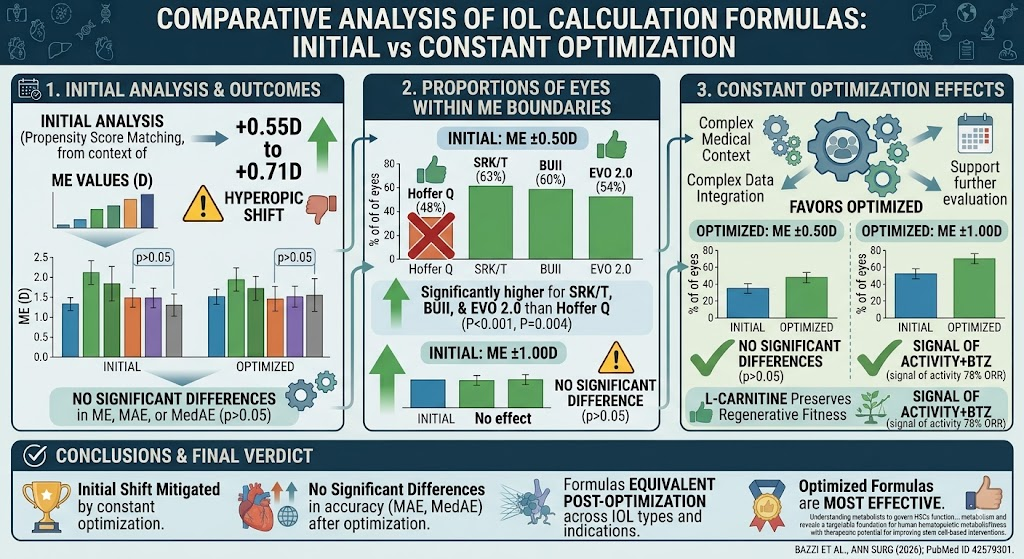
This study assessed the refractive predictability of various intraocular lens (IOL) power calculation formulas in patients undergoing Yamane intrascleral fixation (YISF). Both third-generation and modern IOL formulas showed a systematic hyperopic shift prior to optimization. After constant optimization, refractive outcomes across all formulas were comparable, underscoring the influence of surgical variability in effective lens position.
Study Background
Yamane intrascleral fixation (YISF) is a modern technique for securing an intraocular lens in eyes lacking capsular support, such as those with aphakia or single-piece IOL subluxation. Precise IOL power calculation is critical for achieving optimal refractive outcomes; however, surgical factors and unusual lens positioning challenge the accuracy of conventional prediction formulas developed primarily for in-the-bag IOL implantation. Understanding the comparative performance of established third-generation formulas versus newer, modern formulas in this context remains essential to improving postoperative refractive accuracy.
Study Design
This was a retrospective, comparative evaluation involving 87 eyes of 87 patients undergoing Yamane intrascleral fixation due to aphakia or subluxated IOL. The study assessed the predictive refractive outcomes using three third-generation formulas (Hoffer Q, Holladay 1, Sanders Retzlaff Kraff/Theoretical [SRK/T], and T2) and two modern formulas (Barrett Universal II [BUII] and emmetropia verifying optical [EVO] 2.0). The main outcome measures included mean prediction error (ME), mean absolute error (MAE), median absolute error (MedAE), and proportions of eyes achieving prediction errors within ±0.50 diopters (D) and ±1.00 D. Analyses were performed before and after constant optimization, which involved zeroing the mean prediction error to adjust formula constants.
Key Findings
Initial analyses demonstrated a consistent hyperopic shift across all formulas, with mean prediction errors ranging from +0.55 D to +0.71 D. Despite this shift, no statistically significant differences were found between the formulas concerning ME, MAE, or MedAE (p>0.05). When examining proportions of eyes within ±0.50D error, SRK/T (63%), BUII (60%), and EVO 2.0 (54%) performed better than Hoffer Q (48%) with statistically significant differences (p<0.005). The proportions of eyes within ±1.00D error did not significantly differ among formulas.
After constant optimization, the mean prediction error was effectively zeroed for all formulas, and no significant differences remained among the formulas in terms of predictive accuracy or error proportions within ±0.50D and ±1.00D (p>0.05). Furthermore, the type of IOL implanted and surgical indication did not significantly affect refractive outcomes in either analysis.
Overall, these results highlight the impact of surgery-related variability in the effective lens position on refractive predictability, which appears to limit formula performance regardless of formula type prior to constant adjustment.
Expert Commentary
The hyperopic shift observed aligns with the inherent challenges of predicting effective lens position when the IOL is fixated intrasclerally rather than within the capsular bag. Intrascleral fixation techniques like Yamane’s alter the anatomic location of the lens, complicating preoperative biometric assumptions that underpin most IOL calculation formulas. This study’s findings emphasize that while third-generation formulas—traditionally preferred for their simplicity—and modern formulas with advanced algorithms perform comparably after optimization, initial unadjusted predictions are less reliable.
Constant optimization, by adjusting formula factors to nullify the mean error, remains critical in the clinical practice of YISF cases. However, universal constants are difficult to establish due to individual differences in surgical execution, scleral fixation position, and postoperative lens stability. Future research incorporating three-dimensional lens position measurements or intraoperative optical coherence tomography may enhance formula refinement.
Limitations of this study include its retrospective design and the absence of long-term refractive stability data. Additionally, the cohort size, while respectable, could be expanded to validate these findings across diverse patient populations and IOL designs.
Conclusion
This study corroborates the presence of a systematic hyperopic shift using conventional and modern IOL power formulas in Yamane intrascleral fixation cases. Despite superior pre-optimization accuracy for some formulas, all formulas exhibited comparable refractive performance after constant optimization. These insights underscore the crucial role of surgical variables affecting effective lens position in refractive outcomes after YISF. Surgeons should consider individualized constant optimization to improve predictive accuracy, and ongoing formula refinement tailored to scleral-fixated lenses is warranted.
Funding and ClinicalTrials.gov
The original article did not disclose specific funding sources or clinical trial registration information.
References
1. Icoz M, Tanriverdi B, Yakin M. Refractive Predictability of Third-Generation and Modern IOL Power Calculation Formulas in Yamane Intrascleral Fixation. Am J Ophthalmol. 2026 Aug 11. PMID: 42580432.
2. Yamane S, Sato S, Maruyama-Inoue M, Kadonosono K. Flanged Intrascleral Intraocular Lens Fixation with Double-Needle Technique. Ophthalmology. 2017 Apr;124(4):554-561.
3. Barrett GD. An IOL formula for all axial lengths, all IOLs, and all types of surgery. J Cataract Refract Surg. 2020;46(8):1328-1337.