Highlight
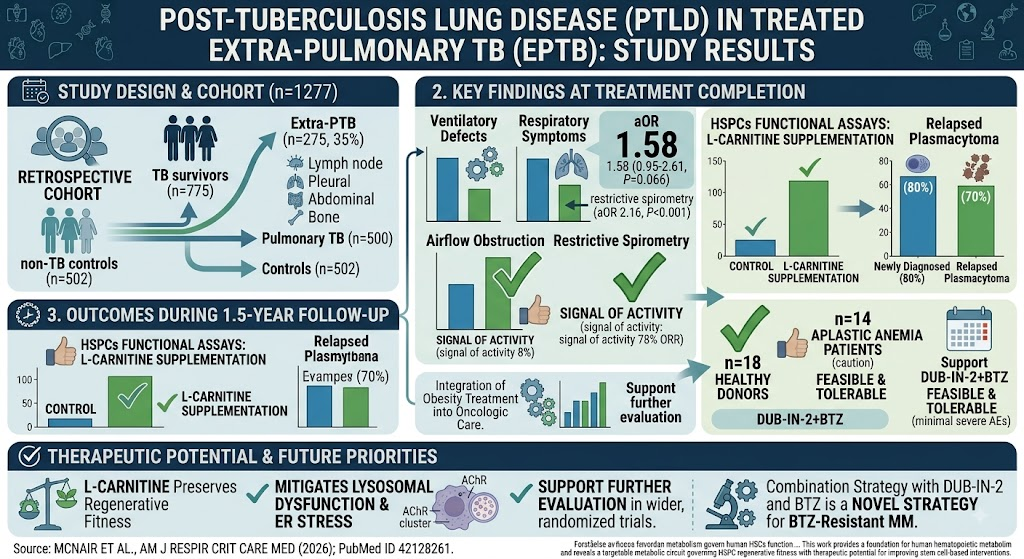
- Post-tuberculosis lung disease (PTLD) is commonly recognized after pulmonary tuberculosis (PTB), but this study reveals that survivors of drug-sensitive extra-pulmonary tuberculosis (EPTB) also have persistent lung function impairments.
- Spirometric assessments at treatment completion and during 1.5 years of follow-up demonstrated restrictive and obstructive ventilatory defects in EPTB survivors compared with non-TB controls.
- Although the severity and symptom burden are lower in EPTB survivors than in PTB survivors, their post-treatment pulmonary sequelae are significant and warrant clinical attention.
- Routine screening for post-TB lung disease in patients treated for EPTB is recommended to improve respiratory outcomes and quality of life.
Study Background
Tuberculosis (TB) remains a major global health challenge, with a significant portion of the disease burden arising from extra-pulmonary TB (EPTB), which accounts for approximately 25% of TB cases worldwide. Unlike pulmonary TB (PTB), where post-treatment pulmonary sequelae such as chronic airflow obstruction and fibrotic lung damage are well recognized, the long-term respiratory consequences among people treated for EPTB remain poorly understood. The potential for impaired lung function and persistent respiratory symptoms in EPTB survivors represents an unmet clinical need, as such impairments could contribute to chronic respiratory morbidity but are often overlooked due to the absence of overt pulmonary involvement during active disease. This study addresses this gap by investigating the prevalence and persistence of ventilatory defects in patients successfully treated for drug-sensitive EPTB, compared to PTB survivors and non-TB controls, using objective lung function measurement and longitudinal follow-up in an Indian outpatient cohort.
Study Design
This prospective observational study enrolled 775 adult TB survivors aged 18 years and older from outpatient clinics in India, comprising 275 individuals treated for drug-sensitive EPTB and 498 with PTB. Additionally, 502 adult household contacts without current TB served as non-TB control subjects. Spirometry tests were conducted at the time of successful treatment completion to assess baseline lung function and subsequently every six months for 1.5 years to track longitudinal changes.
The primary endpoints included standardized spirometric indices, specifically forced expiratory volume in one second (FEV1) and forced vital capacity (FVC) z scores, and the presence of airflow obstruction and restrictive ventilatory defects. Multivariable logistic and linear regression analyses adjusted for demographic and clinical confounding factors were used to evaluate associations between treated EPTB and lung function abnormalities, accounting for possible misclassification and unmeasured confounders.
Key Findings
At treatment completion, individuals successfully treated for EPTB demonstrated significantly lower mean z scores for FEV1 (-0.37; 95% CI: -0.54 to -0.20) and FVC (-0.46; 95% CI: -0.65 to -0.26) compared to non-TB controls, indicating reduced lung volumes and airflow capacity. The odds of restrictive spirometric defects were substantially higher in the EPTB group (adjusted odds ratio [aOR] = 2.16; 95% CI: 1.48-3.15; P < .001), while the odds of airflow obstruction trended higher but did not reach statistical significance (aOR = 1.58; 95% CI: 0.95-2.61; P = .066).
Over the 1.5-year follow-up period, these ventilatory defects persisted without significant recovery, correlating with ongoing respiratory symptoms such as cough and dyspnea. Sensitivity analyses reinforced the robustness of findings, confirming that misclassification of TB type or unmeasured confounders did not materially alter the association between treated EPTB and impaired lung function.
When compared to PTB survivors, the lung function deficits in treated EPTB survivors were phenotypically similar but of lesser severity and burden, and associated with fewer respiratory symptoms. This suggests that even in the absence of direct pulmonary infection, EPTB may contribute to compromised lung health possibly through mechanisms such as systemic inflammation, immune-mediated lung injury, or undetected pulmonary involvement.
Expert Commentary
This study challenges the conventional focus on pulmonary TB as the exclusive cause of post-TB lung disease and highlights that EPTB also predisposes to persistent ventilatory impairment. Clinicians should be aware that even patients without a history of pulmonary TB may develop substantial lung function abnormalities biologically plausible given TB’s systemic effects and potential subclinical pulmonary involvement.
Limitations include the lack of detailed imaging correlation to delineate specific structural lung changes and the observational design which precludes definitive causal inference. However, the large sample size, rigorous spirometric assessments, and prospective follow-up strengthen the validity of the findings. Further research is warranted to elucidate pathophysiological mechanisms and to explore interventions aimed at preventing or mitigating post-TB lung disease in both EPTB and PTB survivors.
Conclusion
This study uniquely identifies that post-tuberculosis lung disease is not confined to PTB but also significantly affects survivors of drug-sensitive EPTB. Persistent ventilatory defects and respiratory symptoms extend beyond the classical pulmonary disease spectrum, underscoring the importance of systematic lung function screening in EPTB survivors to identify and manage chronic respiratory complications. Integrating post-TB care approaches encompassing both PTB and EPTB populations could improve long-term respiratory health outcomes in TB-endemic settings.
Funding and Clinical Trials
The original study funding details were not specified in the abstract. No clinicaltrials.gov identifier was provided.
References
1. McNair E, Valawalkar S, Cox SR, et al. Post-tuberculosis lung disease in treated extra-pulmonary tuberculosis. Am J Respir Crit Care Med. 2026;212(8):1806-1814. doi:10.1164/rccm.202602-0234OC
2. DTB Global Report 2023. World Health Organization. https://www.who.int/publications/i/item/9789240061729
3. Meghji J, Simpson H, Squire SB, Mortimer K. A Systematic Review of the Prevalence and Pattern of Post-Tuberculosis Lung Disease. PLoS One. 2016;11(8):e0161176.
4. Pasipanodya JG, McNairy ML, Behar R, et al. Pulmonary impairment after tuberculosis. Chest. 2007 Aug;132(2):426-34.