Highlights
- DSCD lenses significantly reduce spherical equivalent refraction (SER) progression and axial length (AL) elongation in myopic children over 12 months, outperforming single-vision spectacles (SVS) and single-surface defocus (SSD) lenses.
- In exploratory analyses, DSCD efficacy is pronounced in children aged 8-12 years, with baseline AL 24-25 mm and low myopia, highlighting potential subgroup targeting.
- Comparable spectacle-based interventions, including cylindrical annular refractive elements (CARE) and extended depth-of-focus (EDOF) lenses, also demonstrate robust myopia control, supporting peripheral defocus as a key mechanistic modality.
- DSCD lenses show excellent safety, high compliance, and good tolerability, positioning them as a viable option for pediatric myopia management alongside pharmacologic and ortho-k therapies.

Background
Myopia has escalated globally, especially in pediatric populations, with significant public health implications due to associated risks of vision-threatening complications. Axial elongation is the principal structural correlate of myopia progression. Effective management strategies aiming to slow axial elongation include optical interventions generating retinal defocus patterns, pharmacotherapy (e.g., low-dose atropine), and orthokeratology. Spectacle lens-based treatments offering peripheral myopic defocus represent a non-invasive, safe, and widely acceptable modality. The novel dual-sided composite defocus (DSCD) spectacle lens design incorporates a front-surface microlens array combined with a posterior freeform aspheric surface to induce asymmetric peripheral defocus, hypothesized to enhance myopia control efficacy.
Key Content
Randomized Controlled Trials of DSCD Lenses
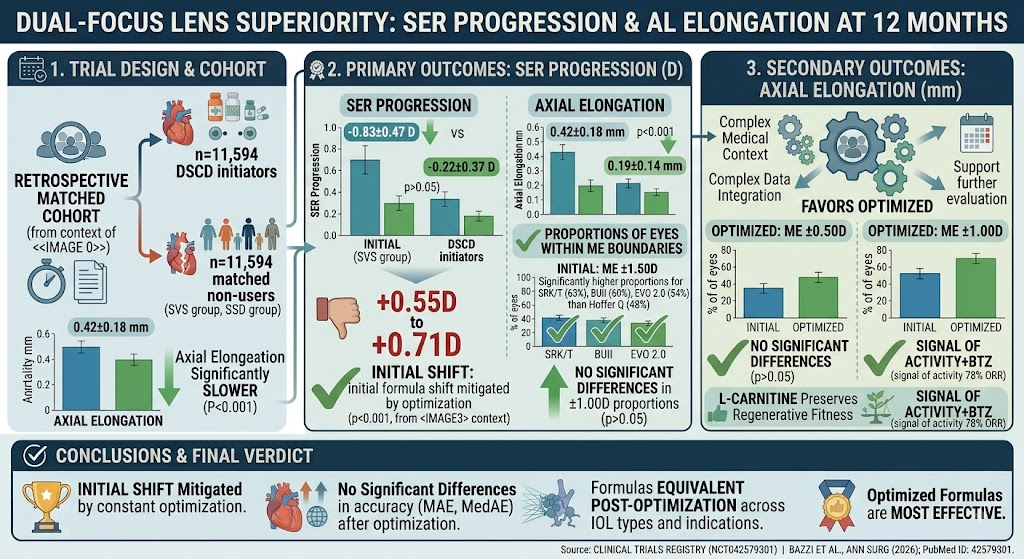
The recently published randomized, double-masked, three-arm controlled trial (Guo et al., 2026) enrolled 225 children aged 6-14 years with myopia between -0.50 D and -6.00 D. Participants were randomized 1:1:1 to wear DSCD, single-surface defocus (SSD), or single-vision spectacles (SVS). At 12 months, DSCD lenses achieved a 73.6% reduction in SER progression relative to SVS (-0.22 ± 0.37 D vs. -0.83 ± 0.47 D, P<0.001) and significantly outperformed SSD lenses (-0.22 ± 0.37 D vs. -0.45 ± 0.43 D, P=0.005). Axial elongation was also significantly slower with DSCD compared to SVS (0.19 ± 0.14 mm vs. 0.42 ± 0.18 mm, P<0.001), though no statistical difference was observed in AL change between DSCD and SSD lenses. No adverse events were reported, and adherence was high. Subgroup analyses indicated enhanced treatment benefits in children aged 8-12 years, those with baseline AL 24-25 mm, and low baseline myopia.
Comparative Efficacy of Spectacle Lens Designs in Myopia Control
Other RCTs corroborate the efficacy of spectacle-based defocus interventions:
- Cylindrical Annular Refractive Elements (CARE) lenses demonstrated sustained efficacy over 24 months in European children (mean AL elongation 0.21 mm vs. 0.43 mm with SV lenses, P<0.001) and reduced rapid progression rates (CARE 30.8% vs. SV 71.4%; P<0.001) (PMID 42571354).
- Diffusion Optics Technology (DOT) lenses in Chinese children showed 12-month AL elongation reductions (0.09 ± 0.22 mm vs. 0.35 ± 0.19 mm with SV, P<0.0001), with improved spherical equivalent refraction changes (PMID 42199728).
- Extended Depth-of-Focus (EDOF) soft contact lenses with a +1.50 D add showed 49% reduction in AL elongation compared to single-vision contact lenses over 12 months (PMID 42339912), highlighting optical profile as a critical determinant of efficacy.
Real-world retrospective studies further indicated that treatment combinations, such as highly aspherical lenslet (HAL) spectacles with low-dose atropine, may enhance response distribution although mean gains are less marked than optical monotherapies (PMID 42116122).
Mechanistic Insights and Biomarkers
Peripheral myopic defocus induced by DSCD and similar lenses appears to retard axial elongation by modulating retinal signaling pathways that regulate scleral growth and ocular biomechanics. Early choroidal thickness changes have been proposed as predictive biomarkers of treatment response, with thickening at 3 months correlating with better 12-month AL control (PMID 42223154).
Safety, Visual Function, and Compliance
Spectacle lenses employing defocus optics generally exhibit excellent tolerability, with no significant adverse events or reduction in central visual acuity in comparative trials. DSCD lenses showed good adaptation, comparable to single-vision and SSD lenses. Visual performance assessments of designs like Defocus Incorporated Multiple Segments (DIMS) with enhanced variants reported minimal and clinically insignificant reductions in mid-peripheral visual acuity (PMID 42524827).
Expert Commentary
DSCD lenses represent a promising advancement in optical myopia control, leveraging dual surface designs to generate complex peripheral defocus profiles, thereby enhancing treatment efficacy relative to conventional single-surface approaches. The 1-year RCT results demonstrate substantial reductions in SER progression and axial elongation, with favorable safety and compliance profiles. Notably, axial elongation results paralleled but did not surpass SSD lenses significantly, indicating a possible ceiling effect in defocus optics or the need for longer observation.
When contextualized with other spectacle lens interventions such as CARE, DOT, and EDOF, DSCD lenses add to the armamentarium of optical strategies that harness peripheral defocus for myopia control. Their asymmetric defocus profile might provide novel retinal stimulus distributions, which future studies could elucidate through imaging and neurophysiological methods.
Limitations of current evidence include relatively short-term follow-up (12 months), reliance on surrogate outcomes like SER and AL, and lack of direct pharmacologic comparator arms. Future investigations should explore longer-term durability, combination therapy potential (e.g., with atropine), and mechanistic underpinnings of differential efficacy in subgroups.
From a translational perspective, DSCD spectacles offer a non-invasive, accessible option for children, potentially improving compliance over contact lens or pharmacologic regimens. Incorporating early biomarkers, such as choroidal thickness, into clinical protocols may facilitate personalized myopia control strategies.
Conclusion
The dual-sided composite defocus spectacle lens is a safe, effective intervention for myopia control in children, achieving significant reductions in refractive progression and axial elongation over 1 year. This novel lens design complements existing optical strategies by providing enhanced peripheral defocus profiles. Integration of DSCD lenses into clinical practice could expand therapeutic choices for pediatric myopia management. However, further studies with extended follow-up, larger and diverse populations, and mechanistic assessments are warranted to refine patient selection, optimize lens design, and evaluate long-term outcomes.
References
- Guo Y, Cao K, Zhang Z, Ye F, Shi R, Wu M, Tang P, Lv Y, Jie Y, Tian L. Efficacy and Safety of Dual-Sided Composite Defocus Spectacles for Myopia Control in Children: A 1-Year Randomized, Double-Masked, Controlled Trial. Ophthalmology. 2026 Aug 11. PMID: 42580560.
- Gu et al. Two-Year Efficacy of Cylindrical Annular Refractive Elements Spectacle Lenses for Myopia Control in European Children. Ophthalmol Sci. 2026 Jul 1;6(9):101309. PMID: 42571354.
- Luo M et al. Randomized Clinical Trial of Diffusion Optics Technology Spectacle Lenses in a Chinese Population (CATHAY): 12-Month Results. Ophthalmol Sci. 2026 Mar 11;6(7):101150. PMID: 42199728.
- Yam JC et al. Effect of Variation in Extended Depth-Of-Focus Design on Myopia Control and Visual Function in Japanese Children. Eye Contact Lens. 2026 Jun 25. PMID: 42339912.
- Lin Z et al. Comparison of effectiveness of four myopia control interventions in Chinese children: a real-world retrospective study. Eye Vis (Lond). 2026 May 12;13(1):18. PMID: 42116122.
- Wang Y et al. Early choroidal thickness changes predict myopia control response to peripheral defocus spectacles in premyopic children. Optom Vis Sci. 2026 May;103(5):e70060. PMID: 42223154.
- Wang Y et al. Visual Performance of Defocus Incorporated Multiple Segments With Triple Enhanced Design Spectacle Lenses Versus DIMS and Single Vision Lenses. Transl Vis Sci Technol. 2026 Jul 1;15(7):32. PMID: 42524827.